

Life insurance is the coverage most people need first; AD&D only pays out for a narrow set of accidental events, which makes it a supplement rather than a replacement. The core difference comes down to scope. A life insurance policy pays a death benefit no matter what kills you, whether it's cancer, a heart attack, or a car crash, as long as you're past the contestability period and didn't misrepresent your health on the application. AD&D, short for accidental death and dismemberment, only pays when death or a serious injury results from a qualifying accident.
That distinction matters because most people don't die by accident. Unintentional injuries rank third among leading causes of death in the U.S., well behind heart disease and cancer. For most households:
- Life insurance should be the primary policy if anyone depends on your income.
- AD&D works best as a low-cost add-on, especially when an employer offers it for free.
- Geneva Insurance Group can review both policies together to spot gaps between them.
Key Takeaways
Life insurance pays for death from nearly any cause, while AD&D pays only for qualifying accidents, which is why most households need life insurance first and AD&D second.
| Point | Details |
|---|---|
| Coverage scope differs sharply | Life insurance pays for illness, natural causes, and accidents; AD&D pays only for qualifying accidental death or injury. |
| Accidents rank third among death causes | Unintentional injuries trail heart disease and cancer, so life insurance covers the more statistically likely causes of death. |
| AD&D pays scheduled benefits for injury | Losing a limb, sight, or hearing typically triggers a percentage payout rather than the full benefit. |
| Check portability before relying on employer AD&D | Group AD&D often ends when employment ends unless it converts to an individual policy. |
| Get a fee-free coverage review | Geneva Insurance Group compares life and AD&D coverage across 25-plus A-rated carriers to identify gaps in your current policies. |
This article is general information, not a substitute for advice from a qualified financial advisor. Consult a qualified financial professional about your own circumstances before acting on anything here.
Table of Contents
- AD&D vs. Life Insurance: Coverage, Exclusions, and Payouts
- Why AD&D Costs Less and What Coverage Amounts Look Like
- When Life Insurance Comes First and When AD&D Makes Sense
- Combining AD&D With Life Insurance: Riders and What to Verify
- How Geneva Insurance Group Reviews AD&D and Life Coverage Together
- The Real Problem Isn't AD&D vs. Life Insurance. It's Policy Language.
- Get a Fee-Free Review of Your Life and AD&D Coverage
- Sources
AD&D vs. Life Insurance: Coverage, Exclusions, and Payouts
Life insurance and AD&D answer two completely different questions. Life insurance asks, "Did this person die?" AD&D asks, "Did this person die or lose a limb, their sight, or their hearing in an accident?"
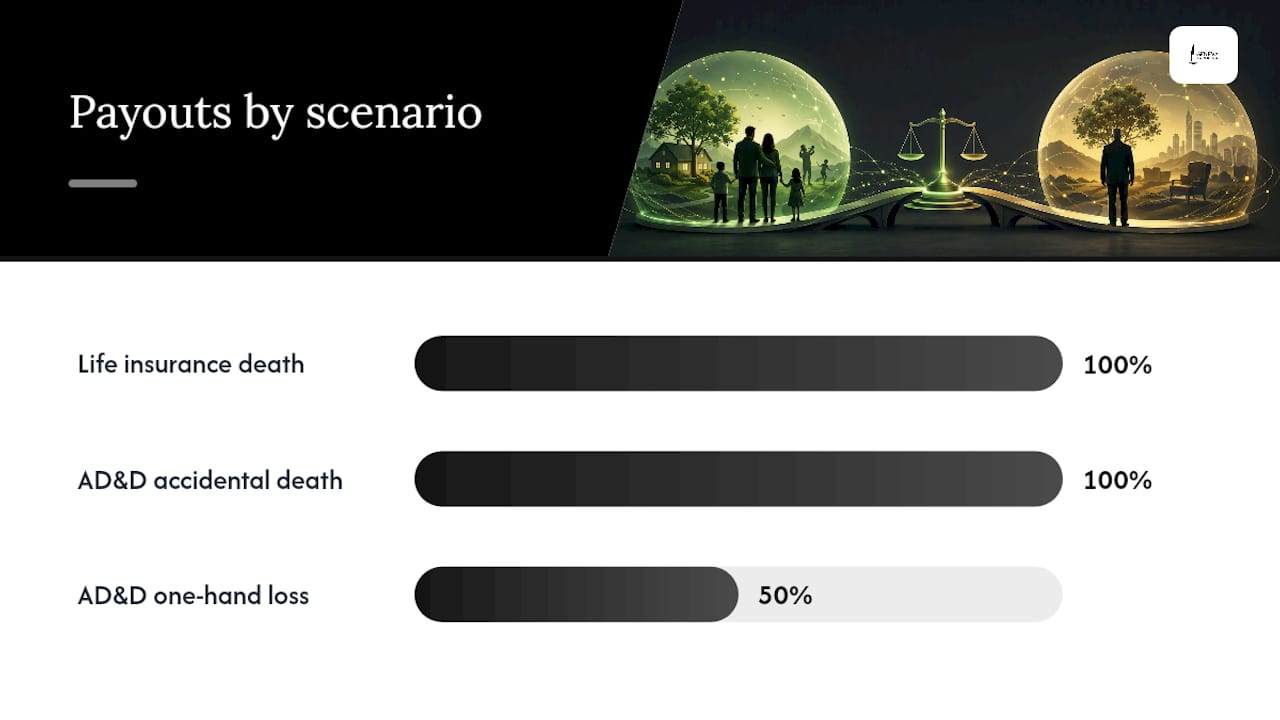
A standard term or whole life policy pays the full death benefit for nearly any cause of death once the policy is active and past its contestability window, typically the first two years. Insurers can still investigate a claim during that window and deny it for misrepresentation, and most policies exclude suicide within the first year or two. After that period, the cause of death almost never matters.
AD&D works on a completely different structure:
- Accidental death triggers the full benefit, but only if death happens within a defined window after the accident, often 90 days.
- Dismemberment triggers a scheduled partial payout: losing one hand might pay 50% of the benefit, losing both hands or your sight might pay 100%.
- Paralysis, hearing loss, or severe burns are often listed separately with their own percentages.
The exclusions on AD&D policies are where people get tripped up. Standard exclusions include:
- Death from illness, even if the illness was undiagnosed
- Suicide or self-inflicted injury
- Drug overdose, even accidental
- Injuries from illegal activity or certain high-risk hobbies (some policies exclude scuba diving, skydiving, or racing)
Edge cases show why the language matters more than the label. If someone has a heart attack while driving and crashes, most insurers will call that a natural-cause death, not an accident, and deny the AD&D claim even though a collision happened. If someone dies from complications weeks after a fall, the insurer may deny the claim if it falls outside the policy's time limit. Life insurance doesn't care about any of this. It pays regardless.
Why AD&D Costs Less and What Coverage Amounts Look Like
AD&D is nearly always cheaper than life insurance, and the reason is straightforward: it covers a narrower slice of risk. Insurers know accidental death is statistically rare, so they can price AD&D coverage low, sometimes just a few dollars a month for $100,000 or more in coverage. Life insurance has to account for every cause of death, which means underwriters look at your age, health, smoking status, and family history before setting your premium.

That doesn't mean life insurance is expensive. Term life underwriting has gotten sharper, and many healthy applicants in their 30s or 40s find 20-year term policies surprisingly affordable, sometimes close to what they're already paying for a phone plan.
Coverage amounts differ quite a bit between the two:
- Employer-provided AD&D: often a flat sum like $50,000, or ranges between $10,000 and $500,000 tied to salary multiples.
- Individual term life: typically sized to income replacement, often 10 to 15 times annual salary.
Pro Tip: Check whether your employer's AD&D benefit is a flat number or a multiple of salary. If it's flat, a raise won't increase your coverage, and you could be underinsured without realizing it.
Group AD&D also comes with practical limits: age reductions after 65, benefit caps, and salary ties that shrink your coverage if you take a pay cut.
When Life Insurance Comes First and When AD&D Makes Sense
If anyone relies on your paycheck, your mortgage, or your childcare arrangement, life insurance goes first. It's the policy that keeps a household running if you die from anything, not just an accident. AD&D becomes worth adding once that foundation is in place, particularly in a few specific situations:
- High-risk jobs or hobbies. Construction, commercial driving, or serious motorsports raise your accidental death risk, and AD&D pays out fast without the underwriting delays of a new life policy.
- Free or nearly free employer coverage. If AD&D is bundled into your benefits package at no added cost, take it. There's little downside to free supplemental protection.
- Bridging a gap while waiting on life insurance underwriting. If you're mid-application for a life policy and want interim protection, a cheap AD&D policy can cover the gap for a few weeks.
- Temporary situations where full life underwriting isn't realistic. Someone with a recent serious diagnosis who can't qualify for standard life insurance might use AD&D as a stopgap while they explore guaranteed-issue options.
Watch for two common mistakes. First, assuming employer AD&D follows you if you change jobs. Most group AD&D coverage ends the day your employment ends, unless you convert it to an individual policy. Second, assuming AD&D will cover you if you get sick and die. It won't. That's the single most common misunderstanding people bring into a policy review, and it's an expensive one to discover after the fact.
Combining AD&D With Life Insurance: Riders and What to Verify
An AD&D rider attached to a life insurance policy adds accidental death protection on top of the base death benefit. If the insured dies in a qualifying accident, some policies pay double the base benefit, a structure known as double indemnity. This coordination between policies is exactly why claim documentation matters so much: insurers coordinating a rider payout with a group AD&D claim need medical records, police reports, and a clear causal chain tying the death directly to the accident.
Before you assume your coverage works the way you think, check these four things:
- Exclusion list: read the actual policy document, not the summary flyer, since exclusions vary by insurer.
- Time limit: confirm how many days after an accident death must occur for AD&D to pay.
- Portability: ask whether group AD&D converts to an individual policy if you leave your job.
- Claim contacts: know who to call first, since group and individual claims often go through different departments.
How Geneva Insurance Group Reviews AD&D and Life Coverage Together
Comparing AD&D and life insurance side by side is one thing. Making sure your actual policies don't have a gap between them is another. Geneva Insurance Group runs fee-free policy reviews that look at your existing life and AD&D coverage together, comparing options across 25-plus A-rated carriers to spot where employer coverage ends and where you might be underinsured.
The review typically catches a few recurring problems:
- Group AD&D that doesn't convert to an individual policy after a job change
- Coverage amounts based on outdated salary figures
- Overlapping riders that duplicate coverage without adding value
- Exclusions that conflict with a client's job or hobbies
Geneva is licensed in Illinois, Florida, and Washington, and explains every policy in plain language instead of insurance jargon. leads this analysis, drawing on how independent agents routinely flag portability gaps that group benefits summaries gloss over.
The Real Problem Isn't AD&D vs. Life Insurance. It's Policy Language.
Most people don't get burned by choosing the wrong category of insurance. They get burned by assuming their policy says something it doesn't. The AD&D vs. life insurance debate gets framed as a binary choice, but the more useful question is whether your specific policy documents say what you think they say.
Conventional advice tells people to "get life insurance and maybe add AD&D." That's directionally right, but it skips the part that actually causes claim denials: the definition of "accident," the time limit between injury and death, and whether group coverage survives a job change. Those three details cause more disputes than the type of policy someone bought.
If you take one thing from this, prioritize reading your actual policy schedule over trusting the product name. A policy labeled "life insurance" that excludes suicide for two years and a policy labeled "AD&D" that excludes overdose are both doing exactly what they're designed to do. The failure happens when nobody checks the fine print until after a claim gets filed.
— David
Get a Fee-Free Review of Your Life and AD&D Coverage
If this comparison left you wondering whether your own coverage has a gap, that's exactly the kind of question a policy review answers. Genevainsgroup runs fee-free reviews that compare your current life and AD&D coverage against 25-plus A-rated carriers, without any pressure to switch anything.
Because Genevainsgroup is an independent agency rather than a single insurer's sales team, the comparison is unbiased. You get a plain-language breakdown of what your group AD&D actually excludes, whether your term life coverage matches your income, and where a rider might make more sense than a standalone policy. Licensed in Illinois, Florida, and Washington, the agency also stays involved if you ever need to file a claim, advocating on your behalf rather than leaving you to navigate it alone.
Start your fee-free policy review today and find out exactly what your current coverage does and doesn't protect.
Sources
- National Center for Health Statistics (CDC) — Leading causes of death data brief
- NerdWallet — Life insurance vs. accidental death and dismemberment
- Western & Southern — AD&D vs Life Insurance