

Additional insured status gets a third party liability protection, meaning defense and indemnity if someone sues over an accident on your job. Loss payee status gets a lender or lessor a claim to insurance proceeds if the property itself is damaged or destroyed. They solve two completely different problems, so check your Certificate of Insurance now for which one your contract or loan actually requires.
TL;DR:
- Listing the wrong party as an additional insured or loss payee can lead to significant coverage gaps during a claim.
- Lenders and leasing companies typically require loss payee status for property claims, while contractors and landlords usually need additional insured protection for liability.
- Always verify endorsement forms and language directly with your insurer before signing contracts to ensure proper coverage and avoid costly mistakes.
- A single third party can hold both designations if their financial and liability interests are distinct, but each applies only to specific coverage parts.
- A free policy review from an independent agency can identify inconsistencies between certificates, endorsements, and contract requirements.
Table of Contents
- What Is an Additional Insured?
- What Is a Loss Payee, and How Does the Designation Work?
- Additional Insured vs Loss Payee: An At-a-Glance Comparison
- When Do You Need Additional Insured vs Loss Payee Status?
- How to Add Additional Insured or Loss Payee Correctly on Your Policy
- Your Pre-Signature Checklist for Additional Insured and Loss Payee Requests
- Genevainsgroup Helps You Verify These Designations Before They Matter
- Can One Party Be Both an Additional Insured and a Loss Payee?
- What Rights and Limitations Come With Each Designation?
- What Risks Does Each Designation Carry for the Named Insured?
- How Do Claims Get Handled Differently for Each Party?
- When Does Coverage Actually Trigger for Each Designation?
- What Are the Legal Implications in Contracts and Disputes?
- Three Mistakes That Keep Showing Up on Certificates
- Get a Fee-Free Policy Review
- Sources
- FAQ
What Is an Additional Insured?
That means the insurer pays for a lawsuit's defense costs and covers a judgment or settlement up to the policy limits, if the claim falls within the endorsement's scope.
This designation attaches to liability policies: Commercial General Liability, commercial auto liability, and umbrella policies. It does not attach to property coverage.
- A subcontractor adds the general contractor as an additional insured before starting a job site.
- A vendor working a trade show adds the venue owner as an additional insured for the event dates.
- A tenant sometimes adds the landlord for liability arising from the leased space.
Don't confuse "additional insured" with "additional named insured." The latter gets broader rights, closer to those of the original policyholder, and Markel's guidance on insured statuses recommends talking to your agent before agreeing to either term in a contract.
Pro Tip: If a client or landlord asks to be added as "additional insured," confirm they don't actually mean "additional named insured." The wording difference changes what rights they get on your policy.
What Is a Loss Payee, and How Does the Designation Work?
A loss payee is a person or entity entitled to some or all of the insurance proceeds for covered property they have a financial interest in, typically because they financed or leased it, per Business Credentialing Services' explanation of loss payee status. It's not a liability designation. It's a property one.
Loss payee clauses attach to physical-damage and property coverages: commercial property policies, inland marine policies, equipment floaters, and the physical-damage portion of commercial auto policies.
- A bank financing your delivery van is listed as loss payee on the auto physical-damage coverage.
- An equipment leasing company requires loss payee status on your inland marine floater for leased machinery.
- A building lender is often called a "mortgagee" rather than loss payee, a related but distinct designation tied specifically to real property mortgages.
When a covered loss happens, the insurer typically issues a joint payee check naming both you and the lender, or pays the lender directly up to its financial interest, with any remainder going to you.
Additional Insured vs Loss Payee: An At-a-Glance Comparison
The core distinction comes down to what kind of coverage each designation touches and what the third party actually receives when something goes wrong.
| Comparison Point | Additional Insured | Loss Payee |
|---|---|---|
| What it covers | Liability exposure from your operations | Physical damage to specific property |
| Policy type | CGL, commercial auto liability, umbrella | Commercial property, inland marine, equipment floaters, auto physical damage |
| What the third party gets | Defense and indemnity for covered claims | A share of or full claim proceeds |
| Typical use case | Contracts with general contractors, landlords, event venues | Financed equipment, leased vehicles, secured loans |
| Typical cost/fee impact | Can carry a nominal premium effect since it adds exposure, per ShunIns | Usually no premium change, since it only redirects proceeds |
Both designations can appear on the same policy at once, for different reasons. A leased forklift, for example, might need the leasing company as loss payee on the property side and as additional insured on the liability side if it's driven on someone else's premises. They aren't substitutes for each other, and GetBusinessCoverage's comparison of the two notes this is exactly where confusion on certificates tends to start.
When Do You Need Additional Insured vs Loss Payee Status?
Matching the right designation to the right relationship keeps your contracts clean and your renewals painless.
- Subcontractor working for a general contractor: the GC almost always wants additional insured status on your CGL policy, since their exposure is liability, not your tools.
- Tenant leasing commercial space: landlords commonly request additional insured for liability, but if you're covering their fixtures or improvements, they may separately ask for loss payee status on a property policy.
- Financed equipment or vehicles: the lender wants loss payee status, full stop. They have no interest in your liability exposure. They just want their collateral protected.
- Equipment rentals: a rental company might request both, loss payee for the machine itself and additional insured if their name could get pulled into a liability suit over how you used it.
- Red flag to watch for: if a bank or leasing company asks to be added as "additional insured" instead of loss payee, something is off. Lenders almost never need liability defense; they need their proceeds interest protected.
How to Add Additional Insured or Loss Payee Correctly on Your Policy
Your agent requests the endorsement from the insurer, who issues a specific form attached to your policy, not just a note on a certificate. Common examples include CGL additional insured forms and standard loss payable clauses, though exact form numbers vary by carrier.
A Certificate of Insurance is a summary, not proof of coverage. It shows what's currently in force, but it isn't a contract and can be changed the next day unless the endorsement itself requires notice. Before you sign anything relying on a COI, verify these points directly against the endorsement:
- The correct legal name of the party being added matches the contract exactly.
- The policy type lines up with what the third party actually needs, liability or property.
- Limits meet or exceed what the contract requires.
- The endorsement form or its specific wording, not just a COI line item.
- Cancellation notice language, since standard COIs often carry a disclaimer that notice isn't guaranteed.
Pro Tip: Ask for a copy of the actual endorsement, not just an updated certificate. Markel's insurance guidance points out that COI language is frequently abbreviated enough to hide gaps a full endorsement copy would reveal.
Request the endorsement before you sign the underlying contract, and confirm it survives your next renewal. A one-time favor from your agent isn't the same as a standing endorsement that automatically renews.
Your Pre-Signature Checklist for Additional Insured and Loss Payee Requests
Work through these steps before you agree to any COI language in a contract or loan document.
- Identify what the other party actually needs: are they worried about a lawsuit (additional insured) or about their collateral (loss payee)?
- Request the exact endorsement name or a full copy of the endorsement wording, not just a certificate line.
- Confirm the cancellation notice terms and check that your limits satisfy the contract's stated minimum.
- Adapt a short request like: "Please confirm the specific endorsement form being used and provide a copy for our file."
Skipping this costs nothing to fix now and a great deal to fix during a claim.
Genevainsgroup Helps You Verify These Designations Before They Matter
Getting the wrong designation on a policy rarely surfaces until a claim hits, and by then it's too late to fix cheaply. An independent insurance agency licensed in multiple states compares coverage across numerous A-rated carriers, which means a policy review isn't a sales pitch dressed up as advice. It's an actual side-by-side look at your current endorsements.
A fee-free policy review from an independent agency checks exactly the things this article covers: whether the right party is listed under the right designation, whether the endorsement wording matches what your contract requires, and whether your cancellation notice terms hold up. Clients get plain-language explanations instead of insurance jargon, plus ongoing claims advocacy if a dispute ever does arise.
Can One Party Be Both an Additional Insured and a Loss Payee?
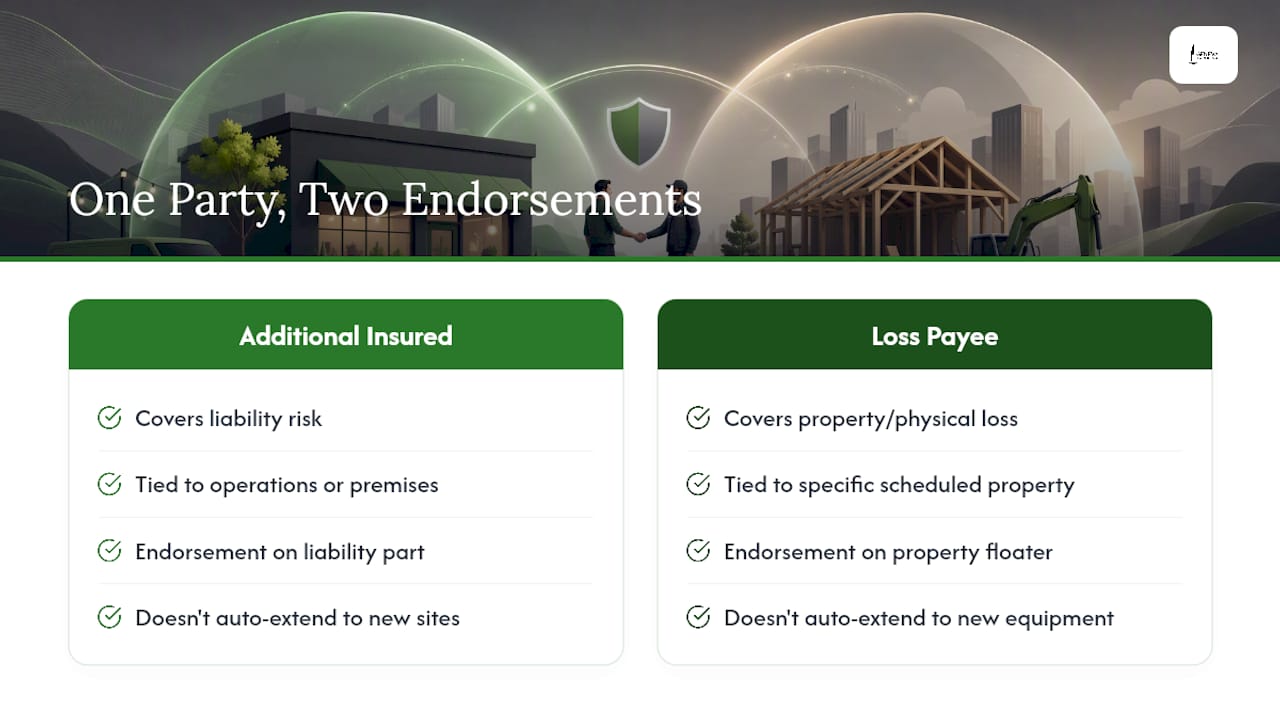
Yes, and it happens more often than most business owners expect. A single third party can hold both designations at once, but only when their financial relationship with you actually spans both liability and property risk.
Take an equipment leasing scenario. The leasing company owns the forklift you're operating, so they have a direct financial interest in the physical machine, which means loss payee status on your inland marine or equipment floater makes sense. If that same forklift causes an injury on a customer's property, the leasing company could get named in the resulting lawsuit simply because their name is on the title. That's the liability exposure additional insured status is built to cover. Two different risks, two different endorsements, one party.
The limit here is scope. Being both doesn't mean the party gets blanket protection across your entire operation. Each designation only reaches as far as its own endorsement language allows. Loss payee rights apply strictly to the specific piece of property named in the floater or property schedule. Additional insured rights apply strictly to the operations or premises named in that endorsement. If you add a new piece of equipment or take on a new job site, neither designation automatically extends to cover it.
Carriers also don't merge the two into a single combined form very often. You'll typically see two separate endorsements sitting on two separate coverage parts of your policy, even when they name the identical party. That's normal, and it's exactly what a careful COI check should catch: two line items, one company name, two different jobs being done.
What Rights and Limitations Come With Each Designation?
Additional insured status and loss payee status both carry rights that go beyond simply being named on a piece of paper, but neither comes close to giving the third party control over your policy.
An additional insured generally does not have the right to cancel, modify, or renew the underlying policy. That authority stays with the named insured. What the additional insured usually does get is a right to receive advance notice if the policy is canceled, though only if the endorsement specifically includes that notice provision. Standard COIs often carry disclaimer language saying the insurer will "endeavor to" notify certificate holders, which is not a guarantee. If your contract requires guaranteed notice, that has to be written into the endorsement itself, not assumed from the certificate.
A loss payee's rights work a little differently because of the money involved. Most loss payee clauses include what's called a standard mortgage clause or a similar provision protecting the loss payee's interest even if the named insured's coverage gets voided due to their own misconduct, like arson or fraud. That's a meaningful protection lenders specifically negotiate for, and it's part of why lenders almost universally insist on being listed correctly rather than accepting a vague assurance of coverage.
Neither designation gives the third party the right to file their own separate claim demanding changes to your policy limits or coverage terms. They can request notice, and in the loss payee's case, they can often step in in front of the named insured on distribution of proceeds up to their financial interest. But full control of the policy always remains with the named insured.
What Risks Does Each Designation Carry for the Named Insured?
Adding either designation shifts some risk onto your policy, and it's worth understanding exactly what you're taking on before you agree to a contract clause.
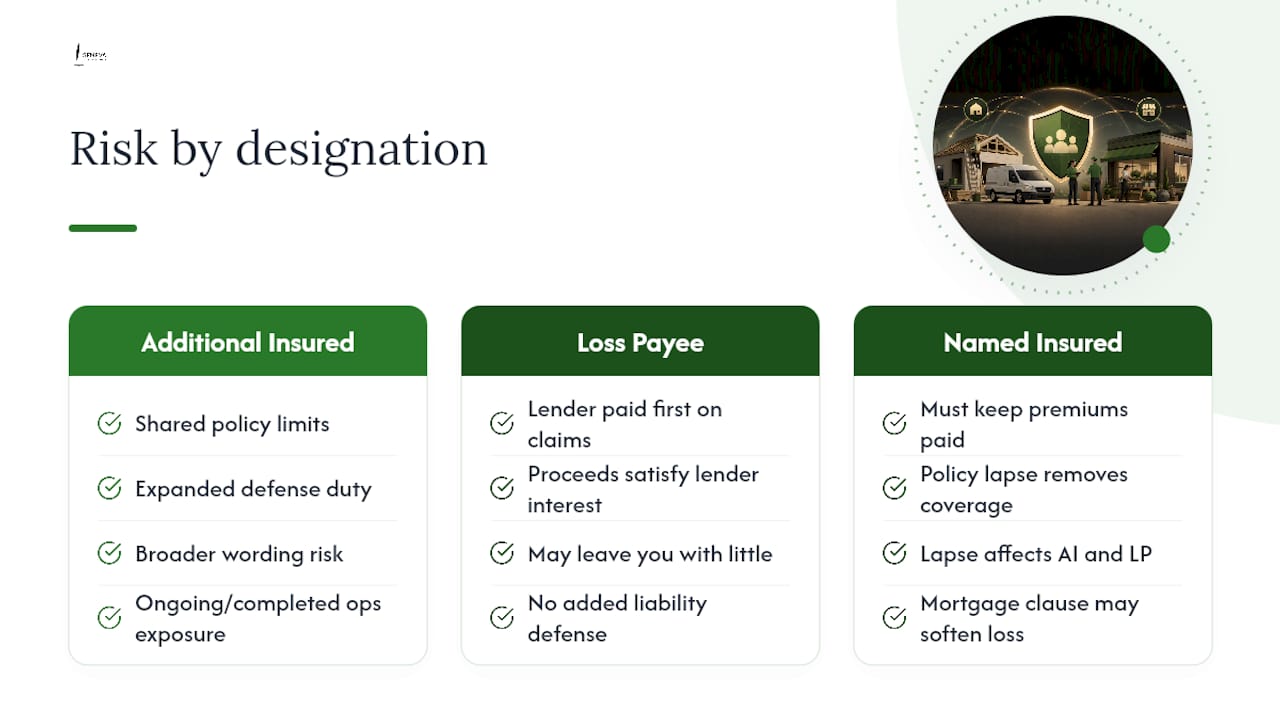
Naming an additional insured expands who your liability coverage has to defend. If a claim comes in against both you and the additional insured for the same incident, your policy limits get shared across both defenses. A large judgment now has two parties drawing against the same pool of coverage instead of one, which can leave you underinsured if your limits were sized only around your own risk.
There's also the scope question. Additional insured endorsements are supposed to be limited to specific operations or a specific contract, but poorly worded requests sometimes creep into broader "ongoing and completed operations" coverage than you intended to grant, extending your exposure well past the job's completion date.
Loss payee status carries a different kind of risk, mostly around claim payouts. If your property is damaged and a lender is listed as loss payee, the insurer typically has to satisfy the lender's financial interest before you see a dollar of the remaining proceeds. If your equipment is worth less than what you owe, you could end up with a check that goes almost entirely to the lender and leaves you without enough to repair or replace the property.
The named insured also carries the burden of keeping premiums paid and the policy active. If coverage lapses, both the additional insured and the loss payee lose their protection, though the loss payee's standard mortgage clause protections partially soften that blow in cases involving the named insured's own misconduct.
How Do Claims Get Handled Differently for Each Party?
Filing and processing a claim looks noticeably different depending on which designation is involved, and priority in the payout process isn't the same either.
For an additional insured, a claim usually starts when a lawsuit or demand letter names both the contractor and the additional insured together. The insurer investigates, decides whether the claim falls within the endorsement's scope, and if it does, provides a defense to both parties, often through the same defense counsel. The additional insured doesn't file a separate first-party claim, they're defended as part of the underlying liability claim against the named insured's operations.
A loss payee's claims process runs on a completely different track because it's a first-party property claim, not a liability lawsuit. The named insured typically reports the property loss, the insurer investigates the damage, and once the claim is approved, the insurer issues payment that accounts for the loss payee's financial interest before anything goes to the named insured. This is where the priority difference becomes concrete: the loss payee often gets paid ahead of the named insured, up to the amount of their interest in the property, while an additional insured has no such payment priority since they're not receiving cash proceeds at all, only a legal defense.
Disputes also unfold differently. An additional insured dispute usually centers on whether the loss falls within the endorsement's scope. A loss payee dispute usually centers on the value of the loss and how the payout should be split between the lender's interest and the owner's remaining equity.
When Does Coverage Actually Trigger for Each Designation?
Coverage doesn't activate the moment someone's name appears on a certificate. Each designation has its own trigger, and knowing the difference keeps you from assuming protection exists when it doesn't.
For an additional insured, the trigger is an occurrence, meaning an accident, injury, or property damage event, that happens within the scope defined by the endorsement, during the policy period. If the endorsement is written for "ongoing operations only" and the incident happens after your work on the project is finished, coverage for the additional insured may not apply at all, even though it applied during the job itself. That's why contract language distinguishing "ongoing operations" from "completed operations" matters so much for anyone relying on this coverage long after the work wraps up.
For a loss payee, the trigger is direct physical loss or damage to the specific covered property, from a cause the policy actually insures against. A fire that destroys financed equipment triggers the claim. A dispute between the borrower and lender over loan terms does not, because that has nothing to do with an insured peril damaging the property.
Both triggers depend heavily on the policy being active and premiums current at the time of loss. Coverage that lapsed the week before an incident protects no one, regardless of what designations are listed.
What Are the Legal Implications in Contracts and Disputes?
Contracts that require additional insured or loss payee status create enforceable obligations, and getting the designation wrong can expose you to a breach-of-contract claim entirely separate from any insurance dispute.
If your contract with a general contractor requires you to name them as additional insured and you fail to do so, or the endorsement doesn't actually match what was promised, you can be on the hook for damages the GC's own insurance would have covered, essentially self-insuring their exposure by default. Courts have consistently treated a certificate that doesn't match the actual endorsement as a serious problem, since the certificate itself typically states it confers no rights beyond what the underlying policy provides.
For loss payees, the legal stakes usually surface during a dispute over payout allocation after a loss. If a policy names a loss payee incorrectly, or the loss payee clause lacks the standard mortgage clause protection a lender expected, the lender may pursue the named insured directly for any shortfall, on top of whatever the insurer paid out.
This is exactly why industry sources consistently flag mistaken listings as one of the most frequent, costly contractual errors small businesses make. The fix isn't complicated. It's confirming the endorsement matches the contract language before you sign, not after a claim forces the question.
Three Mistakes That Keep Showing Up on Certificates
I keep seeing the same three errors: listing a lender as additional insured when they need loss payee status, trusting a COI's summary line instead of the actual endorsement, and never confirming cancellation notice wording. Each fix takes five minutes. Skipping them once cost a contractor I heard about a full equipment payout redirected to the wrong party, simply because nobody checked the form before signing.
— David
Get a Fee-Free Policy Review
If you're not sure whether your current policies have the right party listed under the right designation, that's exactly the gap a fee-free policy review is built to close. An independent agency compares your existing coverage against multiple A-rated carriers and tells you plainly, no jargon, where your endorsements match your contracts and where they don't.
Here's what the review actually checks:
- Whether additional insured and loss payee designations on your certificates match your actual contracts and loan agreements.
- Whether the endorsement wording behind each certificate line matches what the third party requires.
- Whether your cancellation notice language holds up against what your contracts promise other parties.
- Ongoing claims advocacy if a dispute over a designation ever surfaces.
Start by requesting your free policy review through Genevainsgroup and get a clear answer on whether your current certificates would actually hold up if a contract partner or lender ever tested them.
Sources
For deeper reading, WebCE's insured-status breakdown and Markel's guide to certificates and named insureds offer clear industry definitions, while Transparency-in-coverage helps readers verify insurer-specific coverage details when a certificate leaves questions unanswered.
This article is general information, not a substitute for advice from a qualified financial advisor. Consult a qualified financial professional about your own circumstances before acting on anything here.
- Additional Insured vs Loss Payee
- Named insured, certificates of insurance, additional insured and additional named insured: What’s the difference
- What is a loss payee?
FAQ
What's the difference between a mortgagee, a loss payee, and an additional insured?
A mortgagee holds a lien specifically on real property and gets similar proceeds protection to a loss payee, while a loss payee covers personal property like equipment or vehicles, and an additional insured gets liability defense, not property proceeds.
Who should be listed as a loss payee?
Lenders, leasing companies, and other secured creditors with a financial interest in specific covered property should be listed as loss payee, since they need proceeds protection, not liability defense.
Who needs to be listed as an additional insured?
Contract counterparties exposed to liability from your operations, like a general contractor hiring your business as a subcontractor or a venue hosting your event, typically need additional insured status.
What does it mean to be a loss payee on an insurance policy?
Being a loss payee means you're entitled to insurance proceeds from a covered property loss up to your financial interest, typically before the named insured receives any remaining funds.
Is a certificate holder the same as an additional insured?
No. A certificate holder simply receives a copy of the certificate showing coverage exists, while an additional insured has actual contractual rights to defense and indemnity under the policy itself.