

Agreed value guarantees the exact payout you and the insurer set when you bought the policy, with no depreciation deducted. Stated value does not guarantee that number. It pays the lesser of your stated amount or the vehicle's actual cash value at the time of loss. Collectors and restored classics generally need agreed value; modified daily drivers with good receipts can often get by on stated value. Either way, documentation decides what you actually collect.
TL;DR:
- Agreed value guarantees a fixed payout based on a pre-set valuation, while stated value pays the lower of that amount or the vehicle's current cash value.
- Obtaining an agreed value policy typically requires a formal appraisal and periodic re-evaluations, leading to higher premiums than stated value policies.
- Stated value policies are cheaper and easier to obtain but risk a lower payout if market value drops or if receipts and documentation are lacking.
- Collectors and restored classics benefit most from agreed value, whereas modified daily drivers with receipts can often rely on stated value.
- Proper documentation, including professional appraisals, receipts, and photos, streamlines claims and ensures accurate valuation regardless of policy type.
Table of Contents
- What Is Agreed Value Insurance and How Does It Work?
- What Is Stated Value Insurance and What Does the Fine Print Say?
- Agreed Value vs Stated Value: What to Expect at Claim Time
- How Do You Choose Between Agreed Value and Stated Value?
- How to Document Your Vehicle's Value for a Smoother Claim
- How Geneva Insurance Group Helps You Land on the Right Valuation
- Get a Fee-Free Policy Review Before Your Next Renewal
- Sources
What Is Agreed Value Insurance and How Does It Work?
Agreed value means you and the insurer settle on a fixed dollar figure for your vehicle before the policy takes effect, and that number is what you get paid if the car is totaled. No depreciation schedule touches it, and no adjuster argues you down after the fact. The whole point is to lock in a payout for a vehicle whose worth doesn't track a normal depreciation curve, which describes most restored classics and low-production collector cars.
Getting there usually requires a formal appraisal, dated photos, and sometimes a follow-up re-appraisal every few years if the carrier wants to confirm the market hasn't shifted. That underwriting effort is exactly why agreed value policies typically carry higher premiums than a standard auto policy. You're paying for certainty, not just coverage.
What insurers generally want before they'll agree to a number:
- A written appraisal from a qualified appraiser, ideally one who specializes in the vehicle's era or marque
- Photos showing the car's current condition, inside and out
- Receipts for restoration work, replacement parts, or major mechanical rebuilds
- Proof of storage conditions in some cases, since garaged cars depreciate differently than daily-driven ones
Pro Tip: Ask your appraiser to state the valuation method they used, comparable sales, cost-to-replace, or specialty market data, and keep their contact information on file. A carrier can validate an appraisal in minutes when the methodology is spelled out, which speeds up claims considerably.
What Is Stated Value Insurance and What Does the Fine Print Say?
Stated value lets you name a number for your vehicle, but that number is a ceiling, not a promise. At claim time, insurers commonly pay the lesser of your stated amount or the car's actual cash value. If your stated amount is $30,000 but the ACV comes in at $22,000 after depreciation, you get $22,000. That escape clause is the entire difference between stated value and agreed value, and it's the part most owners miss when they buy the cheaper policy.
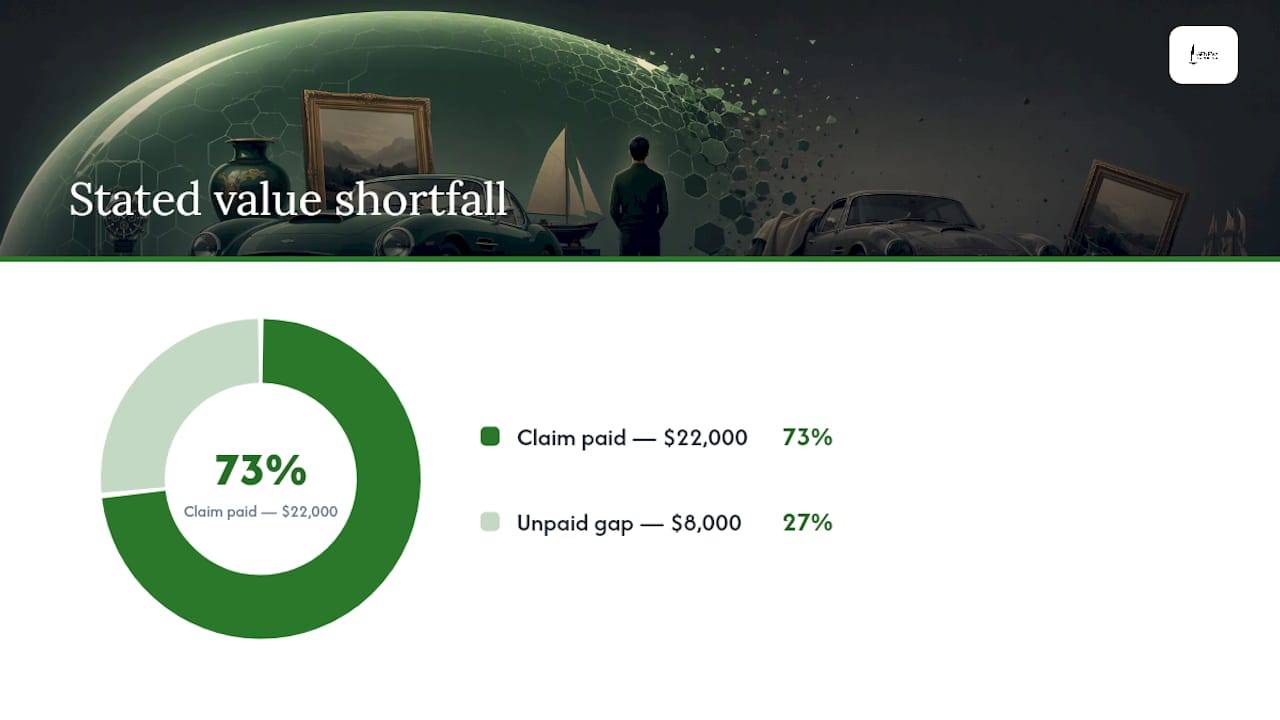
Insurers offer it because it's easier to underwrite and cheaper to sell. No mandatory appraisal, less paperwork, broader availability across mainstream carriers instead of just specialty insurers.
A few things worth knowing before you pick stated value:
- It works reasonably well for vehicles that hold value predictably rather than appreciate
- Documentation still matters. Without receipts for aftermarket parts or upgrades, insurers often discount that modification value entirely when calculating ACV
- Market swings can leave your stated number badly out of sync with real ACV if you set it once and never revisit it
- It's commonly marketed toward modified daily drivers and specialty work vehicles rather than true collector cars
Agreed Value vs Stated Value: What to Expect at Claim Time
Here's where the difference actually costs (or saves) you money.
- Payout guarantee. Agreed value pays the fixed amount, period. Stated value pays the lesser of stated amount or ACV, so you could get less than you named.
- Typical cost. Agreed value premiums run higher because of the appraisal work and the insurer's exposure to a fixed, undepreciated number. Stated value tends to price lower.
- Best for. Agreed value fits collector, classic, and appreciating vehicles. Stated value fits modified daily drivers, work vehicles, and cars whose value tracks a normal depreciation curve.
- Documentation burden. Agreed value requires an upfront appraisal and often periodic re-appraisals. Stated value requires far less at signing, but leans hard on receipts and photos if you ever dispute an ACV number.
- Availability. Agreed value shows up mostly with specialty and collector-focused carriers. Stated value is widely available through mainstream insurers.
Picture two owners with identical restored trucks valued similarly. One has agreed value and receives the full agreed payout with no dispute. The other has stated value at the same amount, but the insurer calculates a lower ACV after considering market data, resulting in a smaller payout representing a significant difference.
Owners frequently confuse the two terms, assuming "stated" means guaranteed simply because they picked the number themselves. It doesn't. When you read a policy, look for the actual words "agreed value" or "stated amount," not marketing language like "full value coverage," which can describe either structure depending on the carrier.
How Do You Choose Between Agreed Value and Stated Value?
Start with three questions. Is your vehicle appreciating, holding steady, or depreciating like a normal used car? How complete is your paper trail of receipts, appraisals, and photos? And how much premium difference are you actually willing to pay for a guarantee versus a probability?
Before you call an agent, gather:
- A recent professional appraisal, if you have one
- Restoration and parts receipts, organized by date
- Before and after photos of any major work
- Service records showing ongoing maintenance
Ask the agent directly: "Does this policy use the words agreed value or stated amount?" and "What happens if ACV comes in below my number at claim time?" If the answer is vague or the agent can't point to specific policy language, that is a red flag worth pushing on.
As a shortcut: true collectors and restored classics almost always do better with agreed value despite the premium. Modified daily drivers with solid receipts can often run stated value safely. Plain commuter cars rarely need either, standard ACV coverage usually suffices.
How to Document Your Vehicle's Value for a Smoother Claim
- Get a professional appraisal. Choose an appraiser who works with your vehicle's era or type and ask them to specify their valuation method, comparable sales, replacement cost, or specialty market data.
- Assemble your paper trail. Collect invoices for parts, labor receipts, and dated before and after photos of any restoration or modification work.
- Submit documentation and request the specific wording. Send everything to your agent and ask explicitly for "agreed value" language in the policy, not just a stated coverage limit.
- Prepare for claim day. Keep copies of everything accessible. A carrier that can quickly validate your appraiser's credentials and methodology settles a valuation dispute in days instead of weeks.
How Geneva Insurance Group Helps You Land on the Right Valuation
Choosing between agreed value and stated value usually comes down to which carriers actually offer favorable terms for your specific vehicle, and that's where an independent perspective pays off. An independent agency runs fee-free policy reviews comparing options across many carriers, so you're not stuck with whatever one insurer decides your classic is worth. That kind of comparison shopping matters, since agreed-value premiums can vary meaningfully between insurers for the same vehicle. Expect help documenting value, negotiating agreed-value wording into the policy, and advocacy if a claim ever gets contentious.
— David
Get a Fee-Free Policy Review Before Your Next Renewal
If you're staring at a renewal notice wondering whether your classic, restored truck, or modified daily driver is actually covered the way you think it is, that's exactly the gap Genevainsgroup closes. Instead of guessing at policy wording or hoping your current carrier's "stated value" actually means what you assumed, Genevainsgroup reviews your existing coverage at no cost and compares it against 25 or more A-rated carriers to see who actually offers agreed value terms for your vehicle.
The process typically involves requesting a review, sharing your vehicle details and any appraisals or receipts you have, and working with a team that will flag gaps and negotiate specific policy language, agreed value or stated amount, that fits how you actually use the car. Because the agency works independently across carriers rather than for one insurer, the comparison stays unbiased, and claims advocacy can continue after you're already a policyholder. Start with a fee-free policy review and find out what your vehicle would actually collect today.
This article is general information, not a substitute for advice from a qualified financial advisor. Consult a qualified financial professional about your own circumstances before acting on anything here.