
If your business temporarily holds a customer's property, from a repair shop bench to a dry cleaner's rack, your general liability policy probably will not cover damage to that property because of a standard "care, custody, and control" exclusion. Bailee coverage insurance fills that exact gap. If you routinely hold, store, repair, or transport items you do not own, ask your broker about a bailee endorsement or a standalone inland marine policy now, not after something goes wrong.
TL;DR:
- Bailee coverage is essential for businesses holding customer property, especially when items are high-value, stored for long periods, or frequently moved.
- It offers two types of protection: customer coverage, which pays the customer directly, and legal liability coverage, which pays only if the business is responsible.
- Most policies cover risks like fire, theft, and damage, but exclusions such as mysterious disappearance and gradual deterioration vary and require clarification.
- Limits and deductibles are often set per item, per occurrence, and in aggregate, making understanding these caps crucial to avoid underinsurance.
- A thorough intake process involving signed receipts, condition notes, photos, and a chain-of-custody log is vital for claims approval and dispute prevention.
Table of Contents
- What Is Bailee Coverage Insurance?
- Which Businesses Actually Need This Coverage?
- What Does a Bailee Policy Actually Cover?
- How Do Limits and Deductibles Affect Your Payout?
- Getting Your Claims Process Right From Day One
- Endorsement or Standalone Policy: How to Buy Bailee Coverage
- Why a Broker's Read on Bailee Coverage Matters
- Get a Fee-Free Policy Review Before You Need to File a Claim
- Where to Verify the Details
- Sources
What Is Bailee Coverage Insurance?
Bailee coverage insurance protects businesses that hold someone else's property, whether for repair, storage, cleaning, or transport. It comes in two forms, and the difference matters more than most business owners realize.
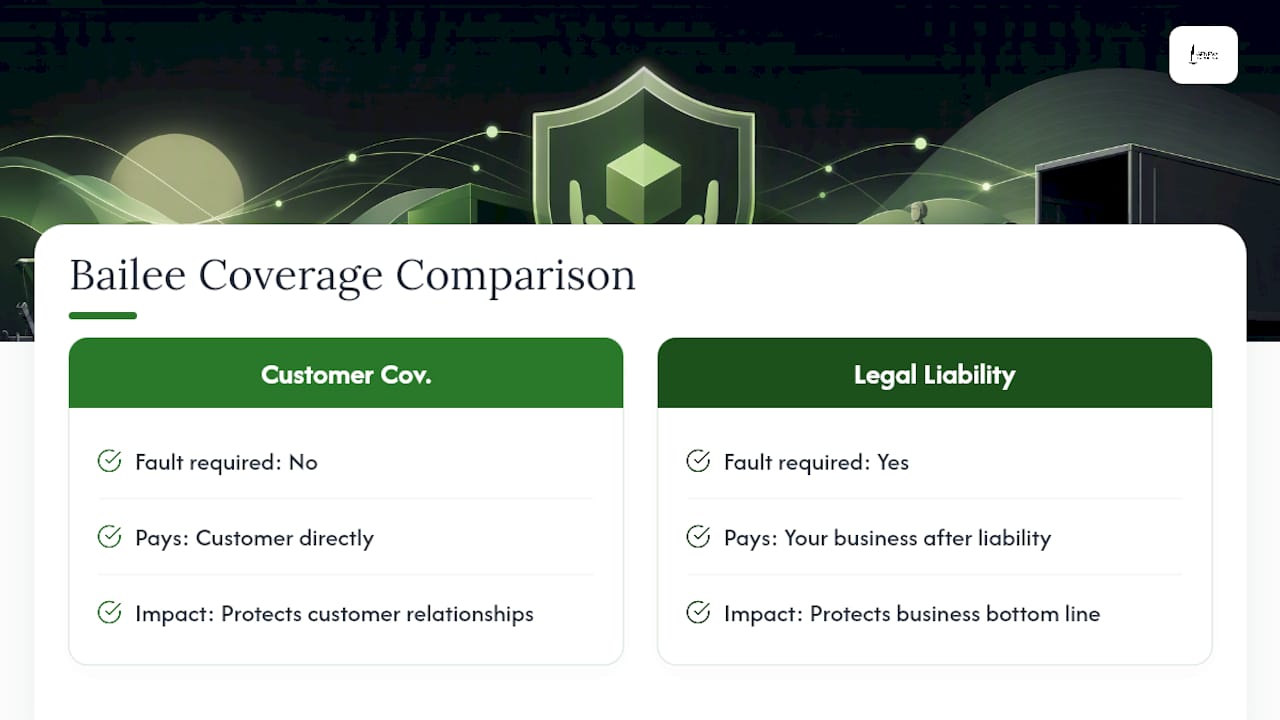
Bailee's customer coverage pays the customer directly for a covered loss, no fault-finding required. Bailee legal liability coverage only pays when the bailee (your business) is found legally responsible for the damage. The first protects your customer relationships even when nobody is technically to blame; the second protects your bottom line only after a liability determination.
Bailee coverage is typically written as an inland marine policy rather than bundled into general liability. The industry standard is the ISO Bailees Customers Coverage Form (IH 00 85 12 20), which spells out the insuring agreement, exclusions, conditions, and limits that most carriers use as a base template. Knowing that form exists gives you leverage when a broker hands you a quote full of unfamiliar language. You can ask, "Is this built on the standard IH 00 85 form, or a modified version?" and get a real answer.
Which Businesses Actually Need This Coverage?
Any business that takes physical possession of a customer's belongings, even for a few hours, carries this exposure. According to IRMI's definition, the industries that lean on bailee coverage most consistently include:
- Dry cleaners and laundries
- Jewelers and watch repair shops
- Furriers and specialty clothing services
- Auto mechanics and body shops
- Furniture and appliance repair services
- Carpet cleaners
- Storage facilities and warehouses
- Marinas and boat repair yards
- Couriers and valet services
The risk signal is not the industry label. It is the combination of high-value items, routine temporary custody, and frequent movement between locations. A watch repair shop holding a single $8,000 timepiece overnight carries a very different exposure than a laundromat processing dozens of low-value loads. A marina storing boats through winter faces months of exposure per item, not hours. If your business fits any of these patterns, and you have never asked about bailee coverage, that is the gap worth closing first.
What Does a Bailee Policy Actually Cover?
Most bailee policies cover the perils you would expect: fire, theft, burglary, and damage sustained while the item is in transit. Some inland marine forms are written on an "open perils" basis, meaning they cover any cause of loss except what is specifically excluded, which is broader protection than a "named perils" form that only pays for causes explicitly listed.
The exclusions are where policies diverge, and where business owners get blind sided. According to Investopedia's coverage of bailee's customer insurance, common exclusions include:
- Damage caused by vermin, rodents, or insects
- Consequential losses or loss of use (the item itself has to be physically damaged, not just unavailable)
- Losses tied to inherent vice or gradual deterioration
- "Mysterious disappearance" claims, unless the policy specifically adds that coverage back in
That last one trips up a lot of jewelers and dry cleaners. An item that simply vanishes, with no evidence of theft or a specific covered event, often falls outside standard coverage unless you have negotiated that language into the policy.
Pro Tip: Ask your broker for the exact exclusion list in writing before you bind coverage, not after a claim gets denied. A five-minute conversation up front saves weeks of dispute later.
Open perils language tends to cost more in premium but closes far more gaps than a named perils form, particularly for businesses handling unpredictable damage scenarios like transit or storage over long periods.
How Do Limits and Deductibles Affect Your Payout?
A policy with a $50,000 aggregate limit sounds generous until you realize that figure might apply per occurrence, not per item, and that a single bad week (say, a burglary that hits ten customer items at once) could exhaust it fast. Understanding how limits stack is the difference between adequate protection and a nasty surprise.
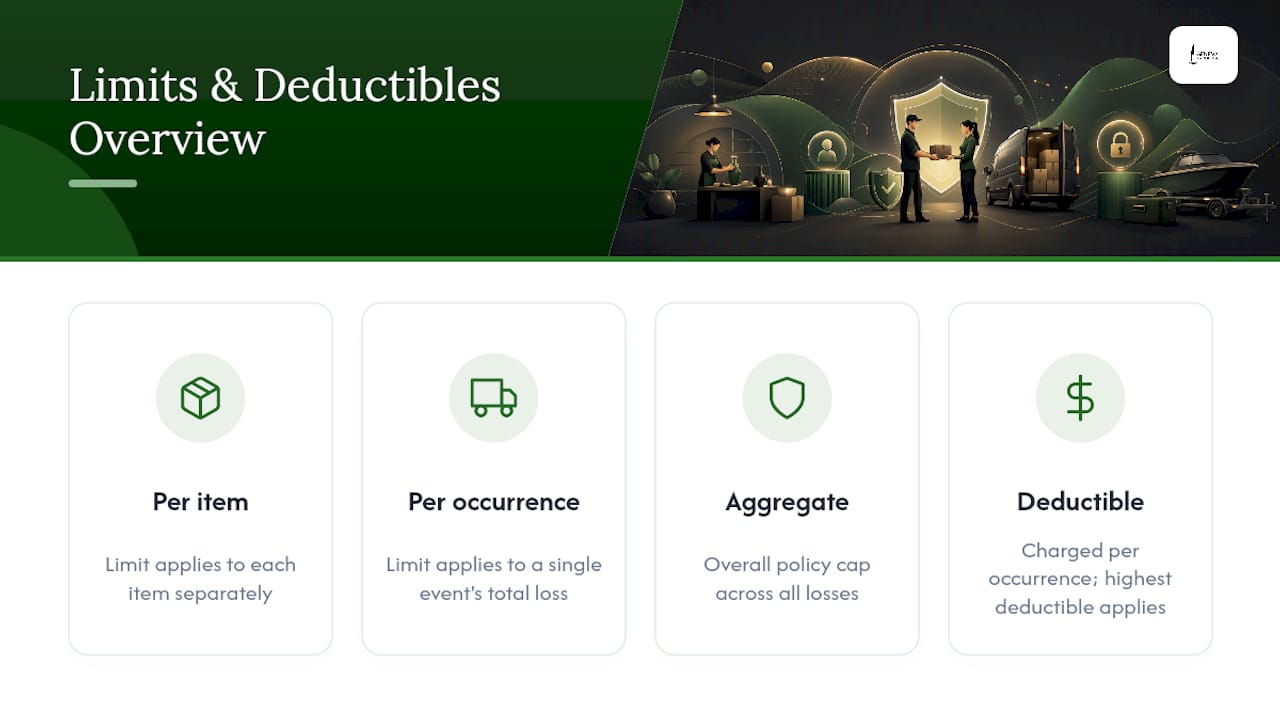
Bailee policies typically set limits three ways: per item, per occurrence, and as an overall aggregate. Some also cap sublimits for specific costs, like debris removal after a fire or particular service categories. According to PropertyCasualty360's analysis of the ISO coverage form, additional coverages are generally part of your stated limit of insurance, not extra coverage on top of it, which means a policy that looks generous on paper may already be accounting for costs you assumed were separate.
Deductibles apply per occurrence, and if multiple deductibles could technically apply to one loss, most policies charge the highest single deductible rather than stacking them. Before you sign anything, ask your carrier for a sample payout scenario using a claim similar to what your business actually handles. A hypothetical number on a declarations page means far less than watching how a $10,000 loss with a $500 deductible and a $25,000 per-occurrence limit actually plays out in dollars.
Getting Your Claims Process Right From Day One
Coverage only pays out if you can prove what happened, and most bailee claims turn on one question: when did legal possession transfer to you? For many policies, that trigger point is the moment you issue a receipt to the customer, according to Investopedia. Everything about your intake process should be built to document that moment clearly.
A simple intake checklist protects you far more than any single insurance clause:
- Issue a signed, dated receipt at the point of transfer.
- Note the item's condition in writing, including any pre-existing damage.
- Take photos from multiple angles before you take custody.
- Timestamp every photo and note automatically if your system allows it.
- Keep a chain-of-custody log if the item moves between locations or staff members.
- Track transport with a tracking number or delivery confirmation whenever the item leaves your premises.
Pro Tip: Keep a physical or digital claims folder template ready before you ever need it. When a loss happens, you want to be pulling documents from a folder, not scrambling to remember what you photographed three weeks ago.
Insurers built these forms around evidence. Match your intake habits to what your policy actually requires, and you turn a fuzzy dispute into a clean claim.
Endorsement or Standalone Policy: How to Buy Bailee Coverage
You generally have two paths: add a bailee endorsement onto your existing commercial property or business owner's policy, or buy a standalone inland marine bailee policy. Endorsements work well for businesses with modest, predictable exposure, an appliance repair shop handling a few units a week. Standalone policies make more sense for businesses with high-value inventory in custody at any given time, like jewelers or marinas, because they typically allow higher limits and more customized language than a bolt-on endorsement.
Walk into that conversation with a broker prepared. Ask directly:
- What are the per-item and per-occurrence limits, and how do they interact?
- Is transit coverage included, or does it require a separate rider?
- Is mysterious disappearance covered, or excluded?
- Is valuation based on replacement cost or actual cash value? That distinction alone can change a payout by thousands of dollars.
- What is the reporting window after a loss occurs?
- How much does the premium increase for higher limits, and at what point does it stop making sense?
Bring documentation to speed up underwriting: your loss history for the past three to five years, a rough inventory profile of what you typically hold, your intake procedures, and photos of your storage or work areas. Underwriters move faster when they are not guessing at your exposure.
Pro Tip: Get quotes from more than one carrier before renewal, even if you are happy with your current policy. Bailee coverage pricing varies more between carriers than most standard commercial lines, because underwriters weigh your specific inventory and process differently.
Why a Broker's Read on Bailee Coverage Matters
Bailee coverage insurance is one of those products where the fine print does more work than the sales pitch. Geneva Insurance Group compares options across more than 25 A-rated carriers specifically because two policies that look similar on price can differ wildly in sublimits, valuation basis, and exclusion language. A fee-free policy review is not a courtesy; it is often the only way a business owner discovers a care, custody, and control gap before a claim exposes it. Good brokers do three things well: they match limits to your actual inventory risk, they translate declarations language you would otherwise gloss over, and they advocate on your behalf when a claim gets filed, not just when the policy gets sold.
— David
Get a Fee-Free Policy Review Before You Need to File a Claim
Genevainsgroup is the practical alternative to guessing whether your current policy actually covers the customer property sitting in your shop right now. Instead of digging through declarations pages alone, you get an independent comparison across more than 25 A-rated carriers and a fee-free policy review that flags gaps like the care, custody, and control exclusion before they turn into a denied claim.
Bring your current policy, a rough list of what you typically hold for customers, and your intake process, and a Geneva Insurance Group advisor can tell you within days whether your existing coverage actually protects your specific exposure or leaves a hole in it. Most reviews wrap up in about a week, start to finish, depending on how quickly your current carrier responds with policy details. If a gap turns up, you get plain-language options for closing it, whether that means an endorsement on your existing policy or a standalone inland marine quote. Request your fee-free policy review and find out exactly where you stand.
Where to Verify the Details
For deeper reading beyond this guide, Investopedia's breakdown of bailee's customer insurance covers definitions and claims triggers, IRMI's glossary entry explains industry usage, and PropertyCasualty360's analysis walks through the ISO form's recent updates.
This article is general information, not a substitute for advice from a qualified financial advisor. Consult a qualified financial professional about your own circumstances before acting on anything here.