
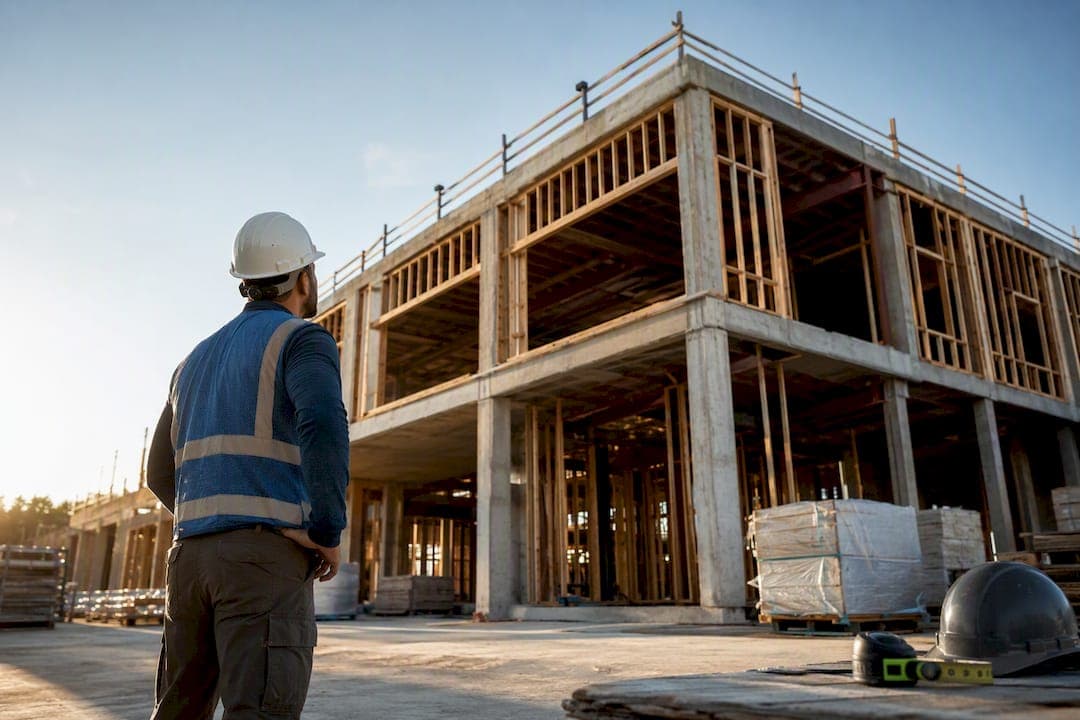
Builders risk insurance covers a building under construction, the materials waiting to become part of it, and often the soft costs tied to a delay, all against fire, wind, theft, and similar perils until the job is finished. Anyone with money on the line, the owner, the general contractor, or the lender, should confirm one is in place before the first shovel hits dirt. Skip it and a single fire or storm can wipe out months of work with nothing to show for it.
TL;DR:
- Confirm that the completed-value limit matches your project's full cost to avoid underinsurance at claim time.
- Ensure all required parties, including owner, contractor, and lender, are correctly listed on the policy's declarations page.
- Understand that all-risk policies cover most causes of loss unless explicitly excluded, with flood, earthquake, and faulty workmanship as common exclusions.
- Be aware that premiums vary based on project size, location, valuation method, and endorsements like wind or flood coverage.
- Review sub-limits and policy language carefully, especially around vacancy clauses and soft-cost limits, to prevent claim denials or reduced payouts.
Table of Contents
- What Does Builders Risk Insurance Cover?
- Who Buys Builders Risk and Who Pays for It?
- What Policy Form Should You Buy?
- How Much Does Builders Risk Insurance Cost?
- What Doesn't Builders Risk Insurance Cover?
- How Do You Choose the Right Builders Risk Policy?
- When Does Builders Risk Insurance End, and What Happens After?
- How Geneva Insurance Group Simplifies Builders Risk Coverage
- What Is the Typical Process for Getting Builders Risk Insurance?
- How Does Project Size and Type Change Your Coverage Needs?
- How Does Builders Risk Fit With Your Other Insurance Policies?
- What Are the Most Common Pitfalls When Filing a Builders Risk Claim?
- What Regulatory Requirements Apply to Builders Risk Insurance?
- What I Tell Every Client Before They Bind a Builders Risk Policy
- Get a Fee-Free Builders Risk Policy Review
- Sources
What Does Builders Risk Insurance Cover?
Most builders risk policies are written on an "all risks" basis, meaning they cover any cause of loss except the ones specifically excluded, rather than a short list of named perils. That distinction matters at claim time: an all-risk form puts the burden on the insurer to prove an exclusion applies, while a named-peril form puts the burden on you to prove the cause was covered. For most residential and commercial projects, the broader all-risk form is worth the modest premium bump.
Coverage typically includes:
- The structure itself while under construction, from foundation to final trim work
- Materials and supplies stored on-site, waiting to be installed
- Installed fixtures, appliances, and equipment already part of the build
- Materials in transit or in offsite storage, when the policy is endorsed for it
- Debris removal after a covered loss
- Soft costs like lost rental income or extra financing interest tied to a delay
Fire, vandalism, and wind losses account for a large share of construction claims, which is exactly why builders risk exists as its own product separate from a standard homeowners or commercial property policy.
Who Buys Builders Risk and Who Pays for It?
The construction contract usually decides this before insurance ever comes up. Lenders financing the project often require builders risk equal to the full completed value, with the lender named as loss payee or mortgagee on the policy.
In practice, ownership of the policy shakes out a few common ways:
- Owners are frequently named insureds, especially on residential ground-up builds or major renovations
- General contractors often purchase the policy themselves and add the owner and lender as additional insureds to keep paperwork centralized
- Contract terms and lender conditions typically dictate who is responsible for binding coverage before the first draw
Whoever pays, get the names right on the declarations page. A missing additional insured is one of the fastest ways to stall a claim payout or a construction draw.
What Policy Form Should You Buy?
Builders risk policies come in a few structural flavors, and the terminology on your quote tells you a lot about how the coverage actually works. A reporting form requires you to periodically report the value of work completed, and premium adjusts as the project value grows. A completed-value form sets the limit at the project's finished value from day one and charges a flat premium up front, which is simpler for most single-project builds and avoids the trap of underreporting values as construction progresses.
Beyond the core builders risk form, two related products fill specific gaps. An inland marine policy or a floater can extend coverage to materials sitting in a warehouse or moving between locations before they ever reach the site. An installation floater covers materials a contractor owns and is actively installing, which matters most for subcontractors supplying and setting equipment like HVAC systems or elevators.
Valuation basis shapes your payout more than most buyers realize. Insuring to replacement cost rather than actual cash value raises the premium slightly but protects against being underpaid after a serious loss on a high-end build.
How Much Does Builders Risk Insurance Cost?
Expect to pay a small percentage of your total construction cost for builders risk coverage, and where you land in that range depends on far more than project size alone. NerdWallet's cost data puts many small residential projects at $100 to $300 per month, while larger commercial builds can run $1,000 to $5,000 or more per year once you factor in scope and endorsements.
The premium drivers worth understanding before you shop are:
- Total project value: bigger builds mean bigger limits and bigger premiums, proportionally
- Geographic exposure: coastal wind zones and earthquake-prone regions cost more to insure
- Valuation method: completed-value forms often price differently than reporting forms
- Policy term: a longer construction timeline extends the exposure period and the cost
- Contractor experience: an established builder with a clean loss history often prices better than a first-time developer
- Endorsements: adding flood, earthquake, or higher soft-cost limits pushes the premium up
A coastal renovation needing a wind buy-back will always cost more than an identical inland project with the standard all-risk form alone, making specialized measures like professional pest control services essential to protect the site.
What Doesn't Builders Risk Insurance Cover?
Every builders risk policy excludes certain perils by default, and knowing them before a loss happens saves a painful argument with a claims adjuster later. The standard exclusion list covers flood, earthquake, ordinary wear and tear, employee theft, and faulty workmanship, along with tools and equipment owned by contractors rather than the project itself.
Common exclusions and their typical fixes:
- Flood and earthquake: excluded almost everywhere by default, but available as buy-back endorsements in high-risk zones
- Faulty workmanship: never covered directly, though resulting damage from a workmanship failure sometimes is
- Employee theft: usually requires a separate crime or fidelity policy
- Contractor tools and equipment: covered under a contractor's equipment policy, not builders risk
- Materials in transit: needs an inland marine endorsement if your project sources materials from a distance
Pro Tip: Read the sub-limits section before you sign anything. A policy might carry a $2 million overall limit but cap theft or debris removal at a fraction of that, and vacancy or idle-project clauses can void coverage if the site sits untouched for 30 or 60 days.
How Do You Choose the Right Builders Risk Policy?
Shopping for builders risk isn't about finding the cheapest quote. It's about matching the policy to your contract obligations, your lender's fine print, and the actual risk sitting on your job site.
Work through this before you bind anything:
- Confirm the completed-value limit matches your total project cost, not just the current construction value
- Name every required party correctly, owner, lender, general contractor, exactly as the contract specifies
- Verify the valuation basis, replacement cost versus actual cash value, against what your lender or contract requires
- Request the endorsements you actually need based on location: flood, earthquake, wind, or transit coverage
- Check the policy term and extension options against your realistic construction timeline, with buffer for delays
- Confirm the carrier's admitted status and financial strength rating before you rely on their paper for a lender requirement
Bring your agent the construction contract, the draw schedule, the project timeline, and a subcontractor list. That paperwork lets them price accurately and flag gaps fast.
| What to check | Why it matters |
|---|---|
| Completed-value limit | Underinsuring the finished value leaves you exposed on a late-stage loss |
| Named insureds | Missing parties can delay claims or violate lender terms |
| Valuation basis | Actual cash value can shortchange you badly after a fire or storm |
| Required endorsements | Flood and earthquake aren't automatic almost anywhere |
| Carrier admissibility | Non-admitted carriers can complicate lender approval |
Watch for binder language that excludes "vacant" periods or caps soft-cost coverage far below your financing exposure. Those details rarely show up until you're reading the fine print at 11 p.m. the night before closing.
When Does Builders Risk Insurance End, and What Happens After?
Builders risk coverage isn't open-ended. It typically terminates on completion, occupancy, abandonment, or after a set period of project idleness, unless you've arranged an extension in advance. If your project runs long, call your agent before the term expires, not after. A permission to occupy endorsement lets residents move in before final completion without voiding coverage, which matters on phased projects or partial move-ins.
If a loss happens, documentation speeds everything. Keep time-stamped photos tied to your progress schedule, an inventory of installed materials with invoices, and subcontractor daily logs. Report the loss promptly. Once construction wraps, the builders risk policy needs to convert into a standard homeowners or commercial property policy. Don't let that gap sit open even for a week.
How Geneva Insurance Group Simplifies Builders Risk Coverage
Comparing builders risk quotes across carriers takes real time, and getting an endorsement wrong can cost you a draw or a claim. Genevainsgroup runs a fee-free policy review on every builders risk submission, checking completed-value limits, required endorsements, named-insured accuracy, and lender certificate language before you ever sign a binder.
Because Genevainsgroup compares coverage across more than 25 A-rated carriers, you get an unbiased read on admitted versus non-admitted placements instead of a single insurer's pitch. That comparison shopping matters most on projects with unusual exposure, coastal builds, high-value renovations, ground-up commercial jobs, where one carrier's standard form leaves gaps another closes automatically.
If a loss happens, Genevainsgroup stays involved through the claims process, translating adjuster language into plain terms and pushing back when a carrier's initial offer falls short of what the policy actually promises.
What Is the Typical Process for Getting Builders Risk Insurance?
Getting builders risk bound usually takes anywhere from a few days to two weeks, depending on project complexity and how fast you can supply documentation. The process starts with an application that asks for the total construction budget, the project address, the construction type (new build, renovation, or addition), and the expected completion date.
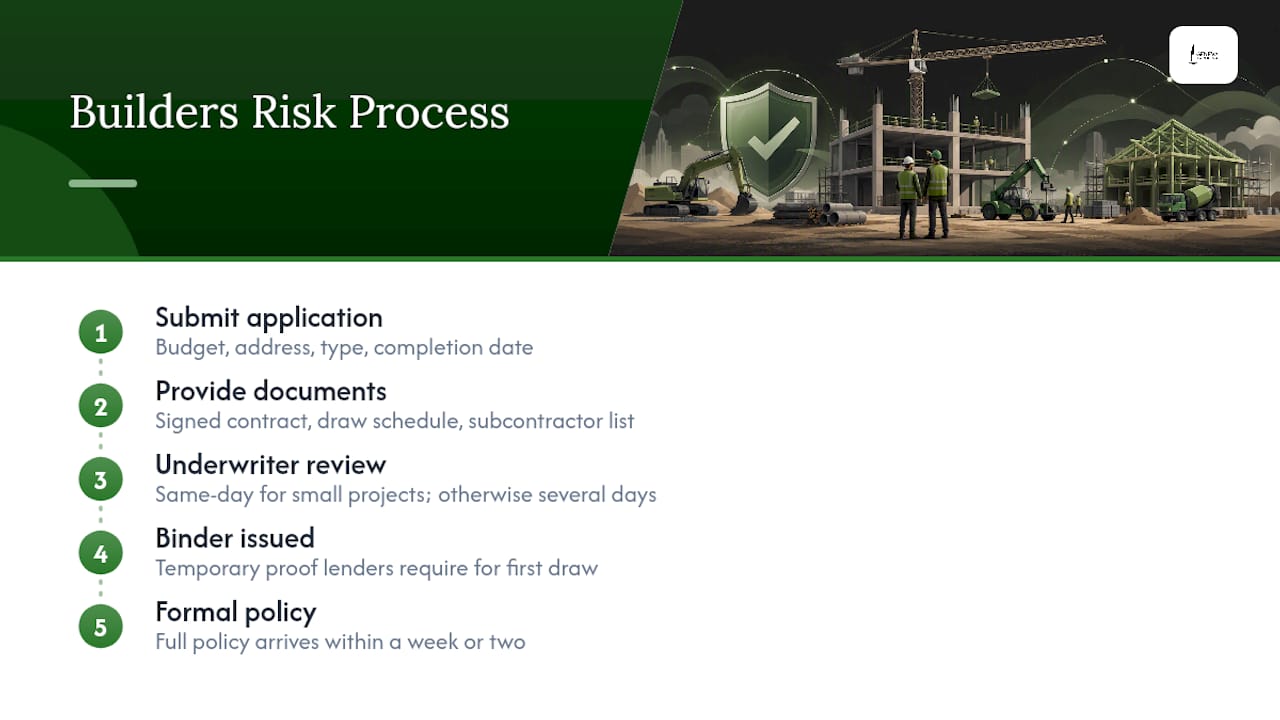
From there, an agent typically requests supporting paperwork: the signed construction contract, a draw schedule if a lender is involved, and a subcontractor list for larger commercial jobs. Simple residential projects with a completed value under a few hundred thousand dollars often get quoted same-day through a single carrier's online portal. Larger or higher-risk projects, coastal builds, ground-up commercial construction, anything needing flood or earthquake endorsements, usually require underwriter review, which adds several business days.
Once terms are set, the carrier issues a binder, a temporary proof of coverage that satisfies most lender requirements while the full policy is finalized. This is the document your lender will typically demand before releasing the first construction draw, so timing matters more than most first-time builders expect. After the binder is issued, the formal policy documents follow, usually within a week or two.
Delays almost always trace back to missing paperwork rather than underwriting complexity. Projects with a clear contract, an accurate budget, and a named subcontractor list move through underwriting far faster than submissions with vague scope or unclear ownership structure. If your project timeline is tight, ask your agent up front what documentation the carrier will need so you're not scrambling the week before groundbreaking.
How Does Project Size and Type Change Your Coverage Needs?
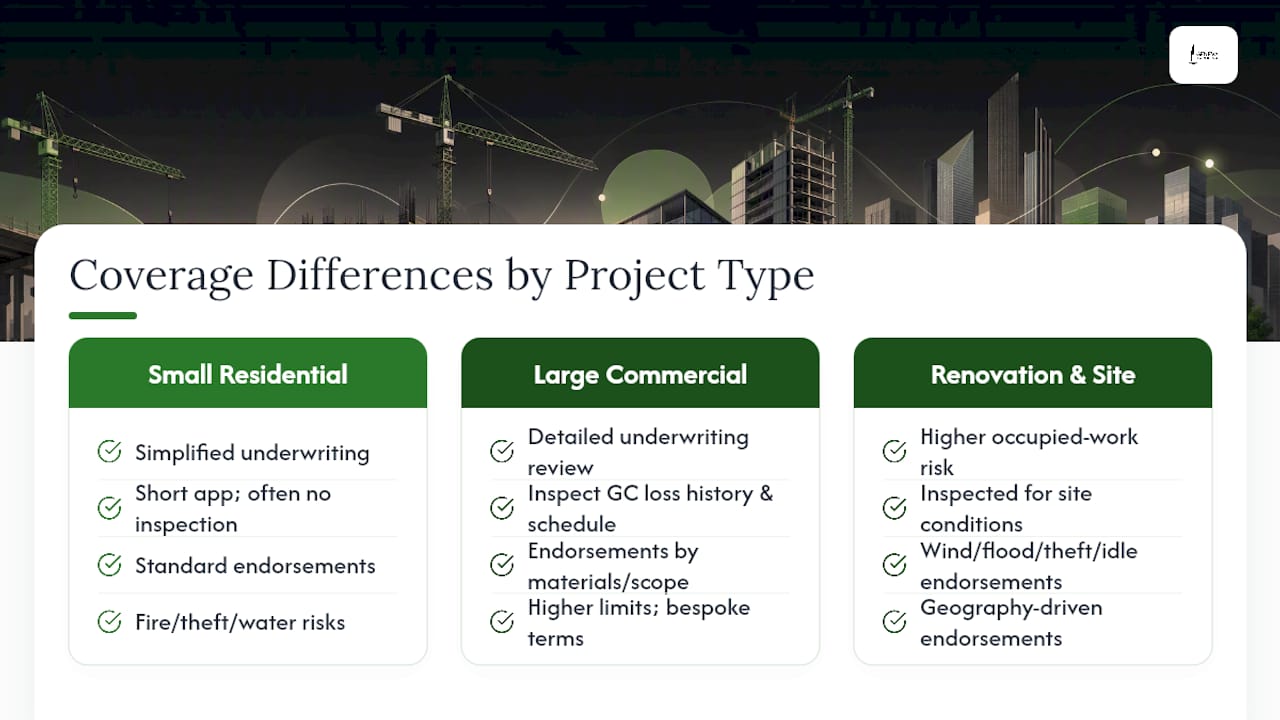
A $150,000 kitchen renovation and a $12 million mixed-use commercial build both need builders risk insurance, but the policies barely resemble each other. Project size drives the limit directly since coverage needs to match the completed value, but it also shapes which endorsements actually matter and how carriers assess the risk.
Smaller residential projects, additions, renovations, single-family ground-up builds, generally qualify for simplified underwriting and standardized forms. A carrier can often quote these from a short application without a site inspection. Larger commercial or multi-unit residential projects usually trigger a more detailed underwriting review that looks at the general contractor's loss history, the subcontractor roster, and the construction schedule's realism.
Project type matters just as much as size. A wood-frame residential build carries different fire risk than a steel-and-concrete commercial structure, and insurers price that difference into the quote. Renovation projects carry a distinct risk profile too: working inside or adjacent to an occupied or partially occupied structure raises the odds of water damage, fire from trade work, or theft during unsecured phases, which is part of why homeowners policies fall short here. A standard homeowners policy simply isn't built to handle that exposure.
Geography compounds all of this. A coastal high-rise condo conversion needs wind and possibly flood endorsements that an inland single-family renovation never touches. A mountain-region build might need coverage for extended idle periods during winter shutdowns. The right approach is matching the policy's endorsements and limits to your project's actual risk profile, not just its price tag, which is exactly where an experienced agent earns their commission.
How Does Builders Risk Fit With Your Other Insurance Policies?
Builders risk insurance doesn't operate alone. It sits alongside a handful of other policies that cover the risks builders risk specifically excludes, and understanding where each one starts and stops keeps you from assuming you're covered when you're not.
General liability insurance covers third-party bodily injury and property damage claims, a subcontractor's ladder falling on a neighbor's fence, a visitor tripping on-site, none of which builders risk touches. Builders risk protects the project itself; general liability protects everyone else affected by the work happening on it. Most lenders and general contractors require both policies to be active simultaneously, and a contract will often specify minimum liability limits separate from the builders risk requirement entirely.
Contractor's equipment insurance, sometimes called inland marine equipment coverage, protects tools, machinery, and mobile equipment owned by the contractor, excavators, generators, scaffolding, portable tools. Builders risk explicitly excludes this category, so a contractor running heavy equipment on-site without a separate equipment policy is exposed if a crane or generator is damaged or stolen.
Workers' compensation, required in nearly every state for employees on a job site, covers injury to workers themselves and operates entirely independently of builders risk. None of these policies substitute for each other, and gaps between them are where claims get denied. A broker who understands how these policies interact can spot a coverage seam before it becomes a six-figure argument with three different insurers pointing fingers at each other.
What Are the Most Common Pitfalls When Filing a Builders Risk Claim?
Most builders risk claim disputes trace back to one of a handful of predictable mistakes, and nearly all of them are avoidable with better preparation before the loss ever happens.
The most common pitfall is inadequate documentation of the site's condition before the damage occurred. Without time-stamped photos keyed to a progress schedule, an inventory of installed materials with invoices, and subcontractor daily logs, proving the extent of a loss becomes a matter of dueling estimates rather than clear evidence. Adjusters lean on whatever documentation exists, and a thin paper trail almost always favors a lower payout.
A second frequent problem is confusion over what caused the damage. If a pipe bursts and water damages framing that was already showing signs of workmanship defects, the insurer may argue the underlying cause was excluded faulty workmanship rather than covered water damage. These causation disputes are where an agent's early involvement pays off, because the wording used in the initial loss report often shapes how the claim gets classified.
Underinsurance is the third major pitfall, particularly on projects using a reporting form where the reported value lagged behind actual construction progress. If the policy limit doesn't reflect the true value at the time of loss, most policies apply a coinsurance penalty that reduces the payout proportionally, even on a partial loss.
Finally, delayed notice kills more claims than people expect. Most policies require prompt notification, and waiting weeks to report a loss while assessing the damage yourself can give an insurer grounds to question the claim's validity or deny it outright for late notice.
What Regulatory Requirements Apply to Builders Risk Insurance?
Builders risk insurance is regulated at the state level, which means the specific rules governing your policy depend on where the project sits. Every state requires carriers writing builders risk to either be admitted, licensed and regulated directly by that state's department of insurance, or non-admitted, operating through the surplus lines market for risks standard carriers won't take.
Admitted carriers carry the backing of the state's guaranty fund, meaning policyholders have a financial safety net if the insurer becomes insolvent. Non-admitted carriers don't carry that same guarantee, but they often provide the only available coverage for unusual risks: coastal high-rises, unconventional construction types, or projects in catastrophe-prone zones that admitted carriers avoid. Neither option is automatically wrong, but a lender reviewing your certificate of insurance may have specific requirements about which type they'll accept.
Beyond carrier admissibility, most states require proof of coverage before a building permit is finalized on larger commercial projects, and nearly every construction lender requires a certificate of insurance naming them as mortgagee or loss payee before releasing the first draw. That certificate needs to match the lender's specific wording requirements exactly, a mismatched endorsement or an incorrect named party can delay a draw by weeks while the paperwork gets corrected.
Carrier financial strength ratings, most commonly issued by AM Best, also factor into compliance on larger projects. Many lenders set a minimum rating threshold, often A minus or better, as a condition of the loan. Confirming that requirement before you shop for coverage saves you from binding a policy your lender ultimately won't accept.
What I Tell Every Client Before They Bind a Builders Risk Policy
The single biggest mistake I see is treating the lender's certificate requirement as a formality instead of the actual contract it is. I've watched draws get held up for weeks because the mortgagee clause used the wrong legal entity name. Read that certificate line by line before the binder goes out.
Buy online for a straightforward small renovation. Call an agent the moment your project involves a lender, multiple named parties, or any coastal or catastrophe exposure. That's where the policy language stops being boilerplate and starts mattering.
— David
Get a Fee-Free Builders Risk Policy Review
Genevainsgroup gives you something a single-carrier quote never will: an independent comparison across more than 25 A-rated carriers, so you're not stuck with whatever form the first insurer happens to sell. That matters most on builders risk, where one carrier's standard endorsements leave gaps another closes without a second thought.

The fee-free policy review checks the four things that actually cause problems later: completed-value limits against your real project cost, the endorsements your location and lender actually require, named-insured accuracy across owner, contractor, and lender, and the certificate language your lender's mortgagee clause demands. If you're mid-application with a general contractor or lender waiting on proof of coverage, that review can catch a gap before it delays a draw.
Whether you're breaking ground next month or already mid-project and want a second opinion on your current policy, request a fee-free policy review and get a straight answer on what your builders risk coverage actually protects, and what it doesn't.