
Most drivers who deliver for pay cannot rely on a standard personal auto policy alone. Part-time, single-app drivers usually just need a delivery endorsement; full-time, multi-app, or high-cargo-value drivers need commercial auto plus cargo or general liability coverage. Leased vehicles add mandatory requirements that can rule out the cheap endorsement route entirely. Check your current policy's language on delivery use, then get a written confirmation from your insurer or a fee-free policy review before you accept another order.
TL;DR:
- Many delivery drivers need more than a personal auto policy, especially full-time or high-value cargo carriers, requiring commercial auto and cargo insurance.
- App states significantly affect coverage, with the highest liability limits only applying once an order is accepted, leaving gaps during waiting and pre-acceptance driving.
- Costs range from $5 to $46 per month for part-time endorsements and $1,200 to $3,500 annually for full-time commercial auto, depending on location and risk factors.
- Leased vehicles often have higher minimum coverage requirements, and ignoring lease restrictions can lead to insurance lapses or vehicle repossession.
- Getting a written confirmation of coverage exclusions from your insurer before shifts is crucial to avoid claim denials and coverage gaps during delivery work.
Table of Contents
- Who Needs Delivery Driver Insurance?
- What Types of Insurance Cover Delivery Work?
- How Do App States Affect Your Coverage?
- How Much Does Delivery Driver Insurance Cost?
- Do Leased or Financed Cars Change Your Insurance Requirements?
- How Do You Choose Coverage and Get a Quote?
- How Does Geneva Insurance Group Evaluate Delivery Driver Coverage?
- The Real Problem With Delivery Insurance Advice
- Get a Fee-Free Policy Review Before Your Next Shift
- Sources
Who Needs Delivery Driver Insurance?
Not every delivery job carries the same risk, and your coverage should match your actual exposure, not a generic label. Start by figuring out which segment describes you.
- Part-time, single-app drivers. You deliver for one platform (say, DoorDash) a few hours a week using your own car and low-value cargo. A rideshare/delivery endorsement is usually enough here.
- Multi-app drivers. You bounce between two or three platforms, racking up more miles and more exposure across different app-state coverage rules. Endorsements start to strain at this volume.
- Full-time gig drivers. Delivery is your main income. You're on the road most of the day, which means more claims exposure and less tolerance for coverage gaps.
- Independent couriers. You contract directly with businesses (medical labs, florists, small retailers) rather than through an app, often carrying higher-value goods.
- Small fleet operators. You employ or contract other drivers, which brings workers' comp and hired/non-owned auto into the picture.
Mileage, cargo value, and whether you supervise other drivers all push you toward heavier coverage. A courier hauling lab specimens needs cargo insurance that a pizza-delivery driver doesn't; an operator with two hired drivers needs workers' comp that a solo DoorDash driver doesn't.
What Types of Insurance Cover Delivery Work?
Delivery drivers typically choose from five coverage categories, and picking the right combination depends on how much you drive, what you carry, and whether the platform's own insurance actually protects you.
- Personal auto vs. commercial auto. Personal auto is built for errands and commuting, and most insurers exclude "business use" like paid delivery. Personal auto policies commonly exclude delivery use, which means a claim during a delivery run can get denied even if your premium is current. Commercial auto is required once you're delivering full-time or hauling business cargo regularly, since it's built specifically for that exposure.
- Delivery/rideshare endorsement. This add-on to your personal policy plugs the delivery-use gap for a modest monthly cost. It's the cheapest fix, but it often caps mileage or restricts you to a single platform, and stacking endorsements across apps rarely works cleanly.
- Cargo/inland marine coverage. Platform insurance almost never covers the goods you're transporting. If you carry electronics, pharmaceuticals, or other high-value freight, a separate cargo policy protects against loss that your auto policy simply won't touch.
- General liability and BOP. Independent couriers who operate under their own business name, not just an app account, often need general liability for property damage or injury claims unrelated to a car accident, and may eventually need a full business owner's policy (BOP) as operations grow.
- Hired/non-owned auto, umbrella, and workers' comp. Once you hire other drivers or let someone use a company vehicle, you need hired/non-owned auto coverage and, in most states, workers' comp. An umbrella policy adds a liability cushion above your primary limits, worth considering if you carry valuable cargo or drive high mileage.
Pro Tip: Ask any insurer quoting an endorsement whether it covers "en route with cargo" specifically, not just "logged into the app." Some cheap endorsements only cover the waiting period, leaving you exposed exactly when the risk is highest.
How Do App States Affect Your Coverage?
Delivery and rideshare platforms structure their insurance around three "app states," and the coverage swings dramatically between them. Understanding this is the difference between assuming you're covered and finding out the hard way that you're not.
- App off. You're not logged in. Only your personal auto policy applies here, business-use exclusion and all.
- App on, waiting for a request. The platform typically provides contingent coverage with lower limits, often in the $50,000 to $100,000 range for liability.
- Order accepted, en route. Platform coverage generally jumps to primary liability up to $1 million during active deliveries, which sounds reassuring until you remember it only applies during that narrow window.
The gap shows up in that middle state. You're logged in, driving around waiting for an order, and if you get into an accident before accepting a delivery, the platform's contingent coverage may fall short while your personal insurer denies the claim outright for business use. That combination, thin platform coverage stacked against a hard personal-policy exclusion, is where most uncovered claims actually happen.
Before you drive another shift, ask your insurer directly: does my policy exclude delivery work entirely, or only above a certain mileage or income threshold? Then pull up your platform's driver agreement and check what coverage applies in the waiting state specifically, not just the marketing page's "$1 million policy" headline.
How Much Does Delivery Driver Insurance Cost?
Cost scales almost directly with how much you drive and what you're insuring against, so a fair comparison starts with your own segment rather than a single average number.
- Part-time, single-app drivers: a delivery endorsement typically runs $5 to $46 per month on top of your existing personal premium.
- Full-time or multi-app drivers: commercial auto for a solo operator typically costs $1,200 to $3,500 per year, depending on location, driving record, and vehicle value.
- Small courier operations: add cargo coverage and, if you employ drivers, workers' comp, which pushes annual costs meaningfully higher than a solo commercial policy.
Location, driving history, annual mileage, and cargo risk all move the number. A driver with a clean record delivering groceries in a mid-size city pays far less than one with a recent at-fault accident hauling electronics in a dense metro. Lease status matters too: leased vehicles often carry mandatory minimums that push you past what a basic endorsement covers, forcing an earlier jump to commercial auto than mileage alone would suggest.
The gap between endorsement and commercial auto pricing isn't small, but it reflects real differences in exposure. An endorsement patches one policy's blind spot. Commercial auto rebuilds the coverage from the ground up so app-state gaps stop being your problem.
Do Leased or Financed Cars Change Your Insurance Requirements?
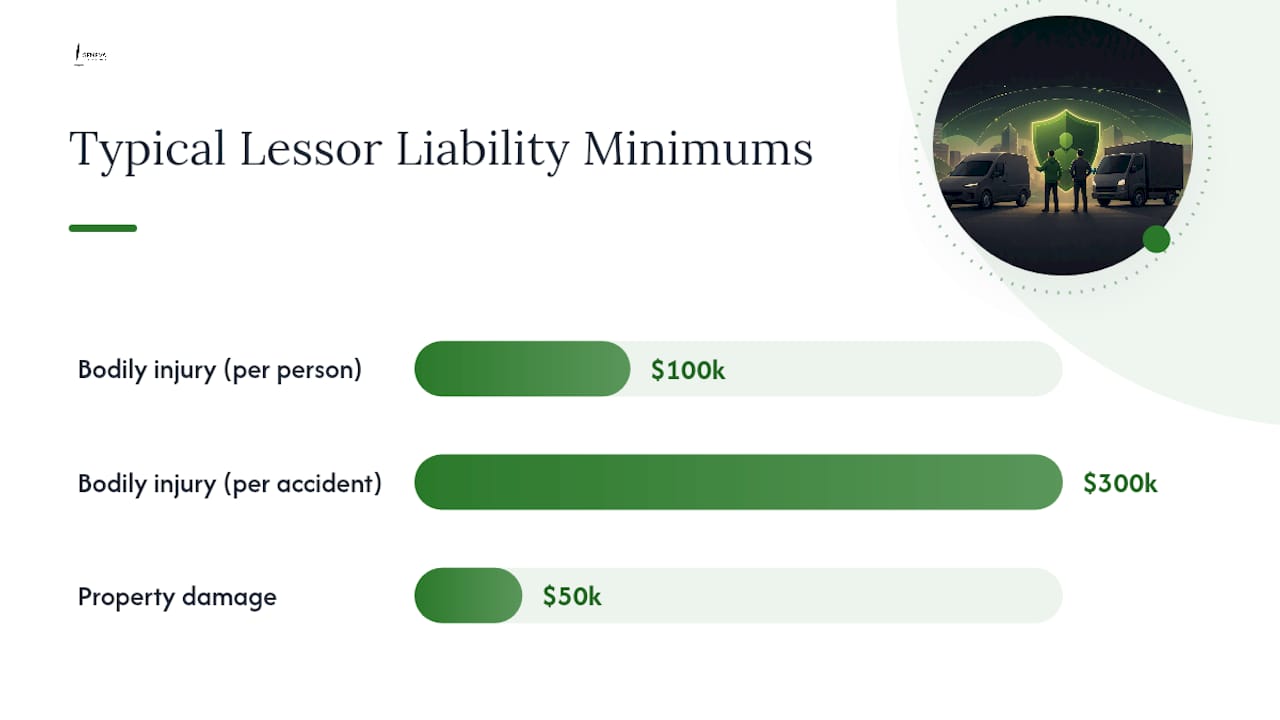
Leasing adds a second set of rules on top of whatever your state and insurer require, and most drivers only discover this after a lessor flags the gap. Lessors commonly require higher liability minimums, often around $100,000/$300,000/$50,000, along with mandatory comprehensive and collision coverage, and sometimes gap insurance to cover the difference between the car's value and what's still owed.
Using a leased car for delivery work without checking those terms creates real risk beyond a denied claim:
- Force-placed insurance. If your lessor discovers you're underinsured, they can add their own coverage to your account, usually at a much higher cost than anything you'd choose yourself.
- Lease violations. Some leases restrict commercial use outright, and delivery work can technically breach that clause even if your insurer never finds out.
- Repossession risk. In serious cases, a lease violation combined with an insurance lapse gives the lessor grounds to reclaim the vehicle.
Read your lease's insurance section before your first delivery shift, not after an accident. If it mentions commercial use restrictions, contact your lessor directly, and get written confirmation from your insurer that your policy or endorsement actually satisfies the lease's minimums. A lease agreement's insurance clauses function like a contract on top of a contract, and skipping that step is how drivers end up paying for coverage they didn't choose.
How Do You Choose Coverage and Get a Quote?
Shopping for delivery driver insurance goes faster and gets you a more accurate quote when you walk in prepared. Here's the order that works.
- Gather your facts first. Vehicle year/make/model, annual mileage, which delivery platforms you use, whether you carry high-value cargo, and your lease or loan status if applicable.
- Pull your platform's insurance terms. Screenshot or print the app-state coverage breakdown so your agent can see exactly where the platform's protection starts and stops.
- Call at least two agents, not one. Ask each the same direct question: "Does an endorsement cover me fully, or do I need commercial auto given my mileage and cargo?"
- Watch for red flags. An agent who can't explain app-state gaps, or who quotes an endorsement without asking your weekly mileage, isn't giving you a real answer.
- Compare quotes on limits, not just price. A cheaper endorsement with a $50,000 liability cap isn't a better deal than a slightly pricier one at $300,000 if you're hauling valuable freight.
- Escalate to commercial auto if you're multi-app, full-time, or hauling high-value cargo. Personal-policy-plus-endorsement setups tend not to scale once you're driving 30+ hours a week across platforms.
Pro Tip: Get every coverage confirmation in writing, even a simple email from your agent. Verbal assurances don't help you during a claim, and insurers sometimes cancel personal policies retroactively after discovering undisclosed delivery activity.
How Does Geneva Insurance Group Evaluate Delivery Driver Coverage?
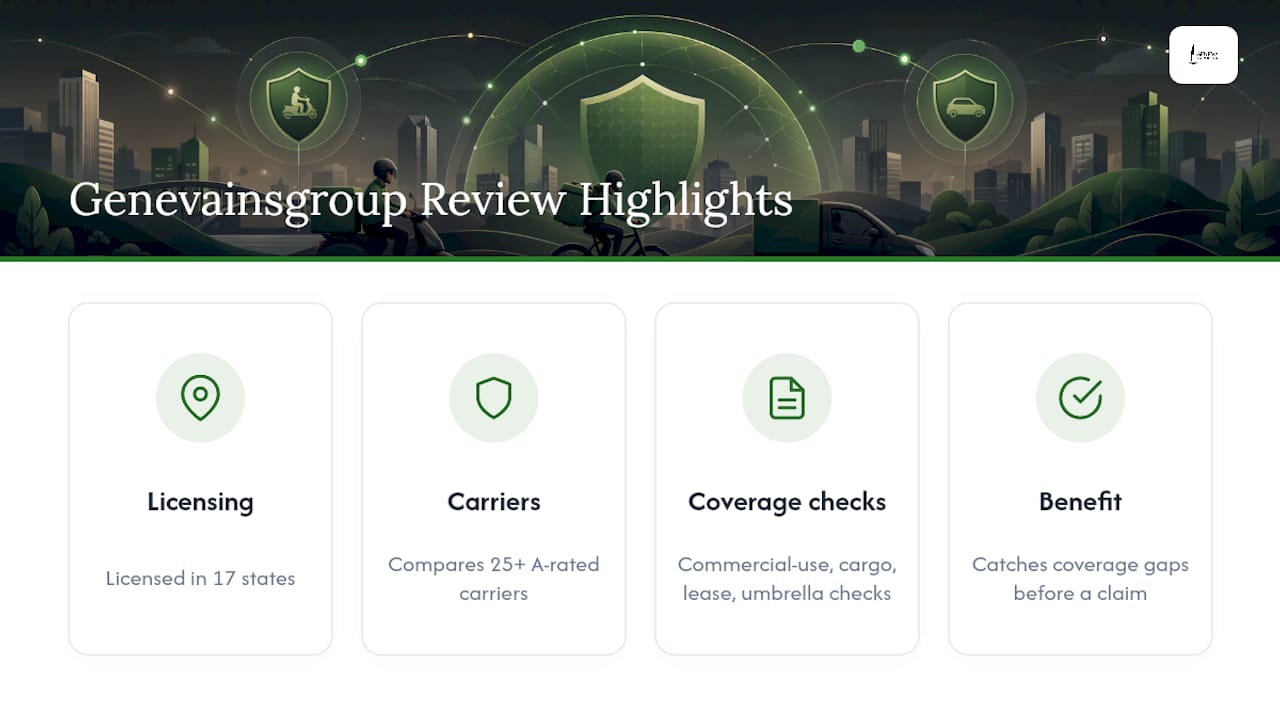
Genevainsgroup is licensed in 17 states and compares coverage across more than 25 A-rated carriers, which means a policy review isn't limited to one company's product lineup. During a fee-free review, Genevainsgroup checks for commercial-use exclusions buried in personal policies, cargo exposure that isn't covered, lease constraints that conflict with your current limits, and whether an umbrella policy makes sense for your mileage and risk level. That kind of independent check is what catches the gap before a claim does, not after.
The Real Problem With Delivery Insurance Advice
Most advice on this topic treats delivery drivers as one group with one answer, usually "get an endorsement" or "go commercial," as if mileage and platform count didn't matter. That's backwards. The right coverage depends entirely on which segment you're actually in, and a lot of drivers end up either overpaying for commercial auto they don't need yet or underinsured with an endorsement that caps out well before their real exposure does.
The bigger blind spot is the app-state gap. Drivers assume the platform's advertised million-dollar liability figure applies the whole time they're logged in, when it actually kicks in only once an order is accepted. That's the exact moment a lot of claims get denied, and it's rarely explained clearly anywhere except the fine print.
If there's one thing worth prioritizing first, it's getting your current policy's exclusions in writing before your next shift, not after an accident forces the question. A five-minute conversation with an agent beats a denied claim every time.
— David
Get a Fee-Free Policy Review Before Your Next Shift
Genevainsgroup gives delivery drivers something most endorsement quotes and app-based insurance pages don't: an independent look across more than 25 A-rated carriers instead of a single company's product line. That review costs nothing, and it's built specifically to catch the gaps this article just walked through, commercial-use exclusions, missing cargo coverage, and lease requirements that don't match your current limits.
If you're not sure whether an endorsement covers your situation or you've been putting off checking your policy's fine print, that's exactly what a review answers. Genevainsgroup will compare your current coverage against your actual driving pattern, whether that's a few DoorDash shifts a week or a full-time multi-app schedule, and flag what's missing before a claim forces the issue. Start your fee-free policy review and find out where your coverage actually stands.
This article is general information, not a substitute for advice from a qualified financial advisor. Consult a qualified financial professional about your own circumstances before acting on anything here.