

Own-occupation disability insurance pays benefits when you can no longer perform the material duties of your specific specialty, even if you're capable of working in a different field. Surgeons who can no longer operate but could teach, attorneys who can't try cases but could consult, and other high-earning specialists are the primary buyers of this coverage. The catch that trips up most policyholders: many contracts quietly convert to a stricter "any occupation" standard after 24 months. Therefore, the fine print matters more than the premium.
TL;DR:
- Most policies convert from own-occupation to any-occupation after 24 months, significantly reducing benefits if not carefully reviewed.
- True own-occupation coverage pays regardless of alternative work, while modified and transitional definitions weaken protection once disability persists.
- Contract language detailing specialty-specific duties and the timing of occupation definitions crucially determines claim approval or denial.
- Employer group plans often follow a two-year own-occupation period before switching to any-occupation, making vocational evidence and income offsets critical after that point.
- An independent policy review can identify gaps in coverage, rider needs, and language nuances that are often overlooked but essential for optimal protection.
Table of Contents
- What Does "Own Occupation" Actually Mean in a Disability Policy?
- Own Occupation vs. Any Occupation: What Actually Happens at Claim Time
- The Policy Provisions That Actually Determine If Your Claim Gets Paid
- What Does Own-Occupation Coverage Cost, and When Is It Worth It?
- How to Actually Buy or Confirm Own-Occupation Coverage
- How Geneva Insurance Group Reviews Your Disability Coverage
- The Long-Term View on Price vs. Contract Language
- Get a Fee-Free Review of Your Disability Coverage
- Sources
What Does "Own Occupation" Actually Mean in a Disability Policy?
Insurance carriers don't all define "own occupation" the same way, and that gap is where claims get denied or paid. Four variants show up repeatedly in the market, and knowing which one sits in your contract determines whether you'll actually collect a benefit when it counts.
True own-occupation is the strongest version. It pays a full benefit if you can't perform the material duties of your specific specialty, regardless of whether you work elsewhere. A cardiothoracic surgeon who develops a hand tremor and can no longer operate, but takes a teaching position at a medical school, still collects the full monthly benefit under a true own-occupation contract. The insurer doesn't care that you found other work. It only cares that you can't do the job you were trained and licensed for.
Modified own-occupation softens that deal. It typically pays only if you can't perform your specialty duties and you aren't "gainfully employed" in another occupation. Take that same surgeon, teaching now at a six-figure salary. A modified policy might reduce or eliminate the benefit because the insurer treats the teaching income as evidence you're no longer "disabled" in the way the contract defines it, even though you'll never operate again.
Transitional and two-year own-occupation definitions start strong and then downgrade. For roughly the first 24 months of a claim, the policy pays under an own-occupation standard. After that, the definition shifts to any-occupation, meaning the insurer only keeps paying if you can't perform any job reasonably suited to your education, training, and experience. This structure is common in group and employer-sponsored plans, and it's the single most misunderstood feature in disability contracts.
The phrase "material and substantial duties" does a lot of quiet work in these definitions, and carriers word it differently:
- Some contracts define material duties as the tasks that are actually part of your day-to-day specialty (an orthopedic surgeon's operating-room duties, specifically).
- Others use broader, more generic language tied to your job title rather than your actual clinical or professional function.
- A few policies limit the definition to duties you performed in the 12 months before disability, which can help or hurt you depending on how your practice evolved.
Reading that clause closely, not the marketing brochure, tells you what you're really buying.
Own Occupation vs. Any Occupation: What Actually Happens at Claim Time
Here's a scenario that plays out constantly among proceduralists. An interventional cardiologist develops a repetitive-motion injury and can no longer perform catheterizations. Under an own-occupation standard, the claim pays in full because the material duties of "interventional cardiologist" can't be performed. Under an any-occupation standard, the same claim gets denied or reduced because the insurer argues the cardiologist could still work as a hospital administrator, a medical consultant, or a general internist. Same disability, two very different outcomes, purely because of contract language.
Employer-sponsored group long-term disability plans almost always follow the transitional pattern: own-occupation for the first two years, any-occupation after that. This structure exists partly because of how ERISA governs employer-sponsored benefit plans, which limits a claimant's legal remedies and generally caps damages to the benefit owed, without the broader damages available in ordinary contract disputes. If your group plan denies you after month 25, your recourse is narrower than most people assume.
Three practical consequences follow from that any-occupation conversion:
- Vocational evidence becomes decisive. Insurers hire vocational experts to identify alternative jobs you're theoretically qualified for, and those findings often decide the claim.
- Income offsets kick in. If you find any paying work after conversion, expect the insurer to reduce your benefit dollar-for-dollar or close to it.
- Benefit termination risk rises sharply. Claims that were stable and paying under own-occupation frequently get re-evaluated and cut off once the any-occupation clock starts, according to Investopedia's comparison of the two standards.
The Policy Provisions That Actually Determine If Your Claim Gets Paid
Four clauses do most of the work in a disability contract, and specialists should scrutinize each before signing anything.
Occupation definition. Look for language that names your specialty specifically ("orthopedic surgeon," "trial attorney," "anesthesiologist") rather than a generic label like "physician" or "lawyer." Specialty-level wording is what makes true own-occupation coverage worth the extra premium.
Material and substantial duties. Confirm whether the contract ties this to your actual documented duties or to a generic job description. Some carriers will ask for a job description from your employer or practice at underwriting, then bake that into the contract, which locks in stronger protection.
Elimination period, benefit amount, and benefit period. The elimination period (commonly 90 or 180 days) is your waiting period before benefits start. Benefit amount is usually capped around 60% to 70% of income. Benefit period options range from a few years to age 65 or 67, and offsets from other disability income (including Social Security) can reduce what you actually collect.
Riders worth checking:
- Residual/partial disability rider pays a partial benefit if you can still work in your specialty but at reduced capacity or income.
- Cost-of-living adjustment (COLA) rider increases your benefit over time to keep pace with inflation during a long claim.
- Future increase option lets you raise coverage later without new medical underwriting, useful as income grows.
- Specialty rider locks the true own-occupation definition in place even if you later change duties within your field.
Watch for exclusions tied to mental health, substance use, or pre-existing conditions, since these vary widely by carrier and can quietly gut a policy that looks strong on price.
Pro Tip: Ask each carrier for the exact contract paragraph that defines "total disability" and "material and substantial duties," not a summary. Paste those paragraphs side by side in one document. The differences are often two or three sentences, and those sentences are where claims get won or lost.
What Does Own-Occupation Coverage Cost, and When Is It Worth It?
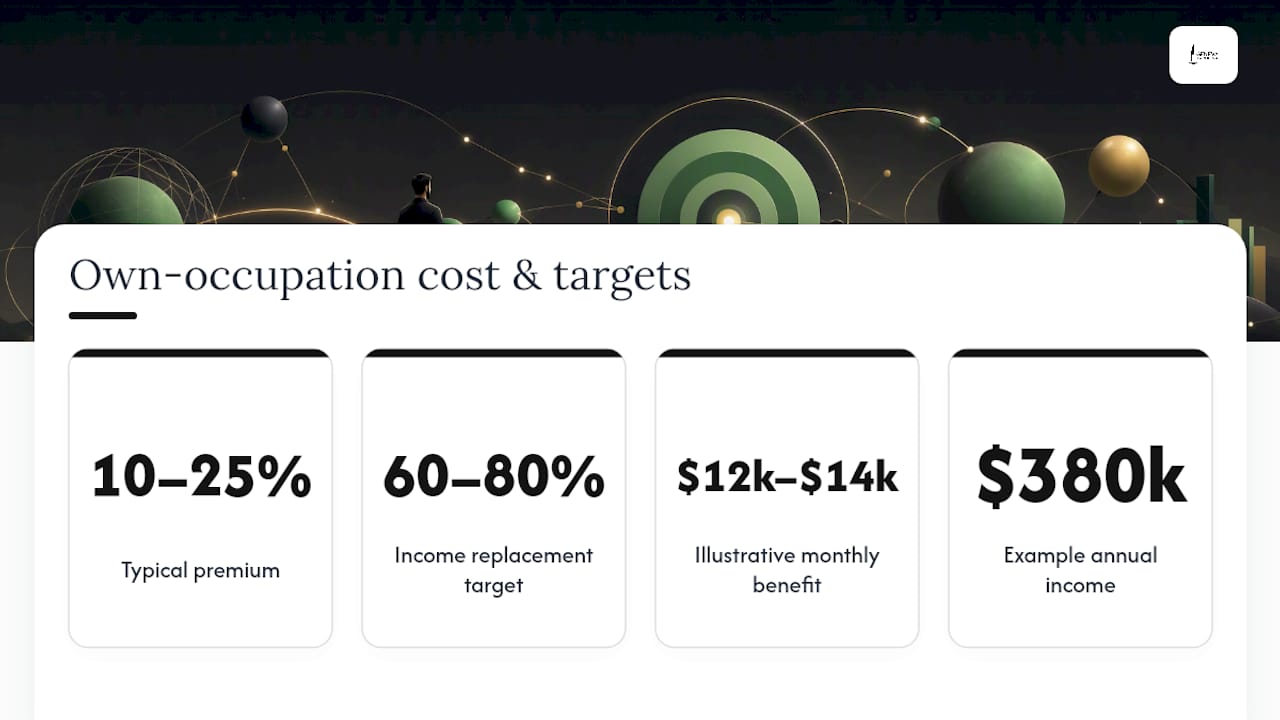
True own-occupation coverage generally costs more than any-occupation or modified alternatives, with industry pricing commentary suggesting a premium roughly 10% to 25% higher depending on occupation class, health, and benefit design, per Department of Labor guidance on employer benefit structures. The main cost drivers are your age at purchase, health history, occupation risk class, benefit amount, benefit period, and how strong a definition you're buying.
That extra cost tends to be worth it when your income is high relative to your specialty's transferable skills, when you're carrying six-figure student debt that doesn't disappear if you're forced into a lower-paying field, or when you're a partner or shareholder whose practice value depends on your specific clinical or professional output.
A reasonable target is replacing 60% to 80% of after-tax income, coordinated with any business overhead insurance or buy-sell agreement funding you already carry. FINRA's consumer resources frame disability coverage as one piece of a broader income-protection plan, not a standalone purchase.
As an illustrative example only: a 38-year-old anesthesiologist earning $380,000 annually might target a $12,000 to $14,000 monthly benefit with a true own-occupation definition to age 65, layering a residual rider on top.
Long-term disability is more common than most professionals assume. The Social Security Administration's disability planning guidance documents that a meaningful share of today's workers will experience a disabling condition long enough to interrupt their career, which is exactly why private coverage functions as primary protection rather than a backup to federal programs.
How to Actually Buy or Confirm Own-Occupation Coverage
Follow this sequence rather than shopping on price alone.
- Inventory what you already have. Pull your employer or group LTD plan's certificate of coverage and find the exact occupation definition, not the HR summary. Most group plans convert to any-occupation at month 24, and you need to know that before assuming you're covered long-term.
- Request individual quotes with your specialty defined precisely. Ask each carrier to quote based on your actual specialty title and duties, not a generic professional category, then compare the definition language itself rather than marketing brochures.
- Decide on riders and trade-offs. Weigh a residual rider against a slightly longer elimination period, or a COLA rider against a shorter benefit period, based on your income stability and family financial obligations.
- Buy while healthy, and use a specialist broker for complex cases. Underwriting gets harder and more expensive after a diagnosis, so timing matters. Complex specialties (surgeons, proceduralists, attorneys with unusual practice structures) benefit from a broker who regularly places this specific coverage.
Pro Tip: When you talk to a broker, ask for the actual policy contract pages, not a brochure or illustration. Request the definitions section, the exclusions section, and any rider language in writing before you apply. If a broker can't produce those pages quickly, that's a signal to keep shopping.
How Geneva Insurance Group Reviews Your Disability Coverage
A fee-free policy review at Genevainsgroup walks through your existing coverage side by side against options from more than 25 A-rated carriers, checking specifically for conversion clauses, occupation-definition wording, and rider gaps most people never think to ask about.
Geneva operates as an independent brokerage, which means the comparison isn't limited to one carrier's product lineup. Every finding gets explained in plain language, not policy jargon, and that advocacy continues if you ever need to file a claim. The agency is licensed in 17 states, including Illinois, Florida, and Washington.
The review ends with specific next steps: which contract clauses need edits, which riders are missing, and which carrier's language actually matches your specialty and income situation.
The Long-Term View on Price vs. Contract Language
The cheapest disability policy and the best disability policy are rarely the same contract, and specialists who shop on premium alone tend to discover that gap only when they're filing a claim. Prioritize the definition and the benefit period over the monthly cost. If you want a second opinion on what you're currently holding, a policy review is worth the hour it takes.
— David
Get a Fee-Free Review of Your Disability Coverage
Geneva Insurance Group gives you an independent second opinion on your disability coverage instead of a single carrier's sales pitch. The review compares your existing policy, or a fresh quote, against more than 25 A-rated carriers to find where the occupation definition, conversion clause, or rider lineup falls short for a specialist income.
Here's what the process covers:
- A fee-free, no-obligation review of your current disability policy or group LTD certificate
- Side-by-side comparison of occupation definitions and conversion clauses across 25+ carriers
- Claims advocacy if you ever need to file, not just help at the point of sale
- Plain-language explanations of riders, exclusions, and benefit calculations
For readers weighing individual policy mechanics further, Infinity Benefits Group's individual insurance page walks through how standalone disability plans are typically structured. If you're also sizing benefit amounts against other income-protection tools, East Two West's quote comparison resources offer useful background on planning around income replacement.
To start, have your current policy or employer benefits certificate on hand. Most reviews take about a week from document submission to a written recommendation. Visit Geneva Insurance Group to request your fee-free policy review and find out exactly where your current coverage stands.
This article is general information, not a substitute for advice from a qualified financial advisor. Consult a qualified financial professional about your own circumstances before acting on anything here.