

Yes. Your mortgage servicer collects a slice of homeowners insurance and property tax costs in every monthly payment, holds it in an escrow account, and pays your insurer and tax office directly when bills come due. That's why your total mortgage payment can shift year to year even if your interest rate never moves.
TL;DR:
- Escrow payments can increase annually if your property taxes or insurance premiums rise, often leading to noticeable monthly payment changes.
- Some loan types, like FHA or low-down-payment conventional loans, typically require escrow, but higher equity can qualify you for an escrow waiver.
- A yearly escrow analysis compares projected and actual costs, with potential for refunds if there is a surplus or a need for a short-term payment if there is a shortage.
- Canceling escrow can be risky if you are not disciplined with your budget, as unpaid taxes or lapses in insurance can lead to forced coverage or liens.
- Changing insurance carriers during escrow requires coordination and documentation; a free policy review can help ensure your coverage remains competitive.
Table of Contents
- Escrow and Insurance: The Essentials
- How Escrow Actually Moves Money From You To Your Insurer
- What You Actually Gain From Escrowing Taxes And Insurance
- The Downsides Nobody Mentions Upfront
- How Servicers Calculate Your Monthly Escrow Payment
- Which Loans Require Escrow, And Can You Waive It?
- Reading Your Annual Escrow Analysis
- What Happens If Insurance Lapses Or Taxes Go Unpaid
- Switching Insurers When Escrow Pays The Bill
- Your Escrow Action Checklist
- An Agency's View On Managing Escrowed Insurance
- Get A Fee-Free Review Of Your Escrowed Policy
- Sources
Escrow and Insurance: The Essentials
- An escrow account (also called an impound account) is a fund your loan servicer manages on your behalf, separate from your loan balance.
- It typically covers homeowners insurance and property taxes, and sometimes flood insurance or mortgage insurance premiums.
- You gain payment convenience and protection against lapses, but you give up short-term access to that money and any interest it might otherwise earn.
How Escrow Actually Moves Money From You To Your Insurer
Escrow is usually set up the day you close on your loan. Your servicer estimates your annual property tax bill and homeowners insurance premium, adds them together, and divides by 12. That figure gets tacked onto your principal and interest as part of your monthly mortgage payment.
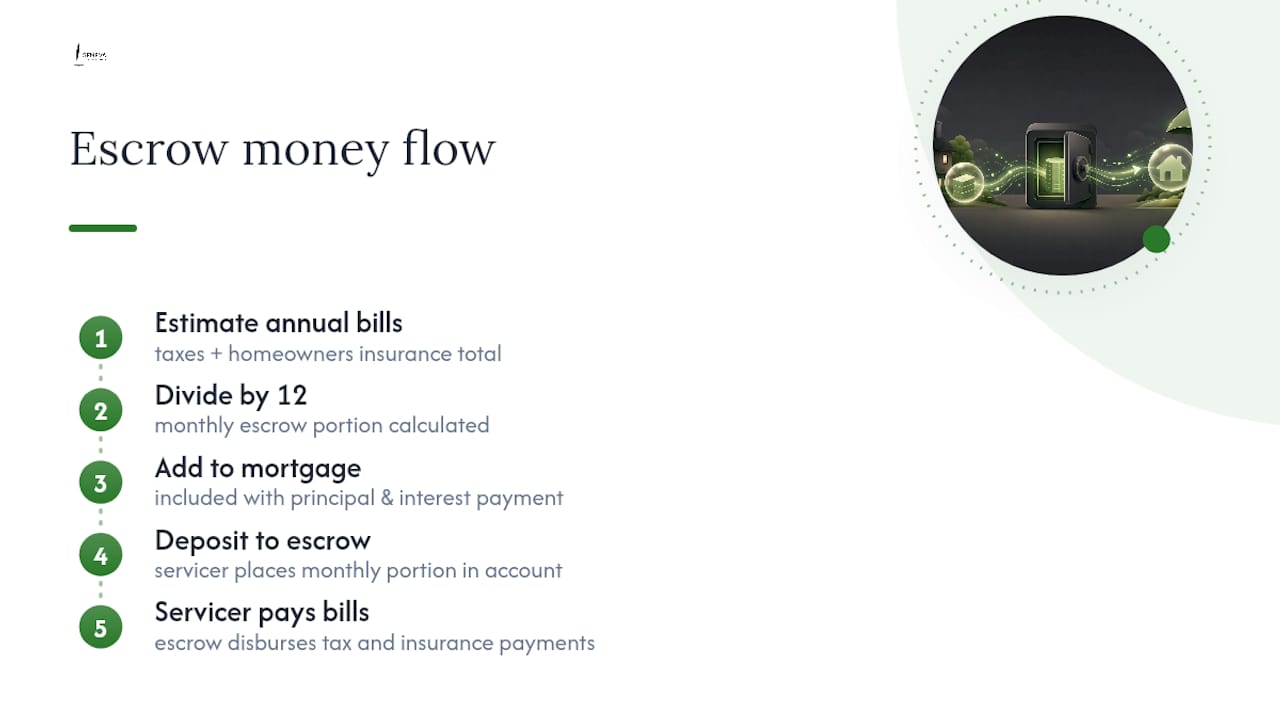
Each month, the servicer deposits your escrow portion into the escrow or impound account and lets it accumulate. When your property tax bill or insurance renewal notice arrives, the servicer pays it directly out of that account, on schedule, without you writing a check. You never touch the money between deposit and disbursement. It sits earmarked for exactly one purpose: covering those two recurring, non-negotiable homeownership costs.
This is the core mechanic behind escrow and insurance coordination. You fund it gradually; the servicer executes the payment precisely.
What You Actually Gain From Escrowing Taxes And Insurance
- Your annual bill becomes a monthly line item instead of one lump-sum payment twice a year.
- Missed tax payments can trigger liens, and lapsed insurance can trigger foreclosure clauses in your loan; escrow removes that risk almost entirely.
- One servicer handles two separate payees, so you're not juggling due dates for your county tax office and your insurance carrier.
For many buyers, especially first-timers, that administrative offload is worth more than the cash-flow trade-off. You stop thinking about it, and the bills still get paid.
The Downsides Nobody Mentions Upfront
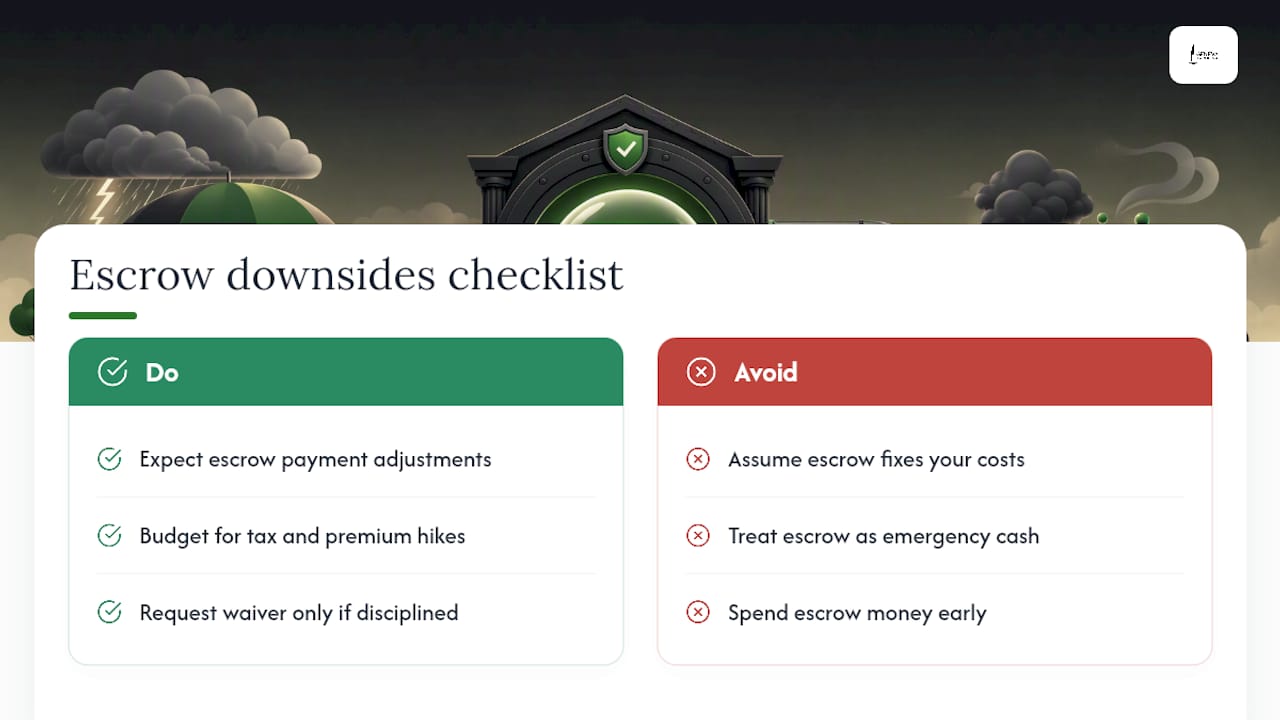
Escrow does not fix your costs. It only smooths how you pay them. If your county reassesses your property or your insurer raises premiums, your monthly escrow contribution rises to match, sometimes by a noticeable amount. Homeowners who assume escrow means "predictable forever" are working from a myth.
You also lose access to that money while it sits in the account. It's not earning you interest, and you can't tap it for anything else, even a real emergency. Some borrowers push for an escrow waiver to keep that liquidity and pay taxes and insurance themselves. That works fine for disciplined budgeters. It backfires badly for anyone who might spend the tax fund on something else in November and come up short in December.
How Servicers Calculate Your Monthly Escrow Payment
The math behind escrow and insurance contributions is simple in structure, even if the inputs vary:
- Add your annual property tax bill to your annual homeowners insurance premium (and any other required item, like flood insurance).
- Divide that total by 12 to get your baseline monthly escrow contribution.
- Add a permitted cushion, often up to one sixth of the annual total, to buffer against cost increases.
Quick example: An estimated sum of annual property taxes and homeowners insurance divided by 12 gives a monthly amount, before any cushion. Adding a modest cushion can increase this monthly escrow line, depending on servicer policy and state rules.
Which Loans Require Escrow, And Can You Waive It?
Certain loan programs make escrow close to mandatory. For example, FHA loans require it, and conventional loans with low down payments commonly require it due to higher lender risk.
If you put down more equity, or your servicer's investor guidelines allow it, you may qualify for a waiver. This usually depends on your loan-to-value ratio and your payment history, and some servicers charge a fee or a slightly higher rate in exchange. Ask before closing. If escrow is already in place, refinancing or reaching a required equity threshold can open the door to removing it later.
Reading Your Annual Escrow Analysis
Once a year, your servicer runs an escrow analysis comparing what it projected against what it actually paid. This isn't optional paperwork. Regulation X under RESPA requires it, and the results determine whether your payment goes up, down, or stays flat.
- A shortage means your account didn't collect enough; you'll typically get the option to pay a lump sum or spread the deficit across the next 12 months.
- A surplus above certain thresholds, commonly $50, must be refunded to you rather than kept in the account.
- Always compare the servicer's billed figures against your actual insurance declarations page and your county tax bill. Errors happen more often than people expect.
What Happens If Insurance Lapses Or Taxes Go Unpaid
This is where escrow earns its reputation as a safety net. If your homeowners policy lapses and you haven't escrowed it, your servicer can buy force-placed insurance on your behalf, and it's usually far more expensive than a policy you'd choose yourself. Unpaid property taxes can trigger liens, and in serious cases, lenders can add those unpaid amounts to your loan balance or move toward foreclosure. The fastest way to avoid force-placed coverage is sending proof of your active policy to your servicer the moment you switch or renew.
Switching Insurers When Escrow Pays The Bill
You can absolutely change insurance carriers even when your premium runs through escrow. Get your new policy's declarations page before your old policy expires, and send it to your servicer immediately so there's no coverage gap on record. Confirm the servicer has updated its payment instructions and ask how long the transition takes. Any premium difference, higher or lower, gets reconciled in your next annual escrow analysis, either as a refund or a shortage.
Your Escrow Action Checklist
- Pull your most recent escrow analysis and check it line by line against your insurance declarations page and tax bill.
- Confirm your servicer's disbursement dates so you know when payments actually go out.
- Set aside a small buffer, even a few hundred dollars, in case a shortage payment shows up unexpectedly.
Pro Tip: Keep a folder, digital or physical, with your current declarations page and tax bill together. When your annual escrow statement arrives, you'll compare it in five minutes instead of an hour.
An Agency's View On Managing Escrowed Insurance
Homeowners often assume they're stuck once a policy is locked into escrow. They're not. An independent agency compares coverage across multiple A-rated carriers and offers a fee-free policy review, so you can see whether your current premium is actually competitive before your next escrow analysis lands. If you switch carriers, that review also covers coordinating the paperwork your servicer needs and standing beside you if a claim gets complicated. Plain language, not fine print, is the point.
— David
Get A Fee-Free Review Of Your Escrowed Policy
If your escrow analysis just showed a premium jump, or you're simply not sure whether you're overpaying, a second look costs nothing and takes little of your time.

The agency runs a fee-free policy review that stacks your current homeowners coverage against multiple A-rated carriers, using your annual escrow analysis and current declarations page as the starting point. Bring both documents and you'll get a clear, jargon-free comparison instead of a sales script. If a switch makes sense, the team helps coordinate the paperwork your servicer needs so nothing lapses mid-transition, and stays involved if you ever need to file a claim. Readers who want a broader grounding in insurance terminology before that conversation can also browse insurance licensing course modules for background on how policies and premiums are structured. Start by requesting your fee-free policy review today.