

HO-5 gives you broader personal property protection through open perils and replacement cost coverage, but it costs more and isn't available to every homeowner. HO-3 is the standard policy most insurers write, covers your home structure the same way HO-5 does, and often costs less because your belongings are covered on a named-perils, actual-cash-value basis. The right pick depends on how much your stuff is worth, your home's age and condition, and what carriers will actually underwrite.
TL;DR:
- HO-5 policies typically cost more because they cover personal property on an open perils basis and settle claims at replacement cost value, unlike HO-3 policies.
- Coverage differences mainly affect personal property, with HO-5 offering broader protection and default replacement cost settlement, while HO-3 covers only on a named perils and actual cash value basis.
- Qualifying for HO-5 depends on factors like home age, condition, claims history, and insurer underwriting; newer, well-maintained homes have higher chances.
- Adding an replacement cost value endorsement to an HO-3 policy can provide similar contents coverage without switching to a full HO-5, often at a lower premium.
- A home inventory and understanding of sub-limits, coverage options, and exclusions are essential before pricing or switching policies to ensure your valuables are adequately protected.
Table of Contents
- HO3 vs HO5: The Real Difference Comes Down to Two Words
- What Each Policy Actually Pays For, Component by Component
- Why HO-5 Costs More, and Why You Might Not Even Qualify
- How to Decide: A Practical Checklist Before You Call Your Agent
- Common Coverage Gaps We Find During Policy Reviews
- Three Homeowners, Three Different Answers
- Get a Fee-Free Policy Review Before You Switch Anything
- Sources
HO3 vs HO5: The Real Difference Comes Down to Two Words
The gap between these two policies isn't about the roof over your head. It's about how your belongings get covered, and how a claims adjuster calculates what you get paid.
Named perils means your personal property is only covered for disasters specifically listed in the policy, things like fire, theft, windstorm, or vandalism. If it's not on the list, you're not covered. Open perils flips that logic: everything is covered unless the policy specifically excludes it. That's the structural difference at the heart of HO-3 vs. HO-5 forms, and it's also where ISO's standardized policy language gets genuinely confusing, because ISO forms can mix perils across property categories within the same policy.
Here's how that plays out in practice:
- HO-3: dwelling and other structures on open perils; personal property on named perils
- HO-5: dwelling, other structures, and personal property all on open perils
Then there's the settlement math. Actual cash value (ACV) pays what your stuff is worth today, after depreciation. Replacement cost value (RCV) pays what it costs to buy it new. HO-3 policies typically settle personal property claims at ACV unless you add an endorsement; HO-5 policies commonly include RCV for contents by default.
Industry data point: HO-5 policies generally cost more than HO-3 policies specifically because of this broader perils and settlement structure, not because the dwelling coverage changed.
What Each Policy Actually Pays For, Component by Component
Both forms break coverage into the same four buckets: dwelling, other structures, personal property, and liability, plus loss of use. Where they diverge is worth mapping out before you compare quotes.
Dwelling and other structures. Both HO-3 and HO-5 typically cover your house, garage, fence, and shed on an open-perils basis. This is the part everyone assumes is different between the two forms, and it usually isn't. Always confirm this in your own declarations page, since carriers can write exceptions.
Personal property. This is where the real split happens:
- HO-3: named perils only, often settled at ACV unless you've added an RCV endorsement
- HO-5: open perils by default, typically settled at RCV
- Both forms usually cap coverage for jewelry, art, and collectibles at low sub-limits, sometimes just a few thousand dollars, regardless of which form you carry
Liability and loss of use. These sections tend to look nearly identical between HO-3 and HO-5. Liability limits and additional living expense coverage are usually set by the limit you choose, not the form itself, so don't assume HO-5 automatically buys you more protection here.
Exclusions. Neither policy is a catch-all. Flood and earthquake damage are excluded from both forms, full stop. If you live somewhere those risks are real, you need a separate flood policy through the National Flood Insurance Program or a private carrier, plus a stand-alone earthquake policy. Normal wear and tear, pest damage, and maintenance neglect are excluded everywhere too.
Why HO-5 Costs More, and Why You Might Not Even Qualify
Money and eligibility are tangled together here, and homeowners often assume price is the only obstacle. It usually isn't.
What drives the premium gap. HO-5's broader personal property coverage and RCV settlement mean insurers expect to pay out more per claim, which pushes average premiums higher than HO-3. Your specific number depends on home value, location, claims history, and the carrier you choose, but the direction is consistent across the industry.
Why you might get turned down for HO-5 anyway. Carriers tend to reserve HO-5 for homes that look like a lower risk on paper:
- Newer homes or recently updated wiring, plumbing, and roofing
- Clean claims history over the past five to ten years
- Higher-value homes where insurers want tighter underwriting control
Eligibility for HO-5 depends heavily on carrier-specific underwriting rules, not just what you're willing to pay. A 40-year-old home with an aging roof might simply never see an HO-5 quote, regardless of budget.
The workaround worth pricing out. You can often add an RCV endorsement to a standard HO-3 policy to get replacement cost coverage on contents without switching forms entirely. Compare that endorsement's added premium against a full HO-5 quote before assuming HO-5 is the only path to better contents protection.
Pro Tip: Ask for both quotes side by side, an HO-3 with an RCV endorsement and a full HO-5, from the same carrier. The dollar difference between them tells you exactly what open-perils coverage on your belongings is actually worth.
How to Decide: A Practical Checklist Before You Call Your Agent
Start with your stuff, not your house. Walk through your home and estimate what it would cost to replace your furniture, electronics, and clothing at today's prices, not what you originally paid. If that number surprises you on the high side, RCV coverage starts looking less optional and more necessary.
- Total up your personal property value. A home inventory with photos and receipts makes this step accurate and speeds up any future claim.
- Decide how you feel about ACV. If a five-year-old couch getting paid out at depreciated value would wreck your budget, RCV coverage matters more than saving a little on premium.
- Check your home's age and condition. Updated systems and a newer roof improve your odds of qualifying for HO-5 in the first place.
- Get quotes for both HO-3 with an RCV endorsement and full HO-5. Compare the actual premium gap, not just the coverage description.
When you talk to an agent or insurer, ask these questions directly:
- Is my personal property covered on an open-perils or named-perils basis?
- Does this policy include replacement cost value for contents, or do I need to add it?
- What are the sub-limits on jewelry, electronics, and collectibles, and can I raise them with a rider?
- Does raising my deductible meaningfully lower the premium, and how does that tradeoff play out on a $5,000 claim versus a $50,000 claim?
One red flag worth watching for: vague language around "special limits of liability" buried in the personal property section. That's usually where sub-limits hide, and it's easy to miss until you're filing a claim for a stolen laptop or engagement ring that's worth more than the policy will pay.
Common Coverage Gaps We Find During Policy Reviews
At Genevainsgroup, the same handful of gaps show up over and over when we review existing homeowners policies. Most homeowners don't know these gaps exist until a claim exposes them.
- Contents insured at ACV when the homeowner assumed replacement cost was included
- No RCV endorsement added to an HO-3, even though the carrier offers one
- Personal property coverage set well below actual replacement value, based on an outdated inventory
- Jewelry, art, or electronics sub-limits far below what those items would actually cost to replace
A fee-free policy review looks at your current declarations page line by line and tells you plainly whether an HO-3 upgrade or a full HO-5 switch makes more sense for your situation, compared against options from more than 25 A-rated carriers.
Three Homeowners, Three Different Answers
A young couple in a starter home with modest furniture and no heirlooms is usually fine on a standard HO-3. The premium savings outweigh the ACV tradeoff when there's not much to replace.
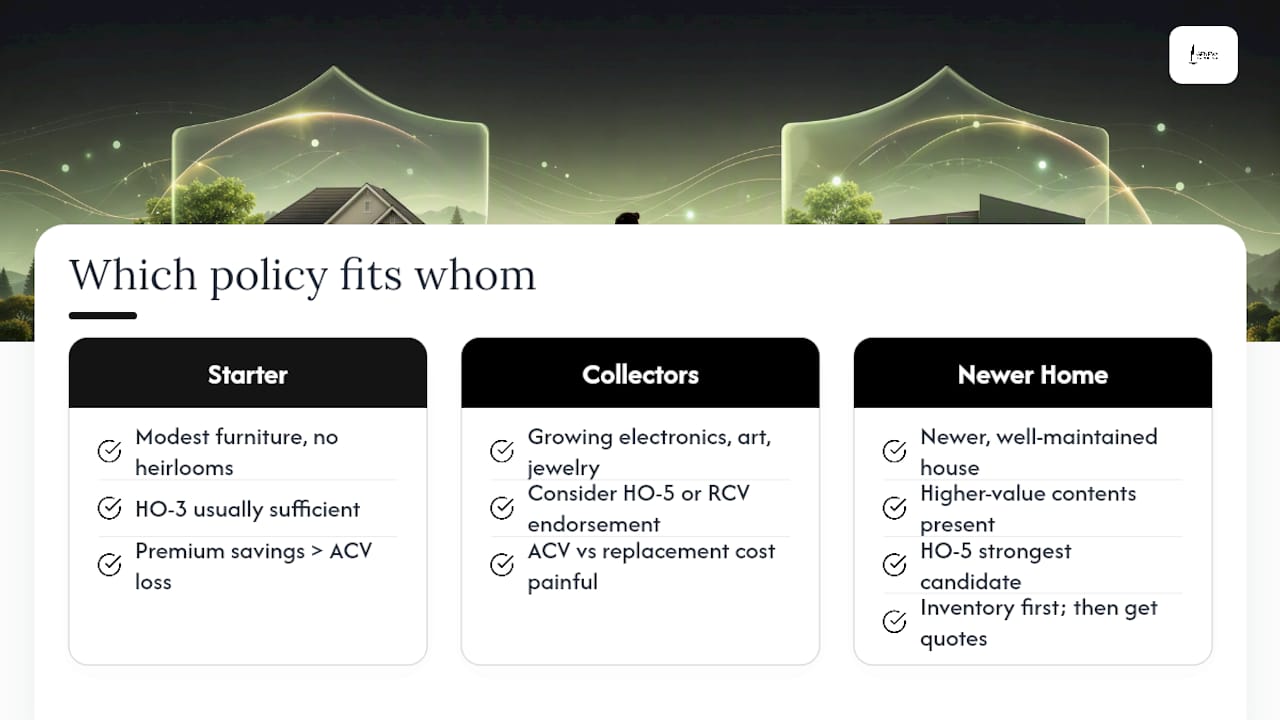
A homeowner with a growing collection of electronics, art, or family jewelry should price out an RCV endorsement or HO-5 seriously. The gap between ACV and replacement cost gets painful fast once real value is involved.
Someone in a newer, well-maintained home with higher-value contents is the clearest HO-5 candidate, assuming underwriting cooperates. Get an inventory done first, then request quotes for both forms before committing.
— David
Get a Fee-Free Policy Review Before You Switch Anything
You don't have to guess whether your current homeowners policy is pulling its weight. Genevainsgroup runs a fee-free policy review that lines up your existing coverage against more than 25 A-rated carriers, so you can see in plain language whether an HO-3 with an RCV endorsement or a full HO-5 policy actually fits your home and your budget.
The review covers the details that matter most: whether your personal property is settled at ACV or RCV, whether your sub-limits for valuables are realistic, and whether your current carrier even offers HO-5 for a home like yours. If you ever need to file a claim, Genevainsgroup stays involved as your advocate, translating adjuster language into terms you actually understand. For a broader look at how coverage should scale with home value, CompareSpot's insurance guides cover similar ground from a consumer perspective. Start your fee-free policy review today and find out exactly where your current policy stands.