

Compare quotes by normalizing coverage first, then judge price against carrier strength and claims experience. Insurance premiums for identical risks can swing 50% to 200% between carriers, so the cheapest number on your screen is meaningless until every quote describes the same policy. Match the coverage, then let price and reputation break the tie. If you'd rather skip the spreadsheet, a fee-free policy review does this work for you.
TL;DR:
- Normalizing coverage details like liability limits, deductibles, and settlement basis is essential to fairly compare insurance quotes, as prices vary widely for identical risks.
- Stress-testing policies by imagining specific claims reveals coverage weaknesses that may not be obvious from premium differences alone.
- Using multiple sources, including aggregators, direct insurer sites, and agents, broadens carrier exposure and improves the accuracy of quote comparisons.
- Verifying carrier strength through ratings and complaint indexes ensures you choose financially stable companies with good customer service, not just the lowest premium.
- Proper comparison requires about three days to a week, involving time to gather documents, normalize quotes, and evaluate claims handling, but independent reviews can shorten this process.
Table of Contents
- How to Compare Insurance Quotes: A Step-by-Step Checklist
- What to Gather Before You Get Quotes
- How to Normalize Quotes So the Comparison Is Fair
- How to Evaluate Carriers Beyond the Price Tag
- Common Traps and Red Flags When Comparing Quotes
- Where to Get Quotes: Aggregators, Insurer Sites, and Agents
- When to Shop for New Insurance Quotes
- How Geneva Insurance Group Runs a Fee-Free Policy Review
- What a Quote Doesn't Tell You: Fees, Taxes, and True Cost
- How Long It Takes to Compare Insurance Quotes Properly
- A Real Workflow: Gathering to Recommendation
- Let Genevainsgroup Handle the Comparison for You
- Where to Verify Carrier Strength and Complaint History
- Sources
How to Compare Insurance Quotes: A Step-by-Step Checklist
Most people compare insurance quotes by scanning a final number and picking the smallest one. That's how you end up underinsured after a claim. Here's the sequence that actually protects you.
- Pull your current declarations page. It lists your existing limits, deductibles, and endorsements, and it's the fastest way to give every new quote the same starting point.
- Collect 3 to 5 quotes from at least two sources. Run your details through two aggregators, then get one or two direct insurer quotes or a quote from an independent agent. Aggregators don't all pull from the same carrier networks, so relying on one alone leaves gaps.
- Normalize every quote. Match liability limits, deductibles, endorsements, policy term, and effective date before you look at price at all.
- Stress-test each option. Picture a specific claim, a kitchen fire, a rear-end collision with $8,000 in damage, a stolen laptop, and ask how each policy would actually pay out. This single exercise exposes weak coverage that a side-by-side premium comparison hides.
Once quotes are normalized and stress-tested, you're left with a real decision, not a guess.
- Pick the cheapest option only when coverage, deductibles, and carrier ratings are functionally identical across your final options.
- Pay more for a policy when it offers meaningfully better claims service, a stronger financial rating, or coverage the cheaper option excludes.
- Never pick on price alone if you can't get a written declarations page confirming what you're actually buying.
Pro Tip: Build a simple spreadsheet with one row per quote and one column per coverage line item. It takes ten minutes and it's the single best defense against comparing apples to oranges.
What to Gather Before You Get Quotes
Quotes are only as accurate as the information behind them. Insurers price risk based on specifics, and vague answers produce vague, unreliable numbers that change once underwriting digs in.
- Your current declarations page, which shows your existing limits, deductibles, and covered drivers or occupants.
- Vehicle details: VIN, make, model, and year for auto policies.
- Home details: square footage, year built, roof age, and a realistic replacement cost estimate, not market value.
- A list of household drivers, their license numbers, and any claims or violations in the past three to five years.
- Your current policy's effective and expiration dates, so new quotes align to the same term.
- Estimated annual mileage and, where your state allows it, awareness that credit-based insurance scores factor into pricing.
Pro Tip: Keep last year's renewal notice on hand too. Insurers sometimes bury a rate increase inside a renewal, and having last year's number makes any new quote easier to judge in context.
How to Normalize Quotes So the Comparison Is Fair
This is the step most people skip, and it's the one that decides whether your comparison means anything. Two quotes with a $400 difference can reflect two completely different products if the underlying terms don't match.
Start with liability and property limits. If one quote carries $100,000 in liability coverage and another carries $300,000, the cheaper one isn't actually cheaper, it's a different policy. The same logic applies to comprehensive and collision limits on auto policies and to dwelling coverage on home policies.
Deductibles need the same scrutiny, especially the ones insurers bury in the fine print. Wind, hail, and hurricane deductibles are often separate from your standard deductible and can run 1% to 5% of your dwelling coverage rather than a flat dollar amount. A quote that looks cheap can hide a $6,000 wind deductible where a competitor charges a flat $1,000.
Confirm the settlement basis too. Replacement cost coverage pays to rebuild or replace; actual cash value pays depreciated value, which can leave you thousands short after a loss. Finally, match policy term length and effective date before you annualize anything, comparing a six-month premium against a twelve-month premium without adjusting the math is a common, costly mistake.
| Line item | What to confirm matches |
|---|---|
| Liability limits | Same dollar amount across every quote |
| Deductibles | Standard deductible plus any wind/hail/hurricane deductible |
| Settlement basis | Replacement cost vs. actual cash value |
| Term length | Six months vs. twelve months, annualized consistently |
| Effective date | Same start date so nothing overlaps or lapses |
How to Evaluate Carriers Beyond the Price Tag
Price tells you what you'll pay. It tells you nothing about what happens when you file a claim, and that's the moment your policy actually matters.

Start with an AM Best rating, which measures an insurer's financial strength and ability to pay future claims. Carriers rated A or higher are generally considered strong; anything below B+ deserves a second look before you commit.
Next, check the NAIC complaint index, published by the National Association of Insurance Commissioners, which measures how many complaints a carrier receives relative to its size. A score above 1.0 means the company draws more complaints than the industry average for its market share.
J.D. Power also publishes annual claims satisfaction and customer satisfaction studies by region and product line, useful for gauging how a carrier actually treats customers after a loss, not just at the point of sale.
- Ask how claims are handled: local adjusters, an app-based claims process, or a national call center.
- Check whether the insurer maintains a preferred repair network in your area.
- Confirm the carrier is actually licensed to write policies in your state, not just quoting online.
- Understand your state's guaranty fund limits, which only provide partial protection if an insurer becomes insolvent.
Consumers routinely check AM Best and NAIC data as standard due diligence before choosing a carrier, and for good reason: a great price from a financially shaky insurer is a bet, not a bargain.
Common Traps and Red Flags When Comparing Quotes
A quote that's dramatically cheaper than the rest almost always means something was left out, not that you found a deal. Here's what to check before you sign anything.
| Red flag | What it usually means |
|---|---|
| Quote is 30%+ cheaper than others | Lower limits, higher hidden deductibles, or missing endorsements |
| No written declarations page offered | Verbal-only quote with nothing to verify later |
| Actual cash value instead of replacement cost | Payout will be depreciated, not full replacement |
| Discount mentioned but not itemized | Conditional discount that may not survive underwriting |
- Always request a written quote summary or declarations page before comparing, never rely on a phone call alone.
- If a discount seems too good to explain, ask the agent to confirm it in writing and describe exactly what qualifies you for it.
- Compare endorsements line by line; water backup, identity theft, and scheduled personal property are commonly excluded from bargain quotes.
Where to Get Quotes: Aggregators, Insurer Sites, and Agents
Each channel has a real strength and a real blind spot, which is why relying on just one leaves value on the table.
Aggregators are fast and convenient, and pulling from two different aggregators widens your carrier exposure since no single aggregator covers every insurer. Direct insurer quotes sometimes come in lower because the company isn't paying a referral fee to a lead-generation site. Independent agents and brokers can pull multiple in-market quotes at once and, critically, help you normalize coverage instead of leaving that work to you.
- Use two aggregators to establish a price range across the widest carrier pool available to you.
- Verify your top one or two options directly with the insurer to confirm the aggregator's numbers hold up.
- Bring your finalists to an independent agent, especially for home, umbrella, or business coverage where policy language gets complicated fast.
Pro Tip: Treat the aggregator stage as reconnaissance, not the finish line. It tells you the market range; an agent or direct quote confirms the real number.
When to Shop for New Insurance Quotes
Shop at least once a year, ideally three to four weeks before your renewal date, so you have time to switch without a coverage gap.
Re-shop immediately after: a move, a new vehicle, marriage or divorce, a significant credit score change, or a renewal notice showing a rate increase you weren't expecting. Any one of these can shift your risk profile enough to change your best-priced option, even if you were happy with your carrier last year.
How Geneva Insurance Group Runs a Fee-Free Policy Review
Doing this checklist yourself works, but it takes time most people don't have on a Saturday afternoon. Genevainsgroup built its fee-free policy review specifically to compress that process. Because Genevainsgroup compares coverage across numerous A-rated carriers instead of one company's book of business, the review reflects the actual market, not a single insurer's pricing.
Bring your current declarations page and any recent quotes you've already collected. Genevainsgroup uses those documents to establish your real baseline, then normalizes new options against it in plain language instead of policy jargon.
- Independent access to 25+ A-rated carriers means broader comparison than any single insurer can offer.
- Licensed in multiple states, with claims advocacy that continues after the policy is bound, not just at the sale.
- No fee for the review whether or not you switch carriers.
What a Quote Doesn't Tell You: Fees, Taxes, and True Cost
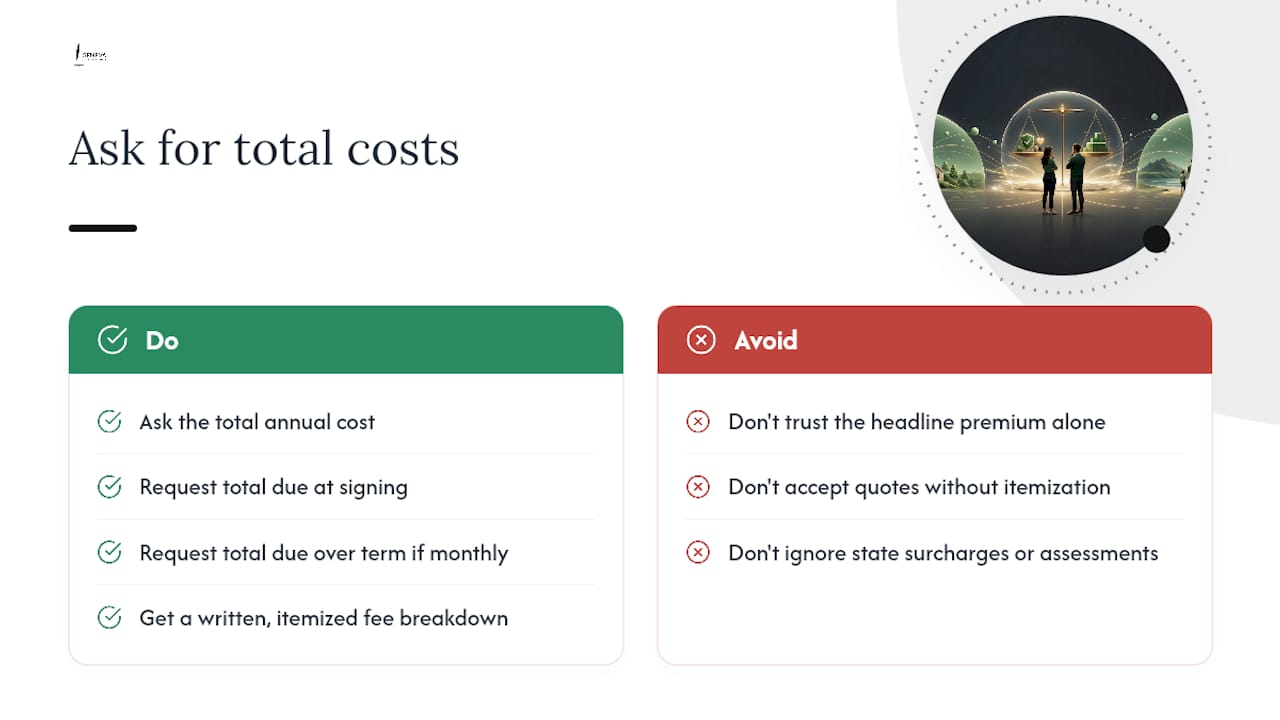
The premium on your screen is rarely the number you'll actually pay. Most states apply surplus lines taxes, policy fees, or installment fees on top of the base premium, and these vary by carrier and by payment plan.
Ask every insurer for the total annual cost, not just the premium, including any policy issuance fee, installment fees if you pay monthly instead of in full, and state-mandated surcharges. A carrier offering the lowest premium can end up costing more once a $150 annual policy fee and a $5 monthly installment charge are added in, while a competitor with a slightly higher premium but no installment fee comes out ahead.
Auto policies in some states also carry uninsured motorist fees or state fraud-prevention assessments baked into the total. Home policies may include a separate wind pool assessment in coastal states. None of these show up in the headline premium number aggregators display, which is exactly why the written quote summary matters more than the marketing number on the results page.
Before you commit, ask for the total due at signing, the total due over the full policy term if you pay monthly, and a breakdown of every fee by name. If an insurer won't itemize that breakdown in writing, treat it as a red flag on its own, alongside the pricing red flags covered earlier.
How Long It Takes to Compare Insurance Quotes Properly
Done right, expect to spend two to four hours spread across a few days, not one rushed evening.
Gathering your documents and details, declarations page, VIN or home specifics, driver history, takes about 30 minutes if you're organized. Running quotes through two aggregators adds another 20 to 30 minutes. Getting one or two direct insurer quotes or scheduling a call with an independent agent typically adds a day or two of turnaround time, since some quotes require a callback rather than an instant online number.
Normalizing and stress-testing your finalists is the part people underestimate, budget 45 minutes to an hour to actually line up limits, deductibles, and endorsements side by side and think through a real claim scenario for each. If you're using a printable comparison worksheet, this step goes faster because the fields are already structured for you.
Total elapsed time from start to a confident decision usually lands between three days and one week, mostly because of quote turnaround time from carriers and agents, not because the comparison work itself is slow. If you hand the process to an independent agency for a fee-free review, that timeline often compresses to a single appointment plus a follow-up call.
A Real Workflow: Gathering to Recommendation
A typical review starts the same way every time: pull the client's declarations page, confirm what's actually covered today, then normalize three to five new quotes against it line by line. One client's cheapest auto quote excluded rental reimbursement and carried a $2,500 collision deductible instead of $500, once matched, it wasn't cheaper at all. Another client's lowest home quote turned out to be the strongest option even after normalization, because the carrier's AM Best rating and claims process outperformed pricier competitors. Cheapest is sometimes right. It's just never automatic.
— David
Let Genevainsgroup Handle the Comparison for You
If the checklist above sounds thorough but time-consuming, that's because it is, and it's exactly the work Genevainsgroup does for free before you ever sign anything. Instead of juggling aggregator tabs and a spreadsheet, you hand over your declarations page and any quotes you've already gathered, and Genevainsgroup normalizes them against more than 25 A-rated carriers to show you what's actually comparable.
Bring your current declarations page, your most recent renewal notice, and any quotes you've collected so far. Genevainsgroup will walk through each line item in plain language, flag any coverage gaps your current policy has, and show you where a different carrier genuinely beats what you have, not just on price, but on claims service and financial strength too. Licensed across 17 states, Genevainsgroup provides ongoing claims advocacy after your policy is bound, not just at the point of sale.
If you're weighing a life insurance purchase alongside your other coverage, a life insurance calculator can help you size the right coverage amount before you request quotes. Ready to see where you actually stand? Start your fee-free policy review with Genevainsgroup today.
Where to Verify Carrier Strength and Complaint History
Use these resources alongside your own quote comparison to confirm the numbers hold up under scrutiny.
- AM Best: financial strength ratings that indicate an insurer's ability to pay future claims.
- NAIC Complaint Index: state-reported complaint data measured against a carrier's market share.
- J.D. Power: annual claims and customer satisfaction studies by region and product line.
- Your state insurance department's website, to confirm a carrier is licensed to write policies where you live.
- A printable insurance comparison worksheet, to line up quotes field by field before you decide.