

Choose whole life if you want a fixed premium, a guaranteed cash value schedule, and a death benefit that never moves. Choose indexed universal life (IUL) if you want index-linked growth potential, flexible premiums, and you're genuinely willing to monitor the policy every year.
Ask yourself three things before reading further:
- Time horizon: Are you funding this for 10 years or 40?
- Complexity tolerance: Do you want to check a policy statement, or ignore it entirely?
- Need for guarantees: Is certainty worth giving up upside?
The mechanics below, plus a checklist for questions to ask an agent, will tell you which side of that line you're on.
Key Takeaways
Whole life delivers guaranteed premiums and cash value while IUL trades that certainty for index-linked upside and ongoing management responsibility.
| Point | Details |
|---|---|
| Whole life suits certainty seekers | Fixed premiums, guaranteed cash value, and a death benefit that never adjusts. |
| IUL suits active managers | Index-linked upside comes with caps, spreads, and rising insurance costs to track. |
| Lapse risk sits with the owner in IUL | Underfunding plus rising cost of insurance drives higher lapse rates than whole life. |
| Stress-test every illustration | Review flat, modest, and strong crediting scenarios before trusting projected cash value. |
| Get a second opinion first | Geneva Insurance Group's fee-free policy review compares assumptions across 25+ carriers before you commit. |
Table of Contents
- IUL vs. Whole Life: How Indexed Universal Life Works
- What Is Whole Life Insurance and How Does It Work?
- What Are the Key Differences Between IUL and Whole Life?
- IUL Pros and Cons vs. Whole Life Pros and Cons
- How Do You Choose Between IUL and Whole Life?
- Geneva Insurance Group's Perspective on IUL vs. Whole Life
- Why the "Best" Policy Depends on Who's Answering
- Get a Second Opinion Before You Sign
- Sources
IUL vs. Whole Life: How Indexed Universal Life Works
Indexed universal life credits interest based on the performance of a market index, usually the S&P 500, but with strings attached. A cap limits your maximum gain. A participation rate determines what percentage of the index's move you actually get. A spread is a fee subtracted before crediting happens. Most contracts include a 0% floor, so a bad market year can't push your cash value below zero from index losses, though that floor does nothing to stop rising internal costs from eating into your balance.
Premiums are flexible, which sounds appealing until you realize the cost of insurance climbs every year as you age. Underfund the policy in your 50s or 60s and that rising cost can outpace your cash value fast.
- Typical fees: premium loads, per-unit charges, cost of insurance, rider costs
- Riders: accelerated death benefit, waiver of premium, long-term care
- Loans and withdrawals reduce cash value and death benefit if not repaid
- Requires annual review of crediting rates and cost of insurance charges
Pro Tip: Ask your agent to show you a year with a flat index return, not just a strong one. A policy that only works in good years isn't a plan, it's a bet.
What Is Whole Life Insurance and How Does It Work?
Whole life insurance runs on guarantees. You pay a level premium that never increases, you get a guaranteed cash value schedule you can read off a table on day one, and your beneficiaries get a guaranteed death benefit. Participating whole life policies may also pay dividends, which aren't guaranteed but have a long track record with established mutual carriers.
Cash value builds slowly in the early years since a chunk of your premium covers the cost of insurance and commissions upfront. It becomes meaningful over a decade or more, which is precisely why people use whole life for legacy planning or infinite-banking style strategies that depend on predictable, loanable value.
- Premiums: fixed for life, never adjust with age or health changes
- Cash value: grows on a guaranteed schedule, sometimes boosted by dividends
- Best fit: certainty-driven goals like estate transfer or a reliable lending source
- Trade-off: higher initial cost and generally less upside than index-linked designs
Because the policy endows at a specified advanced age, often 120, the insurer can calculate guaranteed values precisely from the start. That structural certainty is the whole point.
What Are the Key Differences Between IUL and Whole Life?
The difference between IUL and whole life boils down to one question: who's holding the risk? Whole life keeps it with the insurance company. IUL passes a meaningful share of it to you.
- Premium predictability. Whole life premiums are fixed for life. IUL premiums are flexible, but "flexible" cuts both ways: underfunding the policy shifts more of the cost of insurance onto your existing cash value.
- Cash value reliability. Whole life cash value follows a guaranteed table. IUL cash value depends on the index's performance, filtered through your cap, participation rate, and spread, meaning your actual credited return is almost always less than the index's headline gain.
- Death benefit structure. Whole life's death benefit is guaranteed and fixed (unless you add riders). IUL death benefits can grow with strong crediting years, but they can also shrink or lapse if cash value gets drained by rising costs.
- Costs and fees. Whole life bakes its costs into a level premium you never have to think about again. IUL's cost of insurance rises with age every year, and that increase runs quietly in the background of a policy that looks simple on the illustration page.
- Lapse risk. This is the sharpest contrast. Whole life essentially can't lapse if you keep paying the fixed premium. IUL policies lapse at meaningfully higher rates than whole life, largely because owners underfund them or misjudge how fast internal costs climb.
The core practical difference is that whole life places long-term delivery risk with the insurer, while IUL shifts more of that risk to you through adjustable caps, participation rates, and rising insurance costs. A 0% floor sounds like protection, and it is, against negative index crediting. It does nothing to stop your cash value from declining when the cost of insurance outpaces what the index credits you.
IUL Pros and Cons vs. Whole Life Pros and Cons
IUL pros: upside tied to index performance, tax-deferred cash value growth, premium flexibility for changing budgets.

IUL cons: caps and spreads cap your real return, fees run higher than most buyers expect, and the policy demands active monitoring to avoid a lapse.
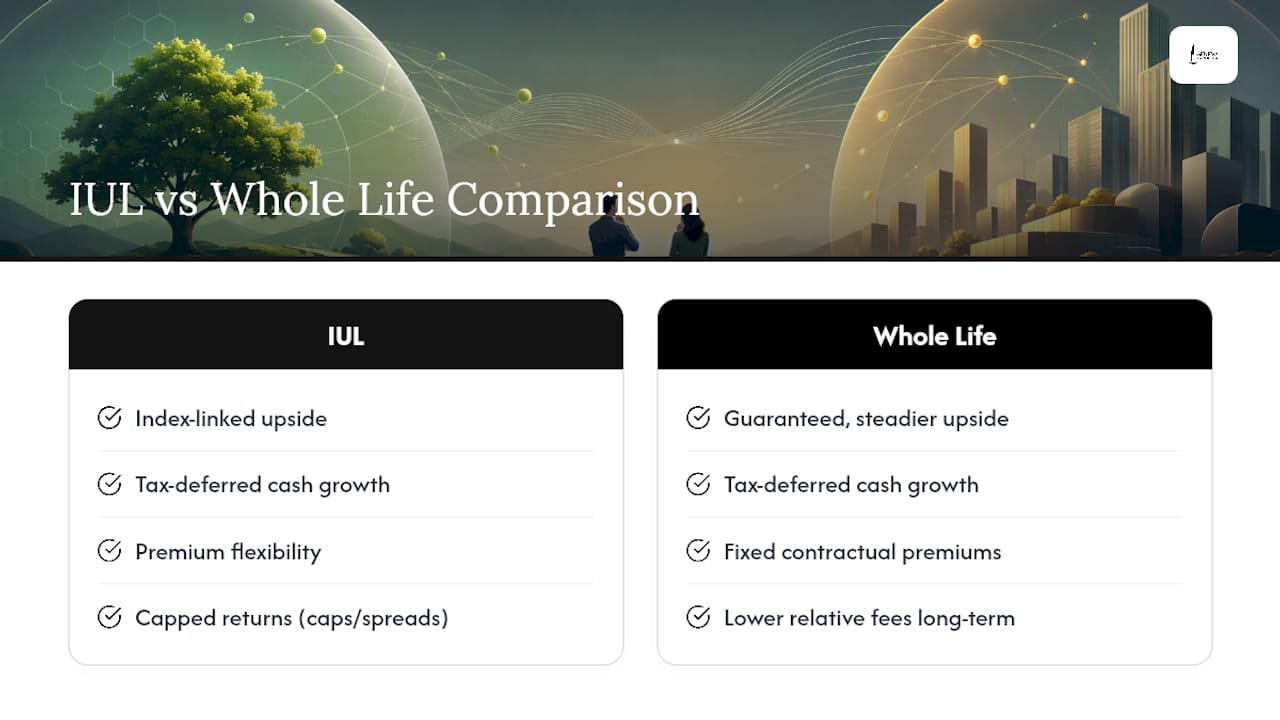
Whole life pros: contractual guarantees on premium, cash value, and death benefit; dividends add upside without adding risk.
Whole life cons: higher cost in the early years, and a growth ceiling that will never match a strong market cycle.
One number should make anyone pause before signing an IUL illustration: universal life policies overall lapse at a higher rate than whole life, usually because rising insurance costs outpace cash value that was never funded aggressively enough to keep up. Illustrations often show optimistic crediting scenarios, so stress-test any projection against a flat-return year before you trust it.
How Do You Choose Between IUL and Whole Life?
Work through this before you sign anything:
- Set your budget and time horizon. A 20-year commitment with tight cash flow points toward whole life's predictability. A 40-year horizon with room to overfund in good years leaves space for IUL's upside.
- Define the purpose. Death benefit certainty for a family or business partner favors whole life. Supplemental cash accumulation with growth potential leans toward IUL, though a 401(k) or IRA often offers broader investment choice for retirement savings at lower cost.
- Check your risk tolerance. If a bad market year would make you lose sleep over your policy's health, that's a sign you want guarantees.
- Interrogate the illustration. Ask exactly what index, cap, participation rate, and spread the policy assumes, and how the cost of insurance is projected to rise.
- Watch for red flags. High assumed crediting rates with no flat-year scenario, vague fee disclosures, or early cash value projections that don't match your actual funding level are all signs to walk away or ask harder questions.
Pro Tip: Bring the illustration to a second, independent set of eyes before you sign. A fee-free policy review can catch an unrealistic crediting assumption that the original agent's own illustration software won't flag.
Geneva Insurance Group's Perspective on IUL vs. Whole Life
Geneva Insurance Group compares options across 25+ A-rated carriers and holds licenses in 17 states, which means we can put a whole life illustration next to an IUL illustration from a different carrier and show you the real gap. Our fee-free policy review checks the assumed index, cap history, participation rate, and cost of insurance trajectory before you fund anything, and our claims advocacy continues after the sale, not just at signing.
Why the "Best" Policy Depends on Who's Answering
Most comparisons treat this like a math problem, as if the answer lives in a spreadsheet of projected crediting rates. It doesn't. The honest answer depends on whether you actually want a second financial variable to manage for the next 30 years.
I think the industry undersells how much IUL asks of the owner. It's marketed as a growth vehicle, and it can be one, but the fine print puts the burden of tracking cost of insurance increases, cap changes, and funding adequacy squarely on you. Whole life asks nothing of you after the first signature. That's not a knock on IUL. It's a fair trade for people who want the upside and are willing to do the homework. But too many buyers get sold the upside story without ever hearing the monitoring obligation that comes attached to it.
If you want my honest read: whole life is the default for anyone who values sleep over spreadsheets. IUL earns its place only when the buyer has the discipline and financial cushion to fund it properly through a flat decade, not just a good one.
— David
Get a Second Opinion Before You Sign
You've seen the mechanics behind both policies, but the real test happens when you're staring at an actual illustration with someone else's assumptions baked in. Geneva Insurance Group runs a fee-free policy review that puts your IUL or whole life illustration side by side with alternatives from more than 25 A-rated carriers, checking the crediting assumptions, cap history, and cost of insurance projections most buyers never think to question.

If you're weighing a new policy or want a second opinion on one an agent already handed you, start a fee-free policy review with Geneva Insurance Group and get a plain-language breakdown of what you're actually buying before you sign anything.
This article is general information, not a substitute for advice from a qualified financial advisor. Consult a qualified financial professional about your own circumstances before acting on anything here.
Sources
- Indexed Universal Life vs. Whole Life Insurance
- IUL vs. Whole Life Insurance: Who Carries the Risk? | The Money Advantage