

Key person insurance is a policy your business owns on the life or health of a critical employee, one whose death or disability would put real revenue, loans, or client relationships at risk. It pays a cash benefit directly to the business, not to the employee's family, giving you money to cover lost income, recruit a replacement, or fund a buyout while the company stabilizes. Any business with revenue concentrated in one or two people, or a lender demanding proof of continuity, should take a serious look.
TL;DR:
- Key person insurance is most valuable if a critical employee's departure would cause significant revenue loss or disrupt client relationships.
- Policies should be sized based on revenue contribution, replacement costs, or salary multiples tailored to the individual's role.
- Insurance payouts are for the business's benefit, funding succession, buyouts, or loan repayment, and not for the employee's family.
- Premiums for key person insurance are generally not tax-deductible, but death benefits are usually tax-free when paid to the business.
- Regular review and proper documentation are essential to ensure coverage stays aligned with the company's changing needs.
Table of Contents
- What Is Key Person Insurance and Who Qualifies as a Key Person?
- How the Policy Works: Ownership, Consent, and Payouts
- Term vs. Permanent Policies and How Much Coverage to Buy
- When Key Person Insurance Actually Pays Off
- Cost Drivers and What the IRS Says About Taxes
- How to Choose and Set Up Key Person Coverage
- How an Independent Agency Like Geneva Insurance Group Helps
- Where Key Person Insurance Falls Short
- Key Person Insurance vs. Other Business Protection Strategies
- The Right Way to Think About This Coverage
- Get a Fee-Free Policy Review from Geneva Insurance Group
- Sources
- FAQ
What Is Key Person Insurance and Who Qualifies as a Key Person?
You'll also see this called key man insurance or key person life insurance, older terms that mean the same thing. It's simply a life or disability policy the business buys, owns, and pays for, with itself named as the beneficiary.
Not every employee qualifies. A key person is someone whose absence would visibly hurt the bottom line, not just someone with a fancy title. Practical criteria include:
- Revenue dependency: does this person directly drive a large share of sales or client retention?
- Specialized skill: could you replace their technical knowledge quickly, or would it take months?
- Client relationships: do customers stay because of that person specifically?
- Loan guarantor status: did a lender require this person's personal guarantee?
A small firm's founding partner, a manufacturer's certified welder, or a startup's technical cofounder are all typical candidates.
How the Policy Works: Ownership, Consent, and Payouts
The business, not the employee, owns the policy and pays every premium. That structure matters because it determines who controls the policy and who collects if something happens.
- The company applies for coverage and is named the policy owner and beneficiary.
- The insured employee must give written consent before the insurer will issue coverage, since a business can't secretly insure someone's life without their knowledge.
- If the insured dies or becomes disabled, according to the policy terms, the death benefit or disability payout goes to the business, not to the employee's spouse or estate.
- The business then decides how to deploy that cash, hiring and training a replacement, repaying a loan tied to that person, funding a partner buyout, or simply covering the operating losses while things get sorted out.
That last point trips people up. Employees sometimes assume a company policy on their life benefits their own family the way a personal policy would. It doesn't. The whole point is protecting the business, and insurers require the insured's written consent precisely because the money flows to the employer, not the employee's heirs.
Term vs. Permanent Policies and How Much Coverage to Buy
Term policies cost less upfront and cover a fixed period, usually 10, 20, or 30 years, which fits most small businesses since the "key person risk" often shrinks as the company grows or the role gets backfilled. Permanent policies cost more but build cash value the business can borrow against later, useful if you want the policy to double as a long-term asset rather than pure risk coverage.
- Term: Lower premiums, no cash value, straightforward protection for a defined window.
- Permanent: Higher premiums, builds tax-deferred cash value, works well when the key person is likely to stay for decades.
- Disability or critical-illness riders: Add these when incapacity, not just death, would disrupt the business. A surgeon who suffers a stroke or an executive sidelined by cancer treatment still can't work, and a death-only policy pays nothing in that scenario.
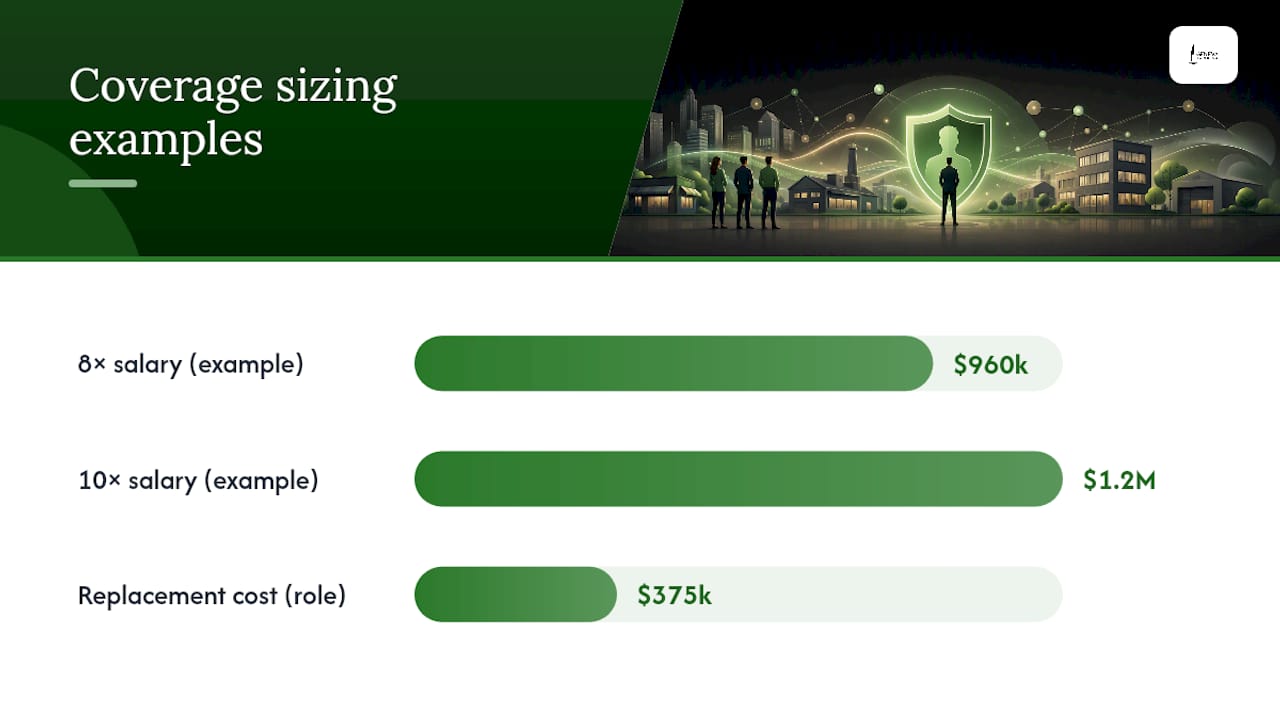
For sizing, three approaches cover most situations. The 8 to 10 times salary rule is quick: a key employee earning $120,000 might justify $960,000 to $1.2 million in coverage. The revenue-attributable method ties coverage to the dollar amount of business that person directly generates. The replacement-cost approach adds up recruiting fees, signing bonuses, and lost productivity during a transition, often landing between $250,000 and $500,000 for a specialized technical role.
Pro Tip: Don't default to the salary multiple just because it's easiest. A $70,000-salary engineer who's the only person who understands your core product can justify far more coverage than 10 times her paycheck suggests.
When Key Person Insurance Actually Pays Off
Coverage earns its premium in a handful of recurring situations, and it's worth checking your business against each one honestly.
- Buy-sell funding: Two partners agree that if one dies, the other buys out their share. A key person policy provides the cash to do that without draining working capital or forcing a fire sale.
- Lender collateral: Banks financing a small business often require key person coverage as a condition of the loan, especially when the loan was underwritten based partly on one founder's track record.
- Concentrated revenue: If one salesperson or rainmaker accounts for 30% or more of annual revenue, losing them overnight is a solvency event, not just a staffing problem.
- Client relationship risk: Professional services firms, agencies, and consultancies often lose accounts when the person clients trust leaves. The payout buys time to transition relationships gracefully instead of losing accounts outright.
Cost Drivers and What the IRS Says About Taxes
Premiums come down to five variables: the insured's age, health, occupation, the policy type, and the coverage amount. A healthy 40 year old executive will pay far less than a 58 year old with a cardiac history for the same face amount, and term coverage runs substantially cheaper than permanent coverage for the same death benefit, since permanent policies fund a savings component alongside the insurance.
Tax snapshot: Premiums are generally not tax-deductible when the business is the policy's beneficiary, since the IRS treats this as buying an asset, not an ordinary business expense. The upside: the death benefit is usually received income tax-free by the business, and cash value in a permanent policy grows tax-deferred. For anything specific to your situation, check current IRS guidance or talk with a tax advisor, since exceptions can apply depending on how the policy is structured.
How to Choose and Set Up Key Person Coverage
Buying the policy is the easy part. Getting it right takes a sequence.
- Identify the candidates. List employees whose loss would meaningfully hurt revenue, and estimate the financial impact: lost sales, replacement and training costs, and any loan exposure tied to them.
- Pick a sizing method. Use the salary multiple, revenue-attributable, or replacement-cost approach, whichever best fits how that person's value shows up in your numbers.
- Shop multiple carriers. Pricing and underwriting standards vary more than most owners expect, especially for applicants with health conditions or high-risk occupations.
- Get written consent. The insured must sign off before underwriting begins, and most carriers will require a medical exam depending on the coverage amount.
- Tie the policy to existing agreements. If you have a buy-sell agreement or a loan covenant, make sure the policy's beneficiary designation and payout terms actually satisfy those documents. A mismatch here is one of the most common and costly mistakes.
- Document everything. Keep signed consent forms, the buy-sell agreement, loan documents, and beneficiary designations together, since lenders and future buyers will ask for them.
- Schedule a review. Revisit coverage annually or whenever compensation, ownership, or role changes, and loop in your tax and legal advisors when anything shifts materially.
Pro Tip: Set a calendar reminder tied to your annual budget review, not a random date. Coverage that made sense at $80,000 salary looks thin after two years of raises and expanded responsibility.
How an Independent Agency Like Geneva Insurance Group Helps
Comparing carriers matters here more than in most insurance categories, because underwriting standards for key person coverage vary widely by insurer. Geneva Insurance Group compares policies across more than 25 A-rated carriers to find competitive pricing and terms that fit your specific risk. The agency's fee-free policy reviews help identify gaps between what you have and what your buy-sell agreement or lender actually requires, explained in plain language rather than policy jargon. Geneva also provides claims advocacy if you ever need to file, and coverage availability depends on where your business operates.
Where Key Person Insurance Falls Short
No policy solves every continuity problem, and a few real limitations deserve attention before you buy.
The payout is a lump sum, not a plan. Money alone doesn't tell your team who takes over a key account or how decisions get made during the transition. Businesses that buy coverage and stop there often discover the cash arrives with no operational plan attached to spend it wisely.
Underwriting can also exclude the exact risk you're worried about. Older key employees or those with existing health conditions may face higher premiums, exclusions, or in some cases outright denial, which is a real problem since the people most critical to a business are often the ones who've been there the longest and are past their 30s and 40s.
Coverage amounts can also fall behind reality. A policy sized for a $90,000 salary three years ago may badly undershoot the actual cost of losing that person today, especially if the business has grown or that role expanded. Without a review cadence, the gap between coverage and need widens quietly.
Finally, key person insurance addresses financial loss, not knowledge loss. It won't recreate a founder's institutional memory, a salesperson's personal relationships, or an engineer's undocumented technical knowledge. Cross-training and documentation address those risks better than any insurance product can, and pairing the two is usually smarter than relying on either alone.
Key Person Insurance vs. Other Business Protection Strategies
Insurance is one tool among several, and it's worth weighing against the alternatives rather than assuming it's the default answer.
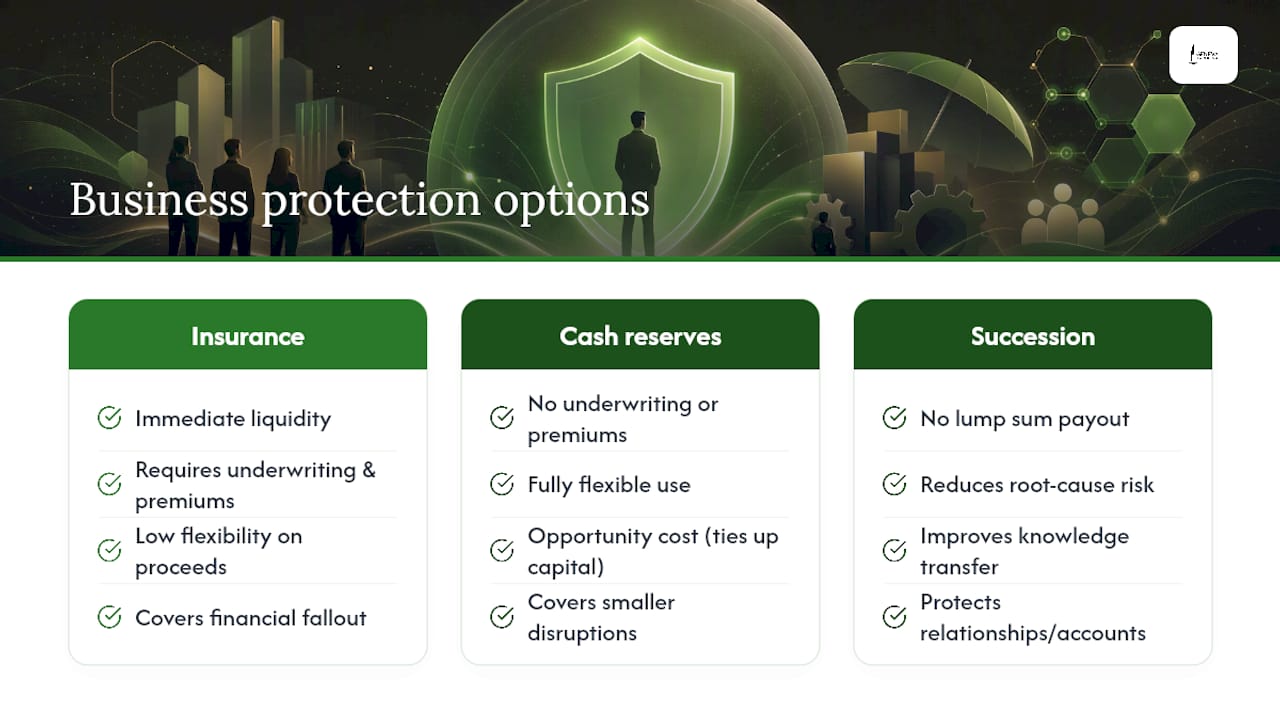
Cash reserves offer more flexibility since there's no underwriting, no premium, and no restriction on how the money gets used. The tradeoff is opportunity cost: capital sitting in reserve isn't funding growth, and building a reserve large enough to replace a key person can take years that insurance covers instantly.
Succession planning and cross-training reduce the actual risk instead of just funding the fallout. Documenting processes, training a second person on critical client accounts, and building bench strength lowers how catastrophic a departure would be in the first place. This is slower to implement and doesn't produce a lump sum, but it addresses root cause rather than symptom.
Buy-sell agreements funded by key person or cross-purchase life insurance work alongside coverage rather than replacing it, giving partners a predetermined, funded mechanism for ownership transfer instead of scrambling to negotiate terms after a death or disability.
Most small businesses land on a combination: insurance for the immediate liquidity need, reserves for smaller disruptions, and succession planning for the knowledge and relationship risk insurance can't touch.
The Right Way to Think About This Coverage
Insurance buys you time and liquidity. It doesn't replace the harder work of succession planning, and treating it as a complete solution is a mistake I see often. Prioritize coverage when revenue is genuinely concentrated in one person, when a lender requires it as loan collateral, or when replacing that person would take real money and months, not weeks. If your team is cross-trained and your cash reserves could absorb six months without that person, a smaller policy, or none at all, may be the more rational call. The goal is matching the tool to the actual risk, not buying coverage because it feels responsible.
— David
Get a Fee-Free Policy Review from Geneva Insurance Group
If you've read this far, you already know coverage needs to match your specific risk, not a generic template. Geneva Insurance Group compares your options across 25-plus A-rated carriers and walks you through the results in plain language, so you understand exactly what you're buying and why.
Start with a fee-free policy review: Geneva looks at whatever coverage you already have, flags gaps against your buy-sell agreement or lender requirements, and lays out real options at no cost to you. There's no obligation attached to the review itself, and if you decide to move forward, Geneva's team helps you get quotes from multiple carriers instead of settling for the first one that responds. Request your policy review or a quote directly through the Geneva Insurance Group site to get started.
This article is general information, not a substitute for advice from a qualified financial advisor. Consult a qualified financial professional about your own circumstances before acting on anything here.
Sources
- Key Person Life Insurance: Definition, Cost And Tax Treatment — Forbes Advisor
- Key Person Insurance: Definition, Cost, Types, and How It Works — Investopedia
FAQ
What is meant by key person insurance?
It's a life or disability policy a business owns and pays for on a critical employee, with the company as beneficiary, designed to cover financial losses if that person dies or becomes disabled.
What is key person insurance intended for?
It's intended to give a business immediate cash to replace lost revenue, fund a buyout, repay a loan, or cover recruiting and training costs after losing a critical employee.
Is key person insurance worth it?
It's worth it when revenue is concentrated in one or two people, a lender requires it as collateral, or replacing that person would take significant time and money; a fee-free policy review can help you decide if your situation qualifies.
Who benefits from key person insurance?
The business itself benefits directly, since it owns the policy and receives the payout; employees, partners, and lenders benefit indirectly because the payout helps stabilize operations and protect their stake in the company.
Are key person insurance premiums tax-deductible?
Generally no. Premiums are typically not tax-deductible when the business is the beneficiary, though the death benefit is usually received tax-free by the company.