

Laddering life insurance means holding several term policies with different expiration dates instead of one large policy, so your coverage shrinks as your obligations do. It works best for people with predictable, front-loaded needs like a mortgage or kids heading to college, and it often costs less than a single long policy sized for your peak need. The catch: it assumes you can still qualify for insurance later, so locking in conversion rights matters. If that description fits you, run quotes on a few term lengths or request a fee-free policy review before your next birthday pushes your rates up.
TL;DR:
- Laddering life insurance can save up to 20-30% in premiums compared to a single long-term policy by matching coverage lengths to declining obligations.
- Shorter-term policies cost less per dollar of coverage than a single policy covering the same period, especially as needs taper off.
- Insurability risks increase if health declines before a rung expires, making conversion riders critical for flexibility and future coverage options.
- Building an effective ladder requires mapping specific obligations to appropriate term lengths and locking in conversion rights on the most vulnerable layer.
- A fee-free policy review from an independent agency can help optimize coverage, identify gaps, and ensure the ladder aligns with your actual needs.
Table of Contents
- What Laddering Life Insurance Actually Means
- Real Numbers: What a Ladder Actually Saves You
- Why Laddering Life Insurance Saves Money and Fits Real Life
- Where Laddering Life Insurance Can Backfire
- How to Build a Ladder That Fits Your Timeline
- Laddering vs. One Long Policy vs. Adding Permanent Coverage
- How Geneva Insurance Group Helps You Get the Ladder Right
- The Bottom Line on Laddering Life Insurance
- What the Data Actually Tells You to Do First
- Get Help Building Your Ladder the Right Way
- Sources
What Laddering Life Insurance Actually Means
Picture three ladder rungs, each one a separate term policy. The bottom rung covers you for 30 years at a smaller amount. The middle rung runs 20 years at a bigger face value. The top rung lasts just 10 years, sized to cover your biggest short-term obligation, like the last stretch of a mortgage or a kid's remaining years before college graduation. As each term expires, that layer of coverage disappears, and so does its premium.
Term policies are almost always the vehicle for this, not permanent insurance, because laddering relies on buying multiple term policies with different coverage amounts and lengths that phase out as needs decline. Whole life and universal life policies are built to last a lifetime and don't shrink on a schedule, so they don't fit the strategy the same way.
A common structure looks like this:
- A 30-year term for baseline income replacement through your working years
- A 20-year term layered on top to cover the mortgage or major debt
- A 10-year term for a short, specific gap, like the final years before a pension or paid-off house kicks in
Each rung is underwritten separately, so your health and age at the time of purchase determine the rate for that layer, not your age when a later rung starts.
Real Numbers: What a Ladder Actually Saves You
Here's where the math gets interesting. A single 30-year, $750,000 term policy prices every dollar of coverage at the 30-year rate, even the portion you only need for 10 years. A ladder prices each chunk at the rate that matches how long you'll actually carry it, and shorter terms cost less per thousand dollars of coverage.
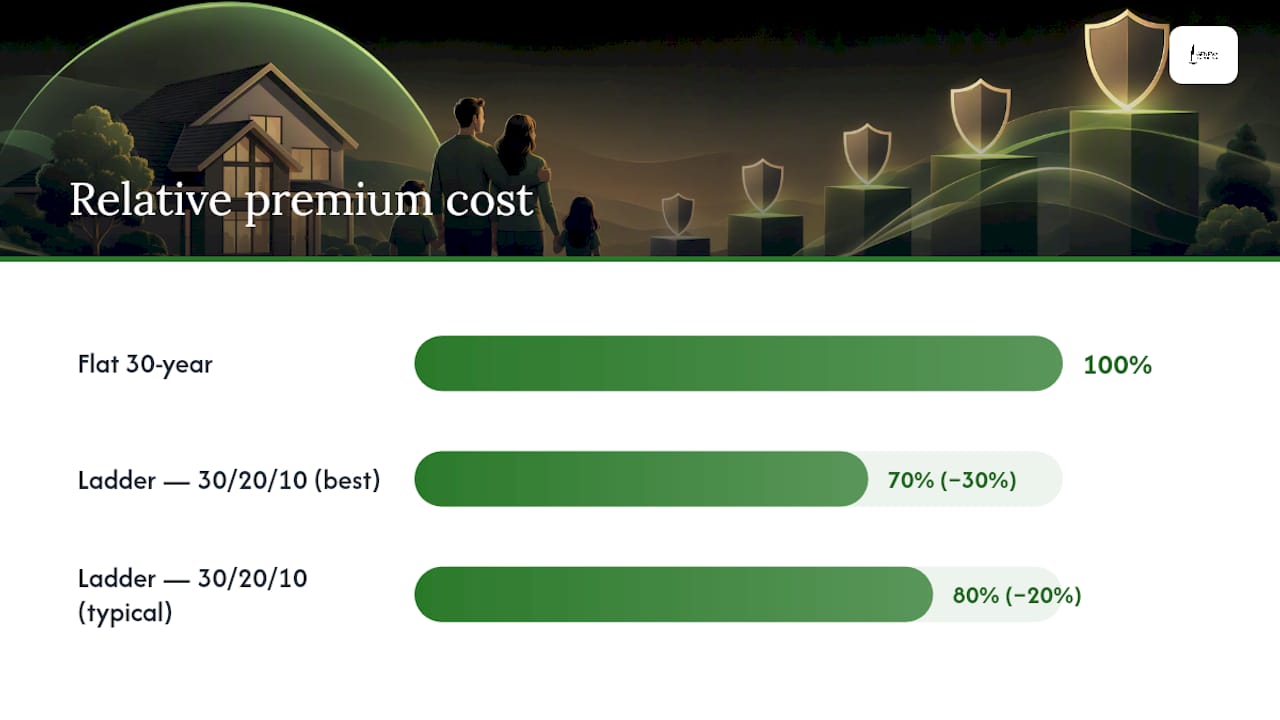
Statistic: Industry examples show a 30/20/10 split can run 20% to 30% cheaper in total premiums than one 30-year policy sized to match the same peak coverage.
Two scenarios show how this plays out:
- A 35-year-old with a $750,000 need. Instead of one 30-year policy at $750,000, they split it: $250,000 for 30 years (income replacement), $250,000 for 20 years (mortgage payoff), and $250,000 for 10 years (until a spouse's retirement account matures). The blended premium across all three tends to run noticeably below what a flat $750,000, 30-year policy would cost, because two of the three layers drop off relatively early.
- A single-earner household with a mortgage and two young kids. They need heavy coverage now, through the mortgage term and until the kids finish college, then much less afterward. A ladder might pair a 25-year term matched to the mortgage with a 15-year term matched to the older child's college timeline, letting both taper off instead of paying peak rates for decades past the point they're needed.
Both examples assume good health at issue age and, importantly, that you stay insurable when each rung lapses. If your health changes for the worse before a shorter rung expires and you need to replace that coverage, you may not qualify for a new policy at a reasonable rate, or at all. That's the tradeoff sitting underneath every savings estimate.
Why Laddering Life Insurance Saves Money and Fits Real Life
Term insurance costs a fraction of whole life or universal life for the same death benefit, because you're renting coverage for a set period instead of building a permanent, cash value asset. Laddering takes that gap further by making sure you're never paying a 30-year premium rate for coverage you only need for 10 years.
The logic is simple: your financial obligations don't stay flat. A mortgage balance shrinks. Kids graduate. Income replacement needs drop once a spouse's retirement savings mature. Matching your death benefit to that declining curve means less wasted premium every year.
- Term premiums run far below permanent policy premiums for equivalent coverage
- Shorter rungs cost less per dollar of coverage than one long policy sized to your peak need
- Letting a layer expire on schedule avoids paying for protection you no longer need
- Conversion options let you turn a term rung into permanent coverage later without new medical underwriting
Pro Tip: Buy conversion riders on your longest rung specifically, since that's the layer most likely to still be active if your health changes years from now.
Where Laddering Life Insurance Can Backfire
The biggest risk isn't cost. It's insurability. Laddering works best for people with clearly defined, predictable obligations, and it's less suitable when future needs are uncertain, because the entire strategy assumes you can adjust or replace coverage later if circumstances shift. If a health diagnosis lands between rungs, you could be stuck with a gap you can't fill affordably.
Conversion riders exist precisely for this reason. Insurers commonly let you convert a term policy to permanent coverage without new underwriting, which hedges against the scenario where your health declines and a rung is about to expire.
Watch for these pitfalls when building a ladder:
- Return-of-premium riders. These typically raise premiums by 50% to 70% and rarely beat simply investing the difference yourself.
- Skipping the waiver of premium rider. This keeps your policy active if you become disabled and can't pay premiums, a real gap for anyone without strong disability coverage elsewhere.
- Ignoring the accelerated death benefit rider. Many policies include this at no extra cost, letting you access part of the death benefit early if diagnosed with a terminal illness.
- Career instability. If you're switching jobs, going self-employed, or expecting income to swing wildly, a rigid ladder tied to today's obligations may not flex well.
How to Build a Ladder That Fits Your Timeline
Building a ladder is a math exercise, not a guessing game. Work through it in order.
- Map your obligations against a timeline. List every major financial commitment and when it ends: mortgage payoff date, years until kids finish college, and how many years of income replacement your family would need if you weren't earning.
- Calculate your total death benefit need, then split it. Add up what each obligation would cost to cover, and assign each chunk to a rung with a term length matching that specific end date rather than a random round number.
- Choose term lengths and amounts you can actually afford. Compare policies with and without conversion options, since the conversion right typically adds a modest premium bump but preserves flexibility if your health changes.
- Get quotes from multiple carriers, lock in your longest or largest rung while healthy, and revisit the plan yearly. Life changes, and so should your coverage.
Pro Tip: Lock the rung tied to your least predictable risk first. If you have a family history of a specific illness, that's the layer worth overinsuring against gaps.
Laddering vs. One Long Policy vs. Adding Permanent Coverage
A single 30-year term is simpler to manage, but it means paying a flat premium for coverage you'll eventually outgrow. A ladder trades that simplicity for a lower blended cost, at the price of tracking multiple policies and renewal dates.
Adding a permanent policy, whole life or universal life, changes the math entirely because it builds cash value and never expires as long as premiums are paid.
- Single long-term policy: flat premium for the full term, simplest to manage, but overpays for coverage in the later years once obligations shrink
- Laddered term policies: lower blended premium overall, but requires tracking several renewal and conversion dates
- Permanent policy layer: premiums run several times higher than term for the same face value, but provides lifetime coverage and cash value, useful for estate planning or a guaranteed final-expense benefit
- Best fit for a permanent base: anyone who wants a guaranteed piece of coverage regardless of future health, on top of term rungs for the bulk of temporary needs
Most households with a mortgage, dependents, and a defined working timeline lean toward laddering. Those focused on estate planning or leaving a guaranteed payout regardless of when death occurs tend to add at least one permanent policy underneath their term rungs.
How Geneva Insurance Group Helps You Get the Ladder Right
A fee-free policy review from Geneva Insurance Group starts by looking at what you already have, then compares it against options from more than 25 A-rated carriers to spot gaps your current setup might be missing. Everything gets explained in plain language, not the fine print most people skim past.
DIY quote comparisons work fine for straightforward situations. But once you're juggling multiple obligations, uncertain future insurability, or riders that actually matter to your situation, an independent agent who isn't tied to a single carrier can catch tradeoffs a quote engine won't flag, like which rung deserves a conversion rider and which one doesn't need it.
David has spent years helping clients untangle exactly these kinds of layered coverage decisions, and this guide reflects that hands-on approach to matching policies to real timelines rather than generic advice.
The Bottom Line on Laddering Life Insurance
Laddering fits anyone with a mortgage, dependents, or a defined working timeline who wants coverage that shrinks along with their obligations instead of staying flat for decades. It doesn't fit well if your future income or health is genuinely unpredictable.
Three moves to make now: get quotes on two or three term lengths matched to your actual timeline, ask about conversion riders on your longest rung, and schedule a fee-free policy review to confirm you're not overpaying or leaving a gap.
What the Data Actually Tells You to Do First
That's the piece conventional advice underweights. A ladder built without conversion rights on at least one layer isn't a savings strategy. It's a bet that your health holds steady for decades, and nobody can promise that.
The other thing overrated in most guides is precision. People agonize over splitting coverage into the perfect three or four rungs when the bigger win is just getting off a single oversized policy and onto any structure that matches your real timeline. A rough two-rung ladder built this year beats a perfect four-rung plan you never get around to buying.
Prioritize this order: lock your longest or highest-risk rung first, secure conversion rights on it, then optimize the shorter layers once the foundation is set. Get the foundation wrong and the savings math becomes irrelevant.
— David
Get Help Building Your Ladder the Right Way
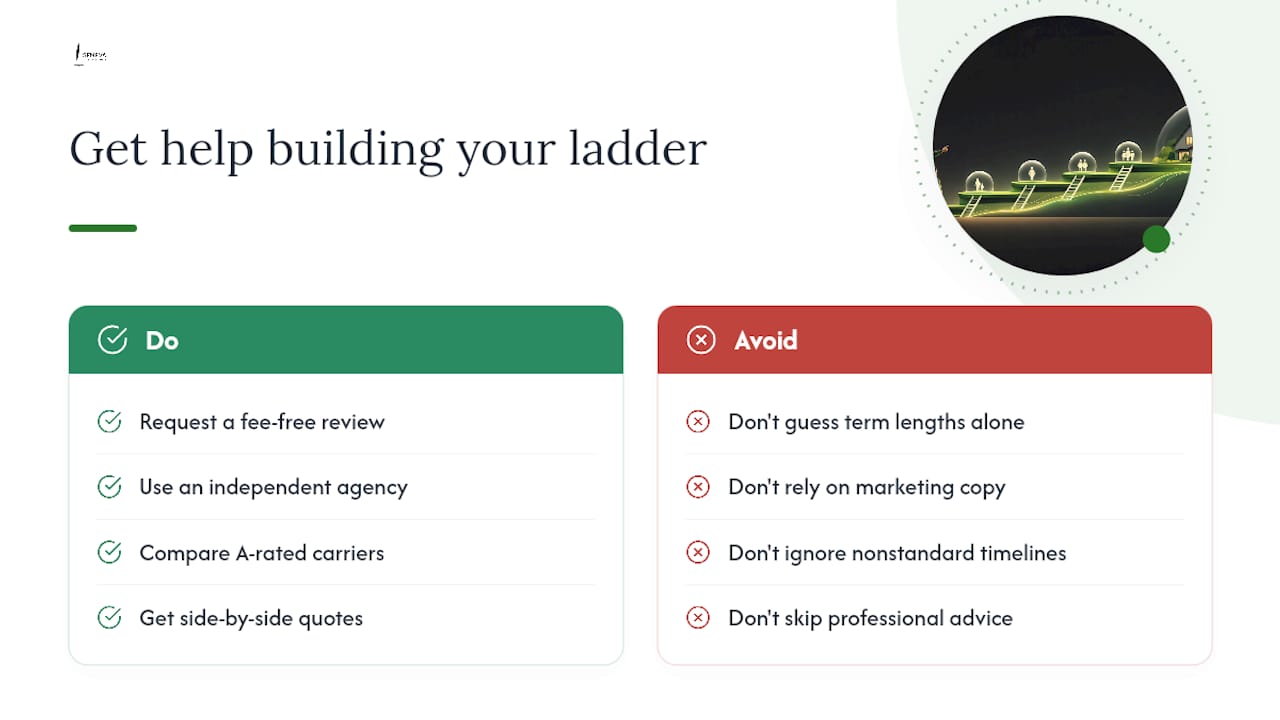
An independent agency can provide a fee-free policy review that compares options across multiple A-rated carriers and flags where a ladder makes sense for your situation, instead of guessing at term lengths on your own.
If you've already sketched out your obligations using the steps above, that review is the next logical move. Geneva looks at your current coverage, if any, identifies where a gap or an overpriced layer is sitting, and walks you through the tradeoffs on conversion riders and rung lengths in plain language, not policy jargon. That's especially useful if your timeline includes anything nonstandard, like a career change on the horizon or a family health history that makes locking in coverage now worth prioritizing.
Licensed in several states, an independent insurance team can pull quotes across carriers side by side so you're comparing real numbers instead of marketing copy. Start by requesting your fee-free policy review and find out where your ladder actually stands.
This article is general information, not a substitute for advice from a qualified financial advisor. Consult a qualified financial professional about your own circumstances before acting on anything here.