

Loss assessment coverage is an optional endorsement on your condo or homeowners policy that reimburses your share of a special assessment when the association bills owners for a covered loss. Most HO-6 policies default to just $1,000 in limit, and that number rarely matches what a real master-policy deductible or liability judgment costs today. If you own a condo or belong to an HOA, check your limit this week against your association's master-policy deductible.
TL;DR:
- Increasing your loss assessment coverage limit from the default $1,000 to $25,000 or $50,000 costs less than $100 annually and significantly reduces the risk of out-of-pocket expenses for large assessments.
- Your coverage only pays after you have paid the assessment bill and can require documented proof, including HOA meeting minutes and assessment notices.
- The endorsement covers assessments related to your share of the master policy's deductible, liability settlements, or partial property damage, but excludes routine maintenance, reserves, and certain natural disasters unless separately insured.
- Knowing your HOA’s deductible and assessing historical claims can help determine an appropriate coverage amount tailored to your building’s risk profile.
- Carriers sometimes limit reimbursements with sub-limits, so clarifying policy details before upgrading your coverage ensures you are protected up to your desired threshold.
Table of Contents
- What Is a Loss Assessment, and What Triggers One?
- How Loss Assessment Coverage Works, Step by Step
- What Loss Assessment Coverage Covers and Excludes
- How Much Loss Assessment Coverage Should You Buy?
- What Loss Assessment Coverage Costs, and How the Deductible Works
- What to Ask Your HOA and Your Agent Before You Buy
- Why We Push Clients to Check This Number First
- Get Your Loss Assessment Limit Checked, Free
- Sources
- FAQ
What Is a Loss Assessment, and What Triggers One?
A loss assessment is a bill your HOA or condo association sends to every owner to cover a shortfall, usually after damage to shared property or a liability claim the master policy doesn't fully pay. It's different from your regular monthly dues, which fund routine upkeep and reserves. An assessment shows up when there's a gap between what happened and what the master policy covers.
Three situations account for most assessments:
- The master policy's deductible applies. A hurricane or pipe burst damages the roof or lobby, and the association must cover the deductible before insurance pays anything, often tens of thousands of dollars.
- A claim exceeds the master policy's limits. Rebuilding costs more than the policy covers, so the remainder gets divided among owners.
- Liability in common areas. Someone slips on ice in the parking lot and sues, and the settlement exceeds what the master liability policy pays.
In a 100-unit building facing a moderate deductible, the flat per-unit split is a portion of the total deductible shared among all owners. Larger claims or smaller buildings push that number much higher fast.
How Loss Assessment Coverage Works, Step by Step
Your endorsement doesn't pay first. It reimburses you after the association bills your unit, and only within the sequence the policy defines. Understanding that chain keeps you from expecting a payout the day damage happens.
Here's the order of events:
- A covered loss occurs to common property, or a liability claim arises in a shared space.
- The master policy responds first, paying out after its own deductible and up to its own limits.
- If a shortfall remains, the association's board levies a special assessment against each owner.
- You pay the assessment, then file a claim under your own loss assessment endorsement for reimbursement, up to your limit.
Property-side assessments (roof, structure, common-area repairs) and liability-side assessments (a lawsuit judgment) often draw from the same endorsement, but some carriers apply separate sub-limits to each. Timing matters too: you typically need to have already paid the assessment, or at least received the bill, before your carrier will process reimbursement.
Pro Tip: Keep every document the HOA sends about a special assessment, including board meeting minutes referencing the vote. Carriers ask for this paper trail before they release a reimbursement check.
What Loss Assessment Coverage Covers and Excludes
The endorsement only responds when the assessment traces back to a covered loss or a liability claim the master policy would otherwise pay. It's not a blank check for anything your association decides to bill you for.
Covered scenarios generally include:
- Your share of the master-policy deductible after a covered property loss like fire, wind, or water damage.
- Your share of a liability settlement tied to an injury or incident in a common area.
- Assessments stemming from damage the master policy partially covers but doesn't fully absorb.
Excluded scenarios generally include:
- Routine maintenance assessments, like repaving a parking lot or replacing aging elevators.
- Reserve fund contributions or planned capital improvements.
- Flood and earthquake losses, unless the association carries separate coverage for those perils.
- Fines, penalties, or assessments resulting from the board's own negligence in some jurisdictions.
Many policies also split limits, so your property-side coverage might run $50,000 while liability-side coverage sits at a lower sub-limit, or vice versa. Read the declarations page, not just the summary, before assuming one number covers everything.
How Much Loss Assessment Coverage Should You Buy?
Start with a simple formula: divide your association's master-policy deductible by the number of units, then add a cushion for claims that exceed the master policy's limits entirely. That single calculation gets you closer to a real number than guessing.
- Get the master-policy deductible from your HOA. This is often $10,000 to $50,000 for mid-size buildings, higher in coastal or wildfire-prone areas.
- Divide by unit count to estimate your worst-case share if the board splits it evenly (some associations don't split evenly, so ask).
- Add a buffer for liability claims or losses above the master policy's limits, since those assessments can dwarf a deductible split.
A 40-unit building carrying a $50,000 master deductible produces a $1,250 per-unit share in a flat split, but a major liability judgment or underinsured rebuild could push individual assessments well past that. That's why recommended ranges typically run from $10,000 to $50,000, with coastal buildings or those carrying high deductibles often needing $50,000 or more.
What Loss Assessment Coverage Costs, and How the Deductible Works
Raising your limit from the default $1,000 to something realistic, like $25,000 or $50,000, is one of the cheaper upgrades on a condo policy. Carriers sometimes charge under $100 a year to increase limits substantially, though the exact premium varies by carrier, state, and how much coverage you're adding.
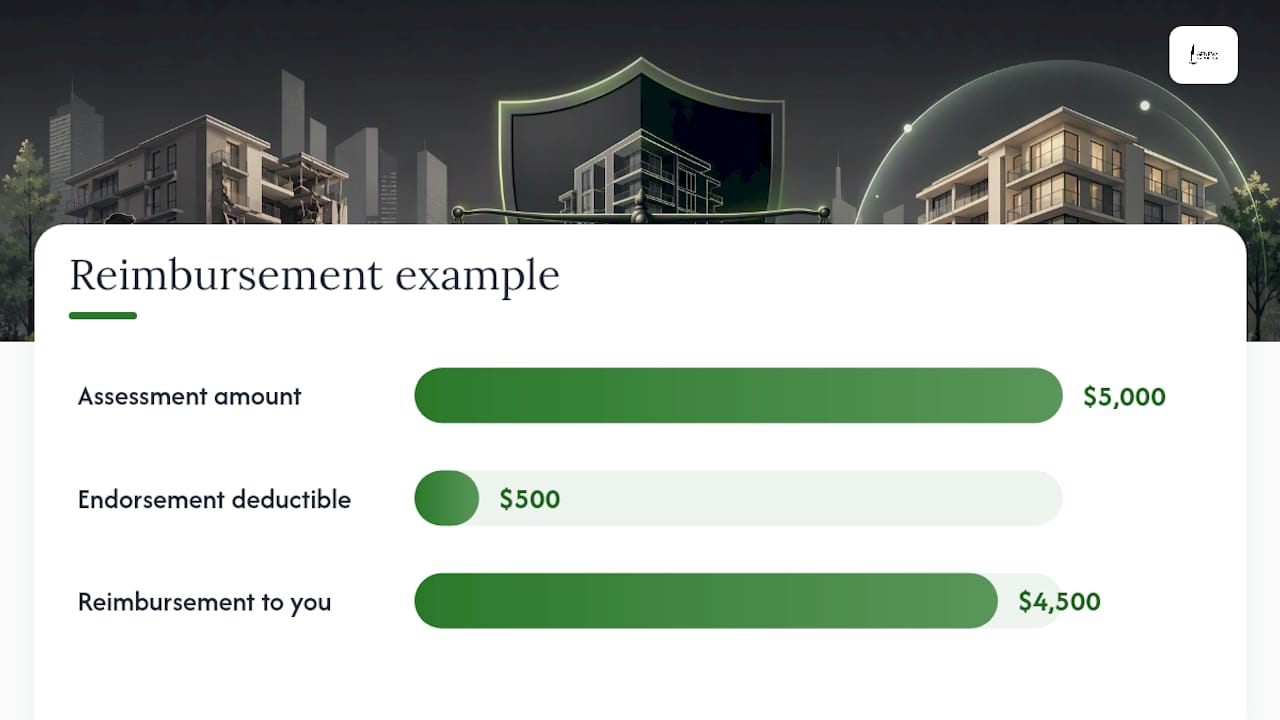
Most endorsements also carry their own deductible, separate from the association's master-policy deductible, commonly running $250 to $1,000. That means a $5,000 assessment against a $500 endorsement deductible nets you $4,500 in reimbursement, not the full amount.
Watch for a specific trap: some carriers cap reimbursement tied to the master-policy deductible with a lower sub-limit, so a $50,000 overall endorsement limit doesn't always mean $50,000 of deductible pass-through protection. Ask your agent to confirm whether that sub-limit exists before you assume you're fully covered.
What to Ask Your HOA and Your Agent Before You Buy
Getting the right number depends on real documents, not estimates. Two short conversations get you there.
Ask your HOA or association for:
- A copy of the master policy's declarations page, including the deductible and coverage limits.
- Current reserve fund balance, since underfunded reserves often signal future assessments.
- A history of large claims or special assessments over the past five years.
Ask your insurance agent about:
- Your current loss assessment limit and its endorsement deductible.
- Whether the policy splits property and liability limits, and if a master-deductible sub-limit applies.
- What it costs to raise your limit to $25,000 or $50,000.
Pro Tip: Request these documents and a policy review before hurricane season, wildfire season, or winter storm season, whichever applies where you live. Carriers process endorsement changes faster outside peak claim periods.
Why We Push Clients to Check This Number First
Surprise assessments still catch owners off guard more than almost any other coverage gap we see. A quick review usually finds a $1,000 limit sitting untouched since the policy was written years ago. Some independent agencies compare options across multiple A-rated carriers and offer fee-free policy reviews specifically to catch gaps like this before a special assessment letter shows up in the mail.
— David
Get Your Loss Assessment Limit Checked, Free
Some agencies give condo and homeowners policyholders a fee-free policy review that compares current loss assessment limits across multiple A-rated carriers, with no pressure to switch and no jargon buried in the fine print. If your endorsement still sits at the default $1,000, or you're not sure what your association's master-policy deductible even is, that's exactly the gap this review finds.

Licensed agents can walk you through your declarations page in plain language, flag any sub-limits on your master-deductible pass-through, and provide quotes to raise your limit to better match your building's risk. Whether you're in a small walkup or a large high-rise, the process generally involves gathering your HOA's numbers and getting a recommendation based on them. Request your fee-free policy review and find out where your current coverage falls short before the next assessment notice lands in your mailbox.
Sources
FAQ
What Is an Example of Loss Assessment Coverage?
If a fire damages your building's roof and the association's master policy deductible is a typical mid-size amount, the board might bill each owner a portion of that deductible. Your loss assessment endorsement reimburses that assessment share, minus your endorsement's own deductible.
Is Loss Assessment Coverage Worth It?
For most condo owners, yes. Raising your limit from the default $1,000 often costs under $100 a year and can save you thousands if your association ever faces a large deductible or liability claim.
How Much Is Loss Assessment Coverage?
Premiums vary by carrier and state, but bumping your limit from $1,000 to $25,000 or $50,000 typically adds a modest amount annually rather than a major cost increase. Some agencies can provide quotes for exact costs during a fee-free policy review.
What Should My Loss of Use Coverage Be?
Loss of use coverage is separate from loss assessment coverage. It reimburses your living expenses if your unit becomes uninhabitable, and coverage amounts vary depending on your area's housing costs and personal needs.