

No-exam life insurance skips the paramedical exam, but it does not skip underwriting. Insurers still evaluate your risk using prescription records, driving history, and public data instead of a needle and a stethoscope. Expect a faster application, but usually a smaller death benefit or a higher premium than fully underwritten coverage. Before you buy, check whether the quote you're looking at is accelerated underwriting, simplified issue, or guaranteed issue. Each one plays by different rules.
TL;DR:
- Accelerated underwriting uses your prescription, driving, and public records to approve policies within hours, but may still flag issues for full underwriting.
- No-exam policies limit coverage amounts, with guaranteed issue often providing only small benefits and graded payout periods within the first few years.
- Premium costs are higher per dollar of coverage for no-exam options, especially as policies move from accelerated underwriting to guaranteed issue.
- Larger face amounts or inconsistencies in your health and driving records might trigger referrals to traditional underwriting, requiring a medical exam.
- It's essential to compare no-exam options with fully underwritten policies, as the latter typically offer better prices and larger coverage for healthy applicants.
Table of Contents
- What Is No-Exam Life Insurance, Really?
- How Does Accelerated Underwriting Actually Work?
- What Are the Main Types of No-Exam Life Insurance?
- Who Should Actually Buy a No-Exam Policy?
- How Much Does No-Exam Life Insurance Cost?
- How Do You Apply for No-Exam Life Insurance?
- What Do Insurers Check Without an Exam?
- When Might You Still Need a Medical Exam?
- How Geneva Insurance Group Helps You Compare No-Exam Offers
- Are No-Exam Life Insurance Payouts Taxed?
- How Do You File a Claim on a No-Exam Policy?
- The Real Trade-Off Nobody Advertises Clearly
- Ready to Compare Your No-Exam Options?
- Sources
- FAQ
What Is No-Exam Life Insurance, Really?
"No exam" describes what you skip, not what the insurer skips. You avoid the nurse visit, the blood draw, and the urine sample. The company still has to classify your risk somehow, and it does that by pulling data instead of drawing it from your arm.
This distinction matters because marketing tends to blur it. Ads for no-exam life insurance often imply an easier approval process overall, when what's really happening is a substitution of evidence sources. Instead of lab results, the insurer leans on your prescription history, motor vehicle records, and answers to health questions on the application. The NAIC notes that accelerated underwriting can reduce decision time from months to hours for qualifying applicants, but that speed comes from automation, not from a lighter risk assessment.
Here's how the four main underwriting paths stack up against each other:
- Fully underwritten: paramedical exam, lab work, full health questionnaire, often the lowest price per dollar of coverage.
- Accelerated underwriting: no exam for qualifying applicants, but the insurer still checks prescription databases, driving records, and predictive models before deciding.
- Simplified issue: a short list of yes/no health questions, no exam, faster issue, but typically higher premiums and lower face amounts.
- Guaranteed issue: no health questions and no exam at all, but small coverage limits and a waiting period before the full death benefit applies.
The practical takeaway: "no exam" is one word on a spectrum. Where you land on that spectrum determines your price, your coverage limit, and how fast you'll have a policy in force.
How Does Accelerated Underwriting Actually Work?
Accelerated underwriting (often shortened to AU) runs your application through a data pipeline instead of a lab. The insurer pulls your prescription history, checks motor vehicle records (MVRs), scans public records, and feeds all of it into a predictive model that scores your mortality risk. The NAIC's overview of accelerated underwriting confirms this process can waive the paramedical exam and fluid collection entirely for applicants who clear the model's thresholds.
Three outcomes come out of that process:
- Instant approval at the applied-for rate, often within minutes to a few hours.
- Referral to traditional underwriting, meaning the model flagged something (a gap in prescription history, an inconsistency between your answers and the data) that needs a human underwriter's judgment.
- Decline or re-rate, where the data suggests a risk level that doesn't fit the product you applied for.
Regulators have paid close attention to how these models get built and audited. The NAIC's own guidance on the topic states plainly:
Accelerated underwriting models that use external data and artificial intelligence carry a risk of unfair or opaque outcomes if insurers don't test them for accuracy and bias, and don't maintain transparency about how the data is weighted.
That's not a footnote. The NAIC's regulatory guidance on accelerated underwriting pushes insurers to test their models for unfair discrimination and to keep the process auditable. If you want a plain answer from a carrier, ask directly what external data sources feed the model and whether you can contest something the model got wrong. A reputable insurer should have a straight answer.
What Are the Main Types of No-Exam Life Insurance?
Three categories cover most of what's marketed as no-exam coverage, and a fourth shows up through your job. Insurers and industry groups generally describe the no-exam market as three tiers: accelerated underwriting, simplified issue, and guaranteed issue.
- Accelerated underwriting term or whole life. Best suited to healthy applicants in their 20s through 50s who want a full-size death benefit (often $250,000 to $2 million or more) without the exam appointment. Approval depends heavily on clean prescription and driving records.
- Simplified issue life insurance. No exam, just a short health questionnaire, typically five to fifteen yes/no questions. Simplified issue policies issue faster but usually cap coverage in the $25,000 to $500,000 range and cost more per thousand dollars of coverage than fully underwritten term life.
- Guaranteed issue life insurance. No health questions, no exam, guaranteed acceptance within an age band (usually 50 to 85). Face amounts are small, often $5,000 to $25,000, and most policies include a two- or three-year graded benefit period. Die of natural causes during that window and beneficiaries typically receive only a return of premiums plus interest, not the full death benefit.
- Group and employer no-exam riders. Many workplace life insurance plans issue coverage up to a set multiple of salary with no exam, though amounts above that threshold may require evidence of insurability.
The pattern across all four: the less the insurer knows about you upfront, the smaller the check it's willing to write without asking more questions.
Who Should Actually Buy a No-Exam Policy?
No-exam coverage earns its premium when speed or approval odds matter more than price. That includes people facing a health diagnosis that could complicate traditional underwriting, applicants in their 60s and 70s looking to cover final expenses, and anyone who needs a policy in place before a loan closing, a divorce settlement, or another deadline-driven event.
It's a worse fit for a healthy 30-year-old who wants $1 million in coverage. Full underwriting will almost always beat a no-exam quote on price for that profile, sometimes by a wide margin, because the insurer has real lab data instead of a statistical guess.
Run through this quick checklist before you decide:
- Do you need coverage in place within days rather than weeks?
- Would a medical exam likely surface a condition that complicates approval?
- Is the coverage amount you need under $500,000, or could a small guaranteed-issue policy realistically cover your need?
- Have you compared the no-exam premium against a fully underwritten quote for the same amount?
Pro Tip: Get both quotes before you commit. A ten-minute call to compare an accelerated underwriting quote against a fully underwritten one for the same face amount often reveals a price gap large enough to justify the wait.
How Much Does No-Exam Life Insurance Cost?
Premiums for no-exam coverage run higher per dollar of death benefit than fully underwritten policies, and the gap widens as you move from accelerated underwriting toward guaranteed issue. The reason is straightforward: insurers price for uncertainty, and less direct health evidence means more built-in cushion in the rate.
By the numbers: Simplified issue policies typically skip the exam entirely but come with lower benefit limits and higher relative premiums than fully underwritten term life, a trade-off insurers make to offset the reduced medical evidence.
Three factors move the price most:
Benefit caps limit how much cushion you're buying. Simplified issue and guaranteed issue policies max out well below what a healthy applicant could get through full underwriting, so a big need often means paying a no-exam premium and still being underinsured.
Graded benefit periods reduce the payout if death occurs from natural causes early in the policy. Most guaranteed issue contracts hold this clause for two to three years, and it's the single most misunderstood feature in this product category.
Contestability clauses give the insurer two years to investigate and deny a claim if it finds a material misrepresentation on the application, no exam or not. That clock starts on the policy's effective date and applies across nearly all life insurance, not just no-exam products.
How Do You Apply for No-Exam Life Insurance?
The application process moves fast when you show up prepared. Slow it down with mismatched dates or forgotten prescriptions, and you risk a referral to full underwriting anyway.
- Gather your records first. List every current medication with dosage and start date, note the dates of any major diagnoses or surgeries, and pull your driving record if you've had a citation in the past three years.
- Confirm the underwriting type before you apply. Ask the agent or read the product page: is this accelerated underwriting, simplified issue, or guaranteed issue? The label changes your expected timeline and coverage ceiling.
- Submit the application and let the data pull happen. Accelerated underwriting cases often return a decision within minutes to a few business days; simplified issue is similar; guaranteed issue is close to instant since there's no risk assessment beyond your age and state.
- Respond quickly if the insurer requests more information. A referral to full underwriting isn't necessarily a decline. It just means the automated model flagged something a human needs to review.
Pro Tip: Ask the carrier directly whether a failed accelerated underwriting check automatically falls back to full underwriting, or whether it's treated as a final decline. The answer varies by insurer, and knowing it upfront saves you from reapplying somewhere else if things don't go through cleanly the first time.
What Do Insurers Check Without an Exam?
Skipping the exam doesn't mean skipping verification. Insurers lean harder on external databases to fill the evidence gap, which is exactly why your application answers need to match what those databases show.
- MIB records. Member insurance companies share coded underwriting data through MIB, and you're entitled to request your free consumer file annually and dispute anything inaccurate.
- Prescription history databases. These reveal medications you may have forgotten to list, which is one of the most common sources of application mismatches.
- Motor vehicle records. A DUI or a string of speeding tickets shows up here even if you never mention it.
- Public records. Bankruptcies, liens, and certain court records can factor into risk models depending on the insurer.
Honest, complete answers matter more here than in traditional underwriting, since there's no lab result to correct a misstatement later. Pull your MIB file before applying if it's been a while since your last policy. Fixing an error before you apply beats disputing a denial after the fact.
When Might You Still Need a Medical Exam?
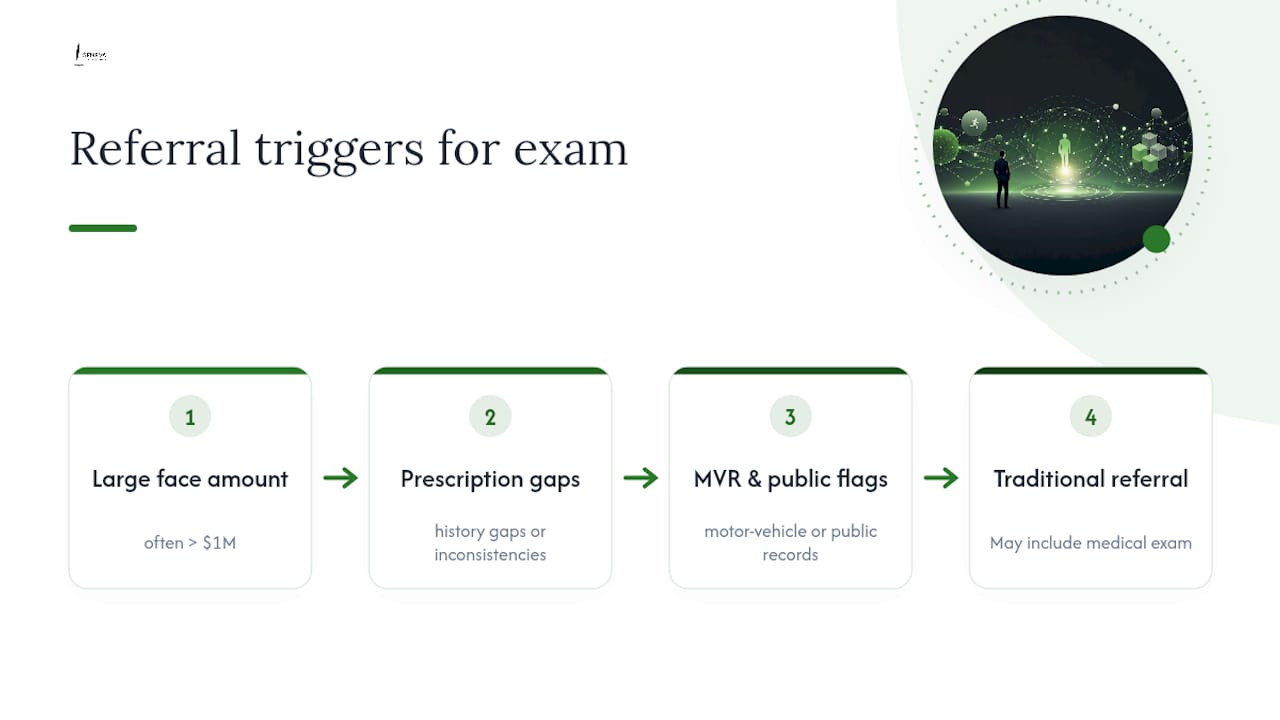
Accelerated underwriting isn't a guaranteed skip. Large face amounts (often above $1 million), gaps or inconsistencies in your prescription history, or flags from motor vehicle and public records can all trigger a referral to traditional underwriting, exam included.
Younger, healthy applicants often choose full underwriting on purpose, not because they're forced into it. A clean bill of health, verified in a lab, tends to unlock the lowest available rate class, and for a 20 or 30-year term policy that difference compounds into real savings over the life of the policy.
If your accelerated underwriting application gets referred, ask the carrier directly whether it automatically rolls into full underwriting or requires a fresh application. Some insurers make that transition seamless. Others treat the referral as the end of the road, and you'll need to start over, possibly with a different company.
How Geneva Insurance Group Helps You Compare No-Exam Offers
Reading one no-exam quote in isolation tells you almost nothing about whether it's competitive. An independent insurance agency can compare policies across multiple A-rated carriers and offer a fee-free policy review that flags coverage gaps before you commit to anything.
That review matters most when you're weighing accelerated underwriting against simplified issue against a fully underwritten alternative, because the fine print differs by carrier. An independent agent can walk through the graded benefit period, the contestability clause, the conversion rights, and the exclusions in your specific contract, in plain language instead of policy jargon. That's the gap between reading a quote and actually understanding what you're buying.
Are No-Exam Life Insurance Payouts Taxed?
Life insurance death benefits are generally not counted as taxable income for beneficiaries, and that rule applies the same way to no-exam policies as it does to fully underwritten ones. The underwriting method behind a policy has no bearing on its tax treatment.
Two situations can complicate that picture. If your estate is large enough to trigger federal estate tax, and you personally owned the policy at death, the death benefit can be pulled into your taxable estate. Naming an irrevocable life insurance trust as owner, or simply naming a spouse or child as owner instead of yourself, is a common way advisors address this, though it requires planning ahead of a health event, not after.
The second wrinkle applies specifically to guaranteed issue policies with a graded benefit period. If a beneficiary receives a return of premiums plus interest instead of the full face amount (because death occurred during the graded period from natural causes), the interest portion may be taxable as income, even though the principal return typically is not. This is a narrow rule, but it catches families off guard when a guaranteed issue policy pays out during its first two or three years.
None of this changes based on whether you skipped a paramedical exam. A tax professional familiar with your estate situation is the right resource if your coverage amount runs into six or seven figures.
How Do You File a Claim on a No-Exam Policy?
Filing a claim on a no-exam policy follows the same basic steps as any life insurance claim, with one added wrinkle: insurers scrutinize applications more closely during the two-year contestability period, precisely because there was no lab work to confirm your health status at issue.
The beneficiary contacts the insurer, requests a claim form, and submits it along with a certified death certificate. Most insurers also want a copy of the policy and identification for the beneficiary. Straightforward claims, especially those filed after the contestability period has passed, often pay out within a few weeks.
If the death occurs within the first two years and the cause of death or the application answers raise a question, the insurer can investigate further before paying. This is where accurate, complete answers on the original application pay off. A misstatement about smoking status, a forgotten prescription, or an unreported diagnosis becomes the exact thing an insurer's investigator looks for during a contestability review. Guaranteed issue policies add another layer: if death occurs during the graded benefit period from natural causes, the payout defaults to a return of premiums plus interest rather than the full face amount, regardless of how the claim itself is handled.
Keep your policy documents somewhere your beneficiaries can find them, and tell at least one person where that is. A perfectly valid claim can still stall for weeks simply because nobody knew the policy existed.

The Real Trade-Off Nobody Advertises Clearly
The industry sells convenience, and convenience is real. What gets buried is how much that convenience costs relative to what you're actually protecting. A guaranteed issue policy marketed as "coverage no matter what" often caps out at $10,000 or $15,000, which barely covers a funeral in most states, let alone years of lost income.
The conventional advice, "just get something rather than nothing," isn't wrong, but it's incomplete. The better first move is figuring out which underwriting tier you actually qualify for before assuming you need the most permissive one. Plenty of applicants with a manageable health condition default straight to guaranteed issue out of fear, when accelerated underwriting or simplified issue would have offered triple the coverage at a comparable price.
The NAIC's push for transparency in these underwriting models deserves more attention from consumers than it gets. You have every right to ask a carrier what data drives your rate and what happens if that data is wrong. Most buyers never ask. That single question, asked before you sign anything, does more for your outcome than comparing three quotes on price alone.
— David
Ready to Compare Your No-Exam Options?
Shopping no-exam life insurance one carrier at a time means you only see the trade-offs that one company chose to build into its product. Some independent agencies compare offers across multiple A-rated carriers so you can see the spread in price, coverage limits, and contract terms before committing to a single quote.
A fee-free policy review can be a good place to start if you already have a policy and aren't sure it still fits. The review helps assess your existing coverage, checks it against your current needs, and flags gaps in plain language, with no jargon and no pressure to switch. If you're starting from scratch, the life and health insurance page walks through how an independent agent helps you weigh accelerated underwriting against simplified issue against full underwriting for your specific situation. And if your life insurance need connects to a bigger financial decision, worth reviewing how much protection actually makes sense for your household before locking in a number.
Request your free policy review or start a multi-line insurance quote today, and get a straight answer about what fits your situation instead of a generic quote.
This article is general information, not a substitute for advice from a qualified financial advisor. Consult a qualified financial professional about your own circumstances before acting on anything here.
Sources
- Insurance Topics | Accelerated Underwriting | NAIC
- MIB consumer guide (MIB)
- How Simplified Issue Life Insurance Works – Forbes Advisor
FAQ
Can I Get Life Insurance Without an Exam?
Yes. Accelerated underwriting, simplified issue, and guaranteed issue policies all skip the paramedical exam, though each uses a different level of health screening. Accelerated underwriting relies on prescription and driving records instead of lab work, while guaranteed issue asks no health questions at all.
How Much Is Life Insurance With No Medical Exam?
Cost depends heavily on which no-exam category you're in, but expect to pay more per dollar of coverage than a fully underwritten policy would charge a healthy applicant. Simplified issue policies typically carry higher premiums and lower benefit caps than fully underwritten term life for the same coverage amount.
What Does a Low-Cost Policy Actually Cover?
Ultra-low monthly premiums advertised for guaranteed acceptance plans typically buy a small guaranteed issue death benefit, often in the low thousands of dollars, with a graded benefit period of two to three years. During that window, a natural-causes death usually pays out only a return of premiums plus interest rather than the full face amount. Always check the specific face amount and graded benefit terms before assuming the premium buys meaningful coverage.
What Is the Best Whole Life Insurance Without a Medical Exam?
There's no single best policy since it depends on your age, health, and coverage need. An independent agent who can pull quotes across dozens of carriers, like Genevainsgroup, gives you a realistic comparison instead of a single insurer's pitch, which matters because benefit caps and pricing vary widely between companies for the same no-exam category.
Is Simplified Issue the Same as Guaranteed Issue?
No. Simplified issue asks a short list of health questions and can decline applicants based on the answers, while guaranteed issue asks no health questions and accepts everyone within its age band. Guaranteed issue typically caps coverage lower and adds a graded benefit period that simplified issue policies usually don't include.