

Non-owner car insurance is a liability-only policy built for licensed drivers who don't own a car but still need their own protection behind the wheel. It fits you if you rent often, borrow a friend's or family member's vehicle regularly, drive for a car-sharing service, or need to file an SR-22. The one thing it never does is pay for damage to the car you're driving.
TL;DR:
- Most non-owner policies cost between $58 and $91 per month for liability coverage, depending on driving history, coverage limits, and state rules.
- These policies only cover bodily injury and property damage liability and do not pay for damage to the borrowed vehicle or personal belongings inside it.
- Non-owner insurance is mainly necessary for frequent renters, those who borrow specific vehicles regularly, or drivers needing an SR-22 filing without owning a car.
- Confirm with the vehicle owner’s insurer whether permissive use is covered before buying a policy, as assumptions can be incorrect.
- An independent agent can help compare carrier options, verify SR-22 filings, and clarify exclusions for better coverage decisions.
Table of Contents
- What Non-Owner Car Insurance Is and How It Works
- What Non-Owner Policies Cover, and What They Don't
- Who Actually Needs Non-Owner Insurance
- What Non-Owner Insurance Costs and What Moves the Price
- How to Buy a Non-Owner Policy and Handle SR-22 Filing
- Rental Insurance, Owner's Policies, or a Short-Term Standard Policy
- How an Independent Agency Helps You Sort This Out
- What Actually Matters Here
- If You Want Help Comparing Your Options
- Selected Authoritative Resources
- Sources
- FAQ
What Non-Owner Car Insurance Is and How It Works
A non-owner policy attaches to you, not a vehicle, so there's no VIN on the paperwork. It exists purely to cover the bodily injury and property damage you might cause someone else while driving a borrowed or rented car. When it comes to who pays first after an accident, the ordering matters.
- The vehicle owner's insurance almost always pays first, since it's tied to the car itself.
- Your non-owner policy acts as secondary coverage, stepping in once the owner's liability limits run out.
- Permissive use, meaning the owner said it was fine for you to drive, is what makes their policy respond at all.
Eligibility is narrower than people expect. Most carriers won't issue a non-owner policy to someone who owns a car, is married to a car owner living in the same household, or drives a company vehicle full time.
What Non-Owner Policies Cover, and What They Don't
The coverage is genuinely liability-only, and that single fact trips up more buyers than anything else in this category.
What's typically included:
- Bodily injury liability for people you hurt in an accident
- Property damage liability for other vehicles or property you damage
- Optional add-ons like uninsured/underinsured motorist coverage or medical payments, depending on the carrier
What's excluded:
- Collision or comprehensive coverage for the car you're driving
- Damage to your own personal belongings inside the vehicle
- Rental company loss-of-use fees while a damaged car sits in a shop
A frequent pitfall: assuming a non-owner policy will pay to fix the borrowed vehicle after a crash. It won't. The owner's own collision coverage or a rental company's damage waiver has to cover that repair bill, and coverage details vary enough by state and carrier that reading the actual policy language before you sign matters more than skimming a summary page.
Statistic to know: MoneyGeek's analysis of non-owner premiums puts typical minimum-coverage pricing at roughly $58 to $91 a month, which tells you this is a liability play, not a comprehensive safety net.
Who Actually Needs Non-Owner Insurance
Not everyone driving someone else's car needs a separate policy. Here's how to tell if you're one of the people who does.
- You rent cars several times a year. A non-owner policy can replace repeated daily rental liability purchases if you rent often enough to make the monthly premium cheaper than the per-trip fee.
- You borrow a specific person's car regularly, like a parent's or roommate's, and want your own liability protection instead of relying entirely on their policy limits.
- You drive for a car-sharing platform between gigs, or use one casually, and the platform's coverage has gaps you want to close.
- You need an SR-22 but don't own a car. States require proof of financial responsibility after certain violations, and a non-owner policy is often the only way to file one without a vehicle to insure.
If you borrow a car once a month or less, and the owner is comfortable with permissive use, you probably don't need this. Full-time car owners don't need it either, since their own policy already follows them into any car they drive with permission.
What Non-Owner Insurance Costs and What Moves the Price
Expect somewhere between $58 and $91 a month for minimum-liability coverage, based on MoneyGeek's carrier pricing data. Your actual number depends on a handful of factors.
- Age and driving history: a clean record and more driving experience both pull the price down.
- Coverage limits: state-minimum liability costs less than higher limits, but higher limits protect more of your assets.
- State minimums and rating rules: some states allow credit-based insurance scoring, which can swing your rate either direction.
- SR-22 status: filing one usually adds a surcharge on top of the base premium.
Run the math against rental counter coverage before you decide. Counter collision-damage waivers typically run $15 to $30 per day. Rent for five days a month and you're paying $75 to $150, which already beats a non-owner policy's monthly cost. Rent twice a year for a week each trip, and the counter waiver is almost certainly cheaper overall.
How to Buy a Non-Owner Policy and Handle SR-22 Filing
Buying one is faster than most people expect, but SR-22 filings have a few extra steps worth getting right the first time.
- Have your license and payment ready. Most major insurers let you bind a non-owner policy online the same day, since there's no vehicle inspection or VIN to verify.
- Confirm SR-22 eligibility with the carrier directly. Not every insurer files SR-22s, and not every non-owner policy automatically qualifies, so ask before you assume.
- Check that the insurer files electronically with your state's DMV. Some states require this within a specific window after your violation.
- Maintain continuous coverage. Letting an SR-22-linked policy lapse, even briefly, typically restarts your filing period and can extend your requirement.
Pro Tip: Call the insurer and ask them to confirm in writing that your policy satisfies SR-22 requirements in your specific state before you cancel any other coverage. A verbal "yes" from a sales rep isn't the same as a filed SR-22 on record with the DMV.
Rental Insurance, Owner's Policies, or a Short-Term Standard Policy
Non-owner coverage isn't the only route to legal driving in a car that isn't yours, and it's often not the cheapest one.
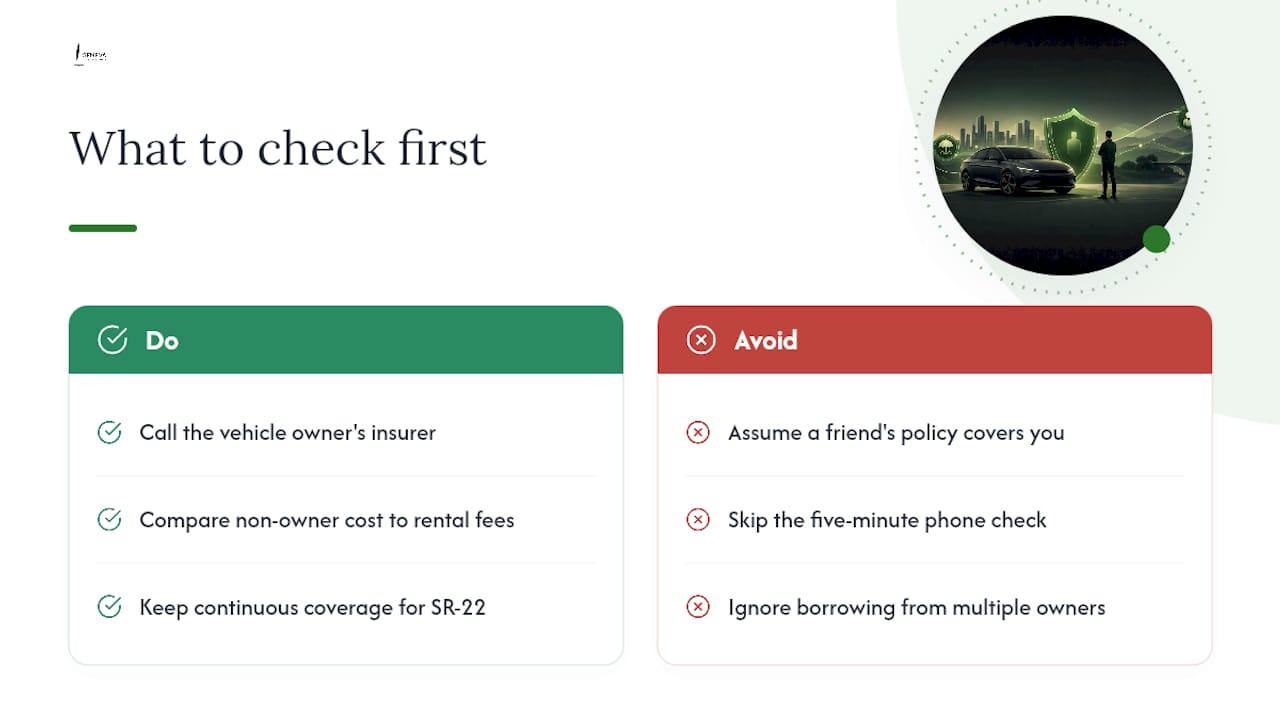
- Verify permissive use first. If you drive a friend's or relative's car occasionally, their policy likely already covers you as a permissive driver, and paying for anything extra is redundant.
- Check your credit card's rental benefits. Many cards include collision damage coverage, though most function as secondary coverage that only kicks in after your personal auto policy responds.
- Consider being added to the owner's policy if you drive their car regularly, since that often costs less than maintaining a separate non-owner policy.
- A short-term standard policy with early cancellation can work if you're about to buy a car, though insurers commonly charge a $25 to $50 cancellation fee, so read the fine print first.
NerdWallet's decision framework sums it up well: rely on permissive use for occasional driving, get added to the policy for regular driving, and buy non-owner coverage specifically when you frequently borrow or rent from multiple sources.
How an Independent Agency Helps You Sort This Out
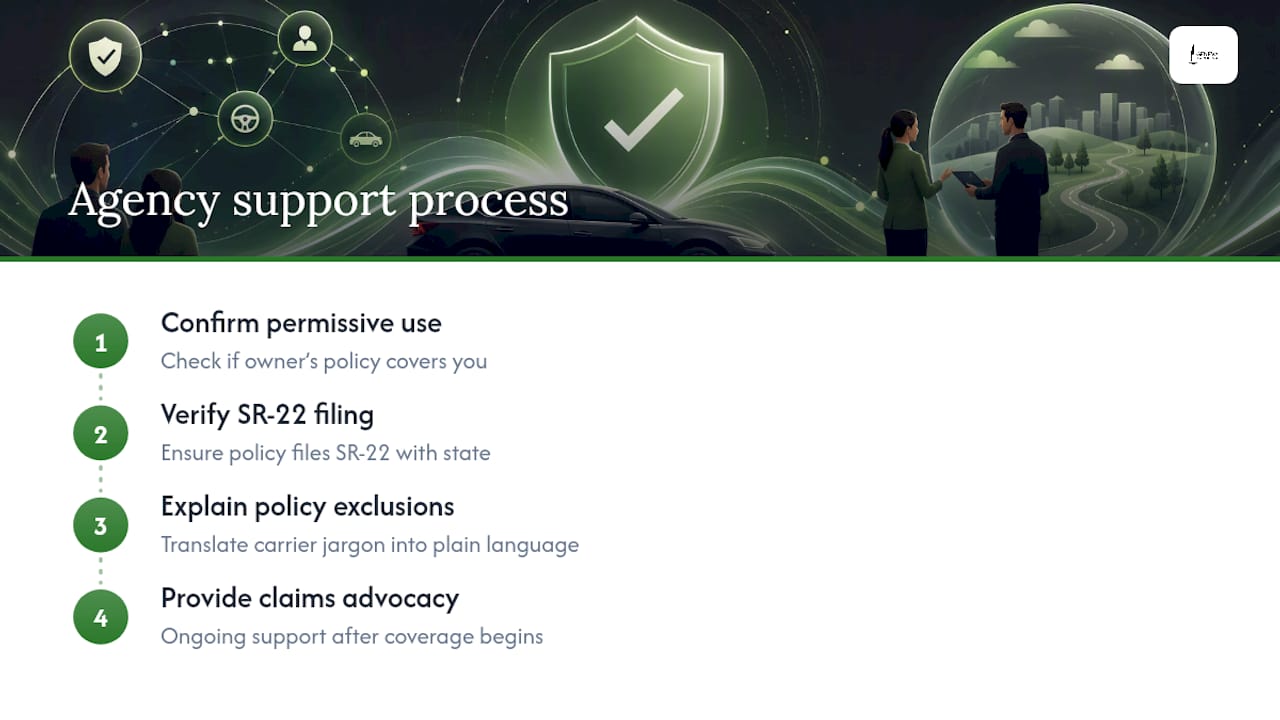
Comparing carriers on your own means requesting quotes one insurer at a time and hoping you're reading the exclusions correctly. An independent insurance agency can compare options across multiple A-rated carriers, which matters here because non-owner pricing and SR-22 filing rules vary noticeably from one insurer to the next.
A knowledgeable agent can confirm whether a specific vehicle owner's policy actually extends permissive use to you before you spend money duplicating coverage. They can also verify that a policy files SR-22 correctly with your state, and walk through exclusions in plain language instead of leaving you to interpret carrier jargon alone. Some agencies offer fee-free policy reviews and provide ongoing advocacy if something goes wrong after you're on the road.
What Actually Matters Here
Most advice on non-owner insurance treats it as a niche product for people with suspended licenses. That's backwards. The bigger use case is math: frequent renters and borrowers who never run the numbers against rental counter fees or credit card benefits, and end up either overpaying at the counter trip after trip or driving underinsured because they assumed a friend's policy had them covered.
The SR-22 angle gets more attention than it deserves relative to how simple it actually is. File it, keep continuous coverage, done. The harder judgment call is the permissive-use question, and that's where I'd tell readers to slow down. Before buying anything, call the vehicle owner's insurer and ask directly whether their policy covers you. That five-minute call resolves more coverage anxiety than any policy comparison chart. If the answer is no, or if you're borrowing from multiple people, that's your signal to price out a non-owner policy against your actual rental frequency, not a hypothetical one.
— David
If You Want Help Comparing Your Options
Working through permissive-use questions, SR-22 filing rules, and carrier pricing on your own eats up time you'd rather spend elsewhere. Some agencies offer fee-free policy reviews where an agent looks at what you already have, or don't have, and compares your options across multiple A-rated carriers instead of pointing you toward a single insurer's product.
That comparison matters most when you're weighing non-owner coverage against being added to someone else's policy, since the right call depends on details a generic online quote tool won't ask about. If you're facing an SR-22 requirement, an agent can also confirm a carrier files correctly with your state before you commit. To get started, have your driver's license and a rough sense of how often you drive borrowed or rented vehicles ready, then request a fee-free policy review to see what actually fits your situation.
Selected Authoritative Resources
- MoneyGeek's temporary car insurance guide breaks down non-owner pricing and same-day binding details.
- MoneyGeek's rental car insurance guide covers daily CDW cost ranges at the rental counter.
- Forbes' rental car coverage explainer walks through checking existing coverage before buying extra.
- Experian's short-term car insurance overview explains liability-only structures in plain terms.
- MPC Law's Massachusetts license reinstatement guide details costs tied to SR-22 filings after suspensions.
Sources
FAQ
What is the cheapest non-owner car insurance?
Pricing runs roughly $58 to $91 a month for minimum liability coverage, though your exact rate depends on your driving record, state, and whether you need an SR-22 filing. Comparing quotes across multiple carriers, rather than accepting the first one you see, is the most reliable way to find the lower end of that range.
Can someone insure a vehicle that is not in their name?
Yes, through a non-owner policy, which attaches liability coverage to you as a driver rather than to a specific vehicle. It won't cover damage to the car itself, so you still need permissive use from the owner or a rental company's own damage protection for that piece.
What is the purpose of non-owner car insurance?
It gives you personal liability protection when you regularly drive vehicles you don't own, and it's also one of the few ways to satisfy an SR-22 filing requirement if you don't have a car registered in your name. Think of it as insurance that follows the driver instead of the vehicle.
Who offers non-owners insurance in Florida?
Availability varies by carrier and changes over time, so the most reliable way to confirm current options and pricing in Florida is to compare carriers directly rather than rely on a fixed list. Working with an independent agency like Genevainsgroup lets you compare multiple carriers licensed in your state at once instead of contacting each one separately.