

Most drivers with full collision and comprehensive coverage and a deductible under $500 can skip the rental counter's collision damage waiver. Liability-only drivers, anyone with a deductible over $1,000, and international renters usually should buy it. Before you do either, call your insurance agent or your credit card's benefits line to confirm what actually extends to a rental in your name today.
TL;DR:
- Drivers with full coverage and a deductible under $500 generally do not need to purchase rental car collision damage waiver unless renting internationally or with a deductible over $1,000.
- Most personal auto policies extend collision, comprehensive, and liability coverage to rental cars, but check for vehicle class exclusions or duration limits exceeding 15 to 31 days.
- Credit card benefits often provide secondary coverage that may not include liability protection or apply only within certain timeframes, requiring validation before use.
- Loss-of-use fees, stemming from rental companies' income loss during repairs, are rarely covered by insurance or credit benefits and can significantly increase final costs.
- An independent insurance review before renting can identify gaps in coverage, especially for nonstandard vehicles or international trips, saving money and avoiding disputes.
Table of Contents
- What Rental Car Insurance Coverage Actually Includes
- Does Your Car Insurance Cover A Rental? Checking Your Policy And Credit Card
- Who Should Buy Rental Car Coverage? A Decision Framework
- The Hidden Rental Charges Your Insurance Won't Touch
- How A Licensed Agent Reviews Your Coverage Before You Rent
- What Renters Get Wrong Most Often
- Get A Fee-Free Policy Review Before Your Next Rental
- Sources
What Rental Car Insurance Coverage Actually Includes
Rental counters sell four distinct products, and lumping them together is how people overpay or under-protect themselves. Each one solves a different problem.
The collision damage waiver (CDW), sometimes called a loss damage waiver (LDW), isn't insurance in the legal sense. It's a waiver where the rental company agrees not to hold you responsible for damage or theft to the vehicle itself. That distinction matters at claim time, since a waiver dispute gets handled by the rental company, not an insurance adjuster. CDW typically runs $15 to $30 a day.
Three other products round out the counter menu:
- Supplemental liability insurance (SLI) covers damage or injury you cause to others, usually $7 to $15 a day.
- Personal accident insurance (PAI) pays medical costs for you and passengers after a crash, roughly $3 to $7 a day.
- Personal effects coverage (PEC) reimburses stolen belongings inside the car, around $1 to $4 a day.
- Roadside assistance covers lockouts, flat tires, and towing, often bundled or sold separately.
Full bundles combining these run $40 to $60 a day, which adds up fast on a week-long trip. None of these products cover unauthorized drivers, off-road use, or violations of the rental agreement, and CDW never covers your liability to a third party unless you've also bought SLI. Read the contract's exclusions section before you sign. Rental companies routinely void coverage for driving on unpaved roads, letting an unlisted driver take the wheel, or using the car for anything the agreement calls "illegal or prohibited."
Does Your Car Insurance Cover A Rental? Checking Your Policy And Credit Card
The question "does insurance cover rental car" damage almost always has a two-part answer: your personal auto policy, and possibly your credit card.
Most personal auto policies extend collision, comprehensive, and liability coverage to a rental car used for personal travel, and they apply the same limits and deductible as your regular vehicle. If your deductible is $1,000, that's what you'll owe on a rental claim too. This is the core of rental car coverage insurance many drivers already carry without realizing it.
Credit card benefits are messier. Some cards offer primary coverage, meaning the card pays out before your personal policy gets touched. Most offer only secondary coverage, which pays after your personal insurer processes the claim, and that gap can mean a rate increase you didn't expect. Card CDW almost never includes liability protection, so a renter with thin personal liability limits can still be exposed even with "free" card coverage. Most card benefits also require you to pay for the entire rental with that card, list yourself as the primary renter, and decline the counter's CDW at pickup, or the coverage voids automatically.
Watch for two more gaps:
- Duration caps. Card and policy coverage often stop protecting you after 15 to 31 consecutive days, so a month-long rental may need separate coverage for the back half of the trip.
- Vehicle-class exclusions. RVs, large cargo vans, and exotic or luxury cars are commonly excluded from both card benefits and standard auto policies.
Pro Tip: Ask your agent or card issuer for a written summary of rental benefits, not just a verbal confirmation. If a claim gets disputed later, that document is your proof, not your memory of a phone call.
Who Should Buy Rental Car Coverage? A Decision Framework
The right call depends on three numbers: your deductible, your liability limits, and how confident you are in your card's fine print.

Buy the counter coverage if you carry liability-only auto insurance, since that leaves collision and theft damage to a rental completely uncovered. Buy it if your deductible sits at $1,000 or higher, since a single fender-bender could cost more out of pocket than a week of CDW. Buy it if you're renting an RV, cargo van, or luxury vehicle your policy or card excludes. And buy it for international trips, since most U.S. personal policies and card benefits stop at the border or exclude specific countries.
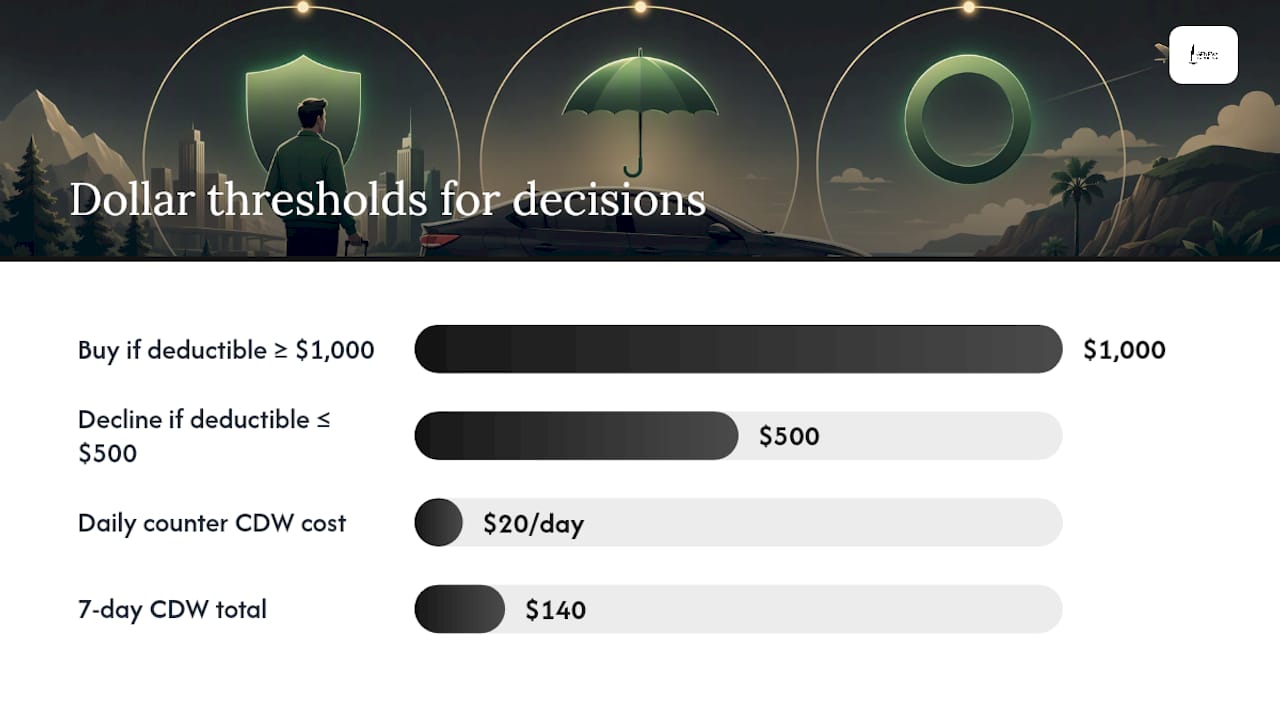
Decline it if you carry full coverage with a deductible of $500 or less and a credit card with confirmed primary CDW. In that scenario, you're paying twice for protection you already have.
Run the math before you decide. A 7-day rental with counter CDW at $20 a day costs $140 total. A $500 deductible only costs you money if you actually file a claim, and most rentals end without incident. According to Consumer Reports, a small minority of renters purchase insurance from the rental agency, suggesting most drivers are comfortable relying on existing coverage once they've verified it.
If you decline, keep these on hand:
- Your agent's direct phone number
- Your card issuer's benefits line
- Timestamped photos of the vehicle's condition at pickup
The Hidden Rental Charges Your Insurance Won't Touch
Counter pricing is only half the cost picture. The bigger surprise usually shows up on your final bill.
Loss-of-use fees are what rental companies charge for the income they lose while a damaged car sits in the shop. Neither your personal auto policy nor most credit card benefits reliably cover this charge, since it's technically a business-interruption cost, not vehicle damage. A company can bill you for weeks of "lost rental days" even after your insurer pays for the repair itself, and that gap has caught plenty of confident renters off guard.
Deductible math matters here too. If your deductible is close to the repair cost, filing a claim may not be worth it once you factor in a potential rate increase from your insurer. Sometimes paying out of pocket is cheaper long term than reporting a small claim.
To limit surprise charges:
- Walk the entire vehicle with a rental employee before driving off, not after.
- Take timestamped photos or video of every panel, tire, and the interior.
- Keep every receipt, email confirmation, and written benefit summary until well after the return.
How A Licensed Agent Reviews Your Coverage Before You Rent
A quick call before you pick up the keys often prevents the messiest disputes. An independent agent can confirm territory restrictions, vehicle-class exclusions, your exact deductible, liability limits, rental duration caps, and how your insurer handles loss-of-use disputes if damage happens.
A good review ends with something concrete in your hands, not just reassurance:
- A written confirmation of what your policy covers for rentals
- Recommended endorsements if a gap turns up
- Claims advocacy if a rental company or insurer pushes back later
Geneva Insurance Group is licensed in 17 states and compares options across more than 25 A-rated carriers, offering a fee-free policy review specifically built to catch these gaps before they cost you at the counter.
What Renters Get Wrong Most Often
The biggest mistake I see is renters assuming a credit card benefit applies without ever reading the terms, then discovering at the counter that it's secondary coverage or excludes their vehicle class. Skipping the loss-of-use question is a close second. The workflow that actually works is simple: verify your coverage before you travel, document the vehicle's condition at pickup, then decide with real numbers instead of a guess.
— David
Get A Fee-Free Policy Review Before Your Next Rental
Genevainsgroup gives you something the rental counter never will: an independent second opinion on your existing coverage, at no cost, before you're standing at the kiosk deciding in thirty seconds. A fee-free policy review checks whether your personal auto policy and card benefits actually cover the vehicle class, territory, and rental length you're planning, then flags any gap worth fixing with a low-cost endorsement instead of a $60-a-day bundle.
To prepare, pull up your policy's declarations page, your credit card's benefits guide, and your rental reservation details. If you're renting a nonstandard vehicle abroad, a specialized provider like Georgian car insurance for foreign vehicles may also be worth a look for that specific trip. For everyday domestic rentals, though, a quick review is usually all it takes. Schedule your fee-free policy review with Geneva Insurance Group and walk into your next rental knowing exactly where you stand.
This article is general information, not a substitute for advice from a qualified financial advisor. Consult a qualified financial professional about your own circumstances before acting on anything here.