

Review every insurance policy you hold at least once a year and immediately after any major life or business change. Start by pulling the declarations page and renewal notice for each policy you own. From there, walk through limits, deductibles, and exclusions line by line, or ask an independent agent for a fee-free review if you'd rather have a second set of eyes on it.
TL;DR:
- Regularly reviewing your policies helps identify outdated coverage amounts, especially for rebuild costs, high-value items, and liability limits that match current needs.
- Percentages deductibles, such as storm or hurricane policies, can lead to significant out-of-pocket costs if not properly understood or updated.
- An independent comparison across multiple carriers can uncover better coverage options or lower rates that a single-agent or direct insurer may not offer.
- Clauses on the declarations page, valuation basis, perils covered, and sub-limits are critical but often overlooked details that influence claim outcomes.
- Updating your coverage immediately after major life changes ensures your policy remains aligned with your current circumstances and financial risks.
Table of Contents
- How to Review an Insurance Policy: The Full Checklist
- What to Check on Homeowners, Auto, Life, Health, and Business Policies
- What the Declarations Page Actually Tells You
- When Should You Review Your Insurance Policy?
- Working Through the Review With Your Agent
- Common Mistakes That Leave You Underinsured
- What a Fee-Free Policy Review With Geneva Covers
- Why Most People Review Their Policy Wrong
- Get a Fee-Free Second Opinion on Your Coverage
- Sources
- FAQ
How to Review an Insurance Policy: The Full Checklist
A good insurance policy review follows a set order, starting with paperwork and ending with a written confirmation of any changes. Skip a step and you risk missing the one clause that actually decides whether a claim gets paid.
Work through it in this sequence:
- Collect every policy and its renewal notice. Home, auto, life, health, and business documents should all be in one folder, digital or paper.
- Find the declarations page for each one. This single page lists your coverage limits, deductibles, and policy period, and it's the fastest way to spot something outdated, according to guidance from LegalClarity.
- Confirm the basics. Named insureds, vehicle or property details, policy numbers, and effective dates all need to match your current reality.
- Check each coverage line individually. Look at limits, deductibles, the valuation basis (actual cash value versus replacement cost), endorsements, and exclusions.
- Hunt for percentage deductibles and sub-limits. Wind and hurricane deductibles are often a percentage of your dwelling coverage, not a flat dollar amount, and jewelry or electronics frequently carry sub-limits that fall far short of replacement value.
- Ask about bundling and discounts. Combining home and auto with one carrier often unlocks a lower rate, but only if your current bundle still makes sense.
- Pull your claims history. A CLUE report shows how past claims are affecting your premiums and underwriting, per LegalClarity's homeowners checklist.
- Request changes in writing and get a fresh declarations page. Verbal confirmation from an agent doesn't protect you. A revised document does.
Pro Tip: Set a recurring calendar reminder 60 days before each renewal date. That gives you enough time to shop around if your agent comes back with a rate increase you don't like.
What to Check on Homeowners, Auto, Life, Health, and Business Policies
Every policy type has its own failure points, and a generic review misses most of them.
- Homeowners or renters: Confirm your Coverage A (dwelling) reflects what it would actually cost to rebuild today, not what you paid or what the home is worth on the market. Check for a named-storm or hurricane percentage deductible, and schedule any high-value items like jewelry, art, or collectibles separately since standard policies cap those at a few thousand dollars.
- Auto: Verify your liability limits, uninsured/underinsured motorist coverage, and medical or PIP coverage still fit your situation. If your commute changed, you started using your car for business, or your annual mileage shifted significantly, tell your carrier. Undisclosed use is one of the more common reasons claims get denied.
- Life: Check your beneficiary designations first. Divorces, remarriages, and new children get missed constantly, and an outdated beneficiary can send a payout to the wrong person entirely. Then confirm the coverage amount still matches your income, debts, and dependents.
- Health: Review network changes, plan year dates, and out-of-pocket maximums, especially if you switched jobs or your employer changed carriers mid-year.
- Small business: Walk through property coverage, general liability, business interruption, workers' compensation, and professional liability. If you run any part of the business from home, check for home-business exclusions on your homeowners policy, and review state-specific compliance requirements if you operate in a state with its own mandates. The Small Business Administration also publishes a practical rundown of coverage types worth checking against your current setup.
What the Declarations Page Actually Tells You
The declarations page is the summary sheet of your entire policy. Read it first because it lists your coverage limits, deductibles, policy period, and named insureds in one place, functioning as the table of contents for everything else in the contract, according to LegalClarity.
A handful of terms on that page determine most claim outcomes:
- Actual cash value (ACV) versus replacement cost (RCV). ACV pays what your damaged property is worth today, factoring in depreciation. RCV pays what it costs to replace it new. That gap is significant: replacement cost coverage can pay 40 to 70% more on certain claims than an ACV policy would.
- Named perils versus open perils. A named-perils policy only covers the specific risks listed. An open-perils policy covers everything except what's explicitly excluded. Flood, earthquake, and sewer backup are excluded from most standard homeowners policies regardless of which structure you have, according to NAIC.
- Coinsurance clauses. If your policy requires you to insure your property to a certain percentage of its value and you fall short, the insurer can reduce your payout proportionally, even on a partial loss. This penalty catches people off guard because it applies even when the loss is small.
- Percentage deductibles. Named-storm and hurricane deductibles are often written as a percentage of your dwelling coverage rather than a flat number.
Here's what that percentage deductible actually looks like in dollars: a named-storm deductible calculated as a few percent of your dwelling coverage can lead to a substantial out-of-pocket cost before your insurer pays. Many homeowners don't discover this until they're filing a claim after a storm, according to the Insurance Information Institute.
When Should You Review Your Insurance Policy?
An annual review at renewal is the baseline every policyholder should stick to, according to NAIC. But several events should trigger an immediate review instead of waiting for your renewal date:
- Marriage or divorce
- A new child, whether by birth or adoption
- Moving to a new home or renovating your current one
- Buying or replacing a vehicle
- Expanding a business or hiring new employees
- A major purchase (jewelry, art, a home office buildout)
- A significant change in income
If you live somewhere prone to hurricanes or wildfires, add a seasonal check before that risk period begins each year. Carriers sometimes stop writing new policies once a storm is forecast, so waiting until the week before landfall is too late.
Working Through the Review With Your Agent
Doing this yourself first makes the conversation with an agent faster and more productive.
- Gather your documents. Declarations pages, renewal notices, receipts for major purchases, and a CLUE report if you've filed claims recently.
- Compare your limits to reality. Match your dwelling coverage against a current rebuild estimate, and check whether your liability limits still cover your net worth.
- Prepare specific questions before you call. Ask directly: "Does my policy include a named-storm deductible, and how much would that cost me on a total loss?" Vague questions get vague answers.
- Request endorsements and get everything in writing. If your agent agrees to raise a limit or add coverage, ask for a written confirmation and an updated declarations page before you hang up.
- File the new documents and set your next reminder. Store the updated paperwork with the old version so you can track what changed and when.
Pro Tip: Bring last year's declarations page to the meeting alongside this year's renewal notice. Comparing them side by side makes it obvious if your carrier quietly reduced a limit or added an exclusion.
Common Mistakes That Leave You Underinsured
Most coverage gaps trace back to a handful of repeat offenders:
- Outdated rebuild estimates. Construction costs rise, and a dwelling limit set five years ago is often thousands of dollars short today.
- Missing percentage deductibles. Homeowners frequently don't realize their named-storm deductible is a percentage of their coverage limit, not a flat fee, until they're filing a claim.
- Beneficiary errors. Old life insurance beneficiary forms don't update themselves after a divorce or new marriage.
- Sub-limits on valuables. Standard policies cap jewelry and electronics coverage far below what those items are actually worth, leaving a real gap unless you schedule them separately.
- Clerical errors. A wrong address, a lapsed policy period, or an old vehicle still listed on your auto policy can all delay or derail a claim.
What a Fee-Free Policy Review With Geneva Covers
An independent agency reviews your existing coverage, checks it against your declarations pages, and compares it across more than 25 carriers to find gaps or better pricing without you paying for the analysis. Reviews cover declarations verification, gap identification, carrier comparison, and bundling opportunities, plus ongoing support if you ever need to file a claim.
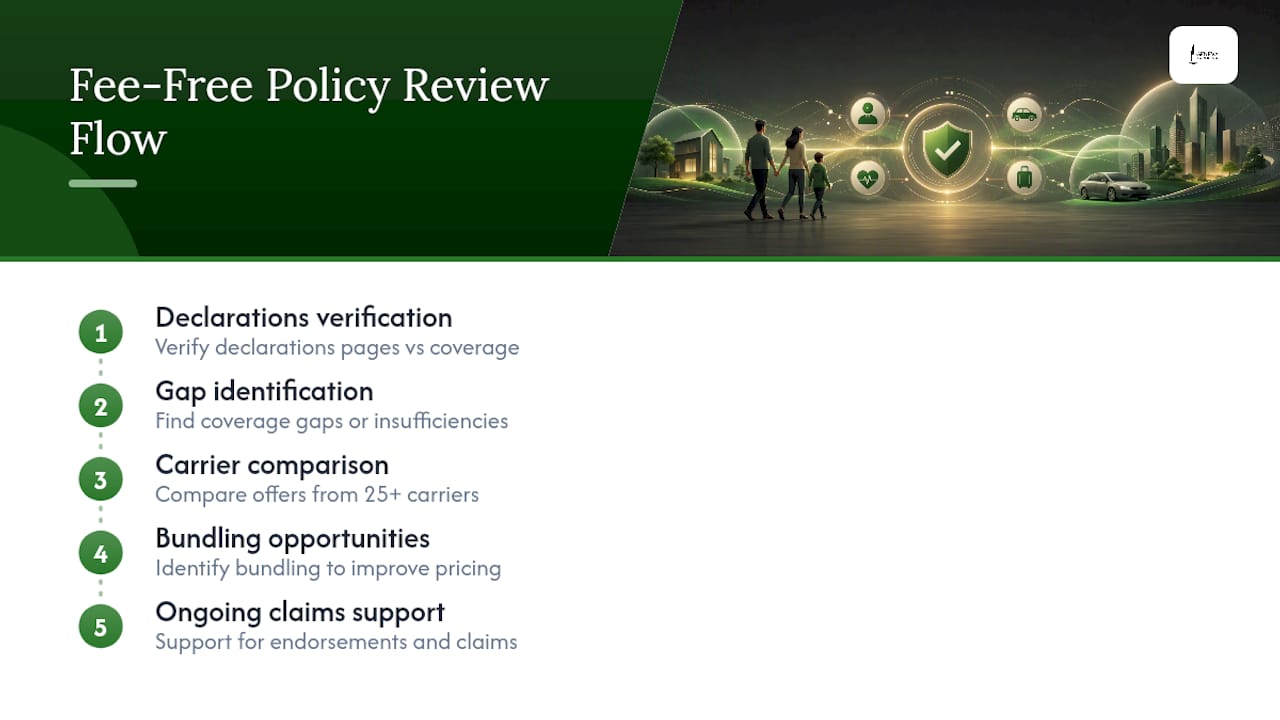
Bring your current declarations pages and renewal notices to the conversation, and the agency handles the rest, from requesting endorsements to producing an updated declarations page you can file for reference. Independent access to multiple carriers tends to surface options a single-carrier agent simply can't offer, particularly when bundling or adding coverage without raising your overall exposure.
Why Most People Review Their Policy Wrong
The conventional advice tells people to "check their coverage every year," which is technically correct and practically useless. Nobody knows what "checking coverage" means without a map of where the money actually hides in a policy.
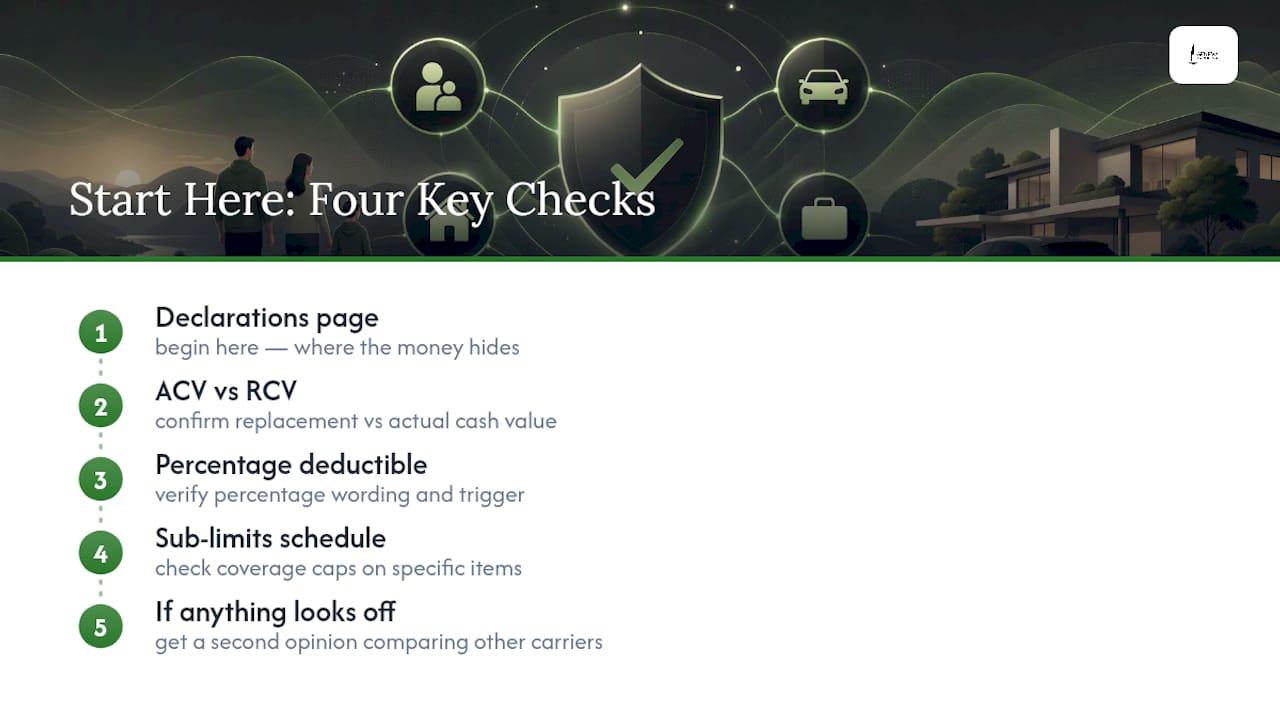
Here's what the research on this actually supports: the handful of clauses that decide claim outcomes are not scattered randomly through a 40-page contract. They cluster in predictable spots. The declarations page, the ACV versus RCV designation, the percentage deductible language, and the sub-limits schedule. A reader who checks those four things in thirty minutes catches more real exposure than someone who reads the entire policy cover to cover and skims past the part that matters.
The bigger failure I see in how this topic gets covered is treating a review as a compliance chore instead of a financial decision. That's not a paperwork issue. Start with the declarations page, verify the four items above, and if anything looks off, get a second opinion from someone who can compare your policy against other carriers instead of just renewing it.
— David
Get a Fee-Free Second Opinion on Your Coverage
An independent review can compare your coverage across more than 25 A-rated carriers at no cost to you.
That matters because a single-carrier agent can only tell you what that one insurer offers. An independent agency is not tied to one company, so the comparison can reveal more options, whether checking for a hidden percentage deductible in a homeowners policy or verifying business liability limits still match the business. The review covers declarations verification, gap identification, and bundling opportunities, explained in plain language instead of policy jargon, and licensed agents handle claims advocacy if you ever need to use the coverage you're paying for.
If your renewal notice is sitting in a drawer somewhere, that's the file to pull first. Request your fee-free policy review and find out in one conversation whether your current coverage actually holds up.
This article is general information, not a substitute for advice from a qualified financial advisor. Consult a qualified financial professional about your own circumstances before acting on anything here.
Sources
For deeper reference, keep these on hand: NAIC's consumer checklists, FloodSmart for NFIP flood coverage, the III on review frequency, SBA business insurance guidance, and IRS contractor definitions for business owners with 1099 workers.
- Searching for a Homeowners Insurance Policy? Tips to Get the Most Value
- How to Do a Policy Review: Coverage, Limits & Exclusions - LegalClarity
FAQ
How Do I Review My Insurance Policy?
Start with the declarations page for each policy, then check your limits, deductibles, valuation basis, and exclusions line by line. Compare what you find against your current rebuild costs, net worth, and life circumstances, and flag anything that looks outdated for a conversation with your agent.
Who Has the Best Insurance Reviews?
An independent agency that compares multiple carriers, rather than a single-company agent, generally gives you the most complete review because it isn't limited to one insurer's products. Some independent agencies offer fee-free reviews across multiple A-rated carriers, allowing you to see how your current coverage stacks up without cost or obligation.
Why Is My Claim Under Review?
Insurers place claims under review to verify coverage details, confirm the loss matches your policy terms, and check for exclusions or sub-limits that might apply. This is routine for larger claims and doesn't necessarily mean your claim will be denied, but it's worth confirming your declarations page and coverage details are current before you file.
What Does "Insurance Review" Mean?
An insurance review means checking your existing policy's limits, deductibles, exclusions, and terms against your current life or business situation to confirm the coverage still fits. It's recommended at least annually and immediately after major events like a move, a marriage, or a new business venture, according to NAIC.