

Your personal auto policy stops covering you the moment you turn on the driver app, and Uber or Lyft's insurance doesn't fully kick in until you accept a ride. That gap, called Period 1, is where most rideshare drivers get burned financially. The fix is straightforward: add a rideshare endorsement to your personal policy if you drive part-time (roughly $15 to $30 a month), or move to a full commercial policy if rideshare driving is your main job.
TL;DR:
- Most rideshare drivers face significant financial risk during Period 1, when their personal policy often does not cover them and platform liability is limited.
- Adding a rideshare endorsement to your personal policy costs around $15 to $30 monthly and mainly benefits drivers logging less than 20 hours weekly on one platform.
- Full commercial policies remove livery exclusions entirely and are suitable for full-time or multi-platform drivers, but they are more expensive than endorsements.
- Verifying how your insurance handles collision coverage during Period 1 is critical, as many policies deny claims due to livery exclusions, especially in accidents while waiting for rides.
- An independent policy review can help drivers understand their specific coverage gaps across states and platforms, ensuring they select the best option for their driving habits.
Table of Contents
- Understanding Rideshare Insurance Coverage: The Core Types
- How Uber and Lyft Insurance Works During Each Driving Period
- Where the Real Financial Exposure Hides
- Rideshare Endorsement vs. Commercial Policy: Which One Fits You
- Your One-Call Checklist Before You Drive Again
- What a Fee-Free Policy Review Actually Catches
- State Rules Change What "Covered" Actually Means
- Comparing Your Real Options as a Driver
- An Agent's Take on the One Thing to Verify First
- Get a Fee-Free Policy Review Before Your Next Shift
- Where to Verify Your Coverage Directly
- Sources
- FAQ
Understanding Rideshare Insurance Coverage: The Core Types
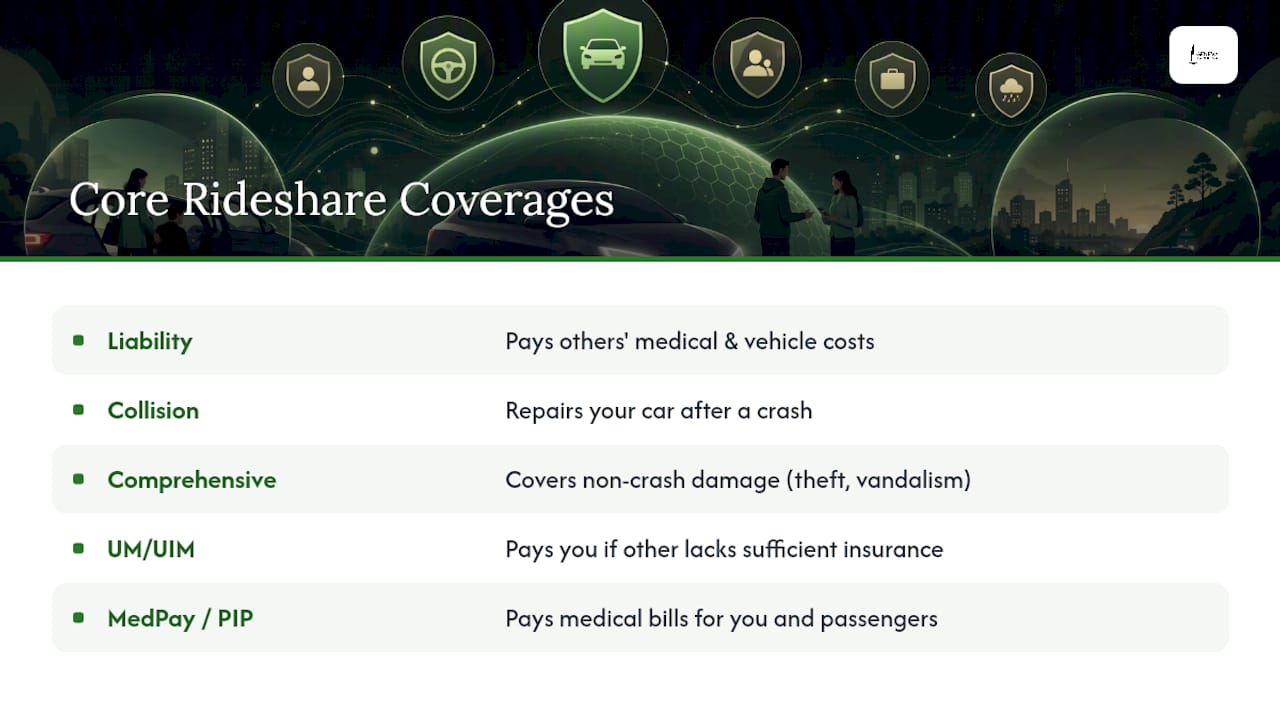
Every rideshare policy conversation comes back to five coverage types, and knowing what each one actually does saves you from a bad surprise after a collision.
Liability coverage pays for the other driver's medical bills and vehicle damage when you're at fault. Collision coverage pays to repair your own car after a crash, regardless of fault. Comprehensive coverage handles non-collision damage like theft, vandalism, or a cracked windshield from road debris. Uninsured/underinsured motorist coverage (UM/UIM) pays your medical bills and vehicle repairs when the other driver has no insurance or not enough of it. MedPay or PIP covers medical bills for you and your passengers no matter who caused the crash, and in some states, occupational accident coverage or Optional Injury Protection replaces lost income and covers injuries while you're logged into the app.
Here's the catch almost nobody reads carefully: standard personal auto policies contain a livery exclusion, language that voids coverage the moment you're driving for hire. A rideshare endorsement rewrites that clause so your personal insurer stays on the hook during the periods that rideshare companies don't fully cover.
Picture a fender bender while you're waiting for a ride request. Your personal insurer might deny the claim outright, citing the livery exclusion. The rideshare company's policy typically offers only limited liability at that moment, not collision coverage for your own car. Without an endorsement bridging that gap, you're paying for repairs out of pocket.
Pro Tip: Call your personal insurer and ask directly, "Do I have a livery exclusion, and does my policy list rideshare driving as an approved use?" Get the answer in writing or in your policy documents, not just verbally from a phone rep.
How Uber and Lyft Insurance Works During Each Driving Period
Rideshare companies split driver coverage into distinct time blocks, and knowing which one you're in tells you exactly what protection exists.
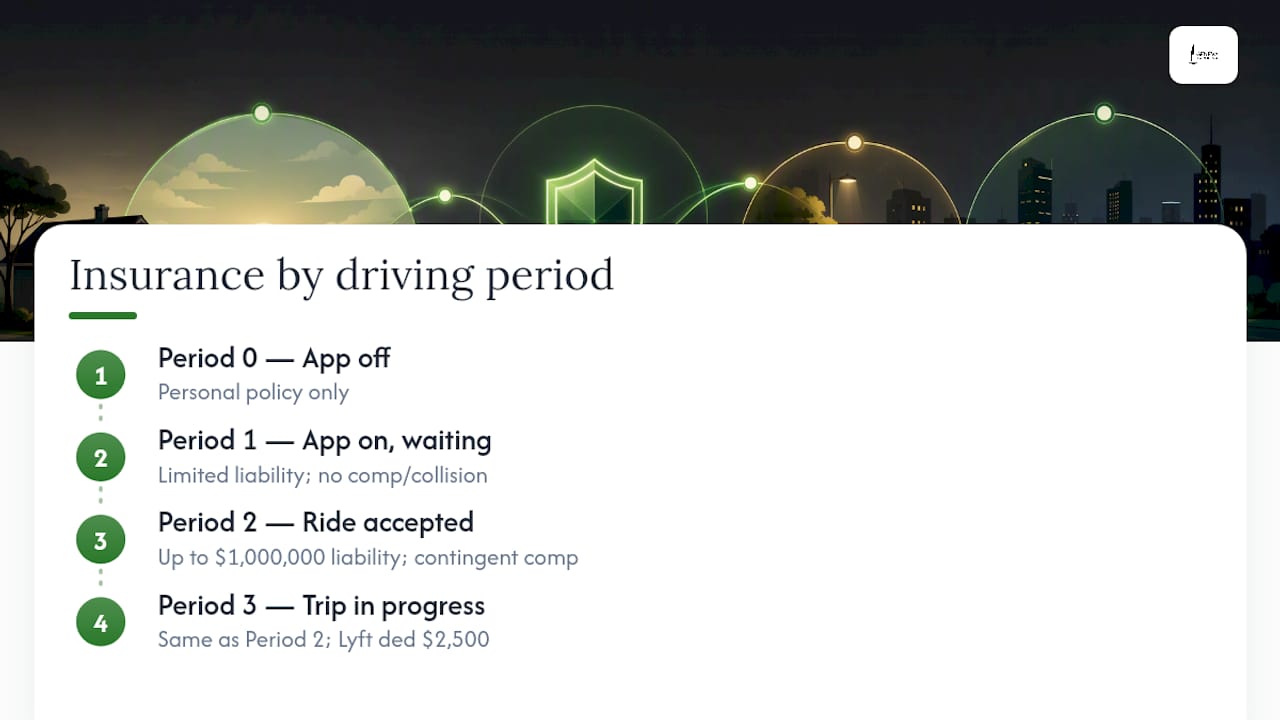
Period 0: App off. You're driving your own car for personal reasons. Only your personal auto policy applies here, exactly as it would for any errand.
Period 1: App on, waiting for a request. This is the coverage no-man's-land. Uber maintains commercial insurance that typically provides limited third-party liability during this period, but not collision or comprehensive coverage for your car. Lyft's structure is similar, with liability limits during this waiting phase running lower than during an active trip in some markets.
Period 2: Ride accepted, en route to pickup. Once you accept a request, both companies raise coverage substantially, generally up to $1,000,000 in third-party liability.
Period 3: Passenger in the car, trip in progress. Coverage stays at that same elevated level through drop-off.
For Periods 2 and 3, both platforms also offer contingent collision and comprehensive coverage, up to your car's actual cash value, but only if you already carry collision and comprehensive on your personal policy. Lyft applies a $2,500 deductible on this contingent coverage, and Uber's structure works similarly.
UM/UIM availability and occupational accident coverage vary by state, and a few markets, including Washington and Massachusetts, apply special workers' compensation style rules for on-trip injuries. Your platform's Certificate of Insurance, found in the driver app's help section, lists the exact numbers for your state. Check it before you assume anything.
Where the Real Financial Exposure Hides
Period 1 is where drivers lose real money, because it combines the weakest platform coverage with a personal policy that may flatly refuse to pay.
Run the numbers on a plausible scenario. You're parked with the app on, waiting for a ride request, when another driver rear-ends you.
- Vehicle repair: $4,000 in bodywork, denied by your personal insurer under the livery exclusion, and not covered by the platform's minimal Period 1 liability for your own car.
- Medical costs: If you're injured and the other driver is uninsured, your UM/UIM coverage, or lack of it, determines whether you pay those bills yourself.
- Lost earnings: Without occupational accident coverage, a week off the road while your car gets fixed is a week of unpaid income.
- Legal fees: If the other driver disputes fault, you may need an attorney, and neither policy automatically covers that cost.
Deductibles complicate the picture further. Your contingent collision deductible under the platform's policy applies on top of, not instead of, whatever deductible sits on your own policy. Advisors consistently flag Period 1 as the single largest exposure rideshare drivers face, precisely because it's the moment when both sides of the coverage stack are weakest at once.
Rideshare Endorsement vs. Commercial Policy: Which One Fits You
Three practical paths exist, and the right one depends almost entirely on how many hours a week you're actually driving.
- Rideshare endorsement: An add-on to your existing personal auto policy that closes the Period 1 gap for collision and comprehensive. It typically runs $15 to $30 a month and fits drivers logging under 20 hours a week on one platform.
- Hybrid or daily-priced options: Some insurers offer coverage that activates only on days you actually drive. It's cheaper for occasional drivers but can leave you uncovered if you forget to toggle it on.
- Full commercial policy: Built for full-time drivers, multi-platform drivers, or anyone using the vehicle for other commercial work. It costs substantially more than an endorsement but removes livery exclusions entirely and often includes higher liability limits.
The endorsement route has an underrated benefit beyond just closing Period 1: it typically keeps your own deductible in play instead of forcing every claim through the platform's contingent coverage and its separate deductible.
Pro Tip: If you drive for more than one rideshare or delivery app, tell your agent every platform by name. An endorsement written for Uber alone may not extend to Lyft or a food delivery app, even if you're using the same car the same day.
Your One-Call Checklist Before You Drive Again
Before you accept another ride, get these answers from your insurer in writing.
- Ask exactly how Period 1 collision and comprehensive are handled, and get the modified livery exclusion language in writing.
- Confirm whether UM/UIM applies during rideshare driving in your state specifically.
- Ask how your deductible interacts with the platform's contingent collision deductible if a claim touches both.
- Watch for red flags: an insurer who won't document the endorsement, vague "call us for terms" answers, or an unexplained premium jump with no coverage change.
- After any accident, save photos, your app timestamps showing your status at the time, the platform's Certificate of Insurance, and the police report.
Pro Tip: Take a screenshot of your driver app status the moment a crash happens, if it's safe to do so. That timestamp often becomes the deciding factor in which insurer pays first.
What a Fee-Free Policy Review Actually Catches
A licensed agent reading your policy line by line finds things a quick phone call never surfaces, especially buried livery exclusions and endorsement gaps between multiple platforms.
An independent agency can compare options across many A-rated carriers during a fee-free policy review, translating the fine print into plain language instead of leaving you to decode it alone. Drivers in certain states may get a review built around their own state's UM/UIM and TNC rules rather than generic national advice. Such a review can also include claims advocacy: if a rideshare accident triggers a dispute between your personal insurer and the platform's policy, someone may work that phone call on your behalf, not just hand you a claims number.
State Rules Change What "Covered" Actually Means
Rideshare insurance requirements are not uniform across the country, and a few states impose rules that go beyond what Uber or Lyft's baseline coverage provides.
Some states mandate minimum liability limits for Transportation Network Companies (TNCs) that exceed standard personal auto minimums, particularly for Period 1. Others require rideshare companies to carry contingent UM/UIM coverage, while several states leave that decision to the platform, meaning it may or may not exist depending on where you drive. Washington and Massachusetts stand out for applying workers' compensation style rules to injuries sustained during active trips, a structure most states don't use at all.
This state-by-state patchwork means two drivers running the identical app in different states can have meaningfully different protection, even though the platform's national marketing describes one unified coverage story. The only reliable way to know your actual numbers is checking your state's insurance regulator guidance alongside the platform's Certificate of Insurance for your specific market. The NAIC's consumer guidance on the sharing economy is a solid starting point for understanding how your state treats TNC coverage before you assume the national averages apply to you.
If you drive across state lines regularly, for example living near a state border and picking up rides in both states, confirm with your agent whether your endorsement or commercial policy travels with you or resets based on where the trip starts.
Comparing Your Real Options as a Driver
Instead of chasing brand names, it helps to think in terms of what each category of product actually solves.
A rideshare endorsement solves the Period 1 gap cheaply and keeps your existing personal policy intact, making it the default choice for anyone driving under 20 hours weekly on a single platform. To understand how such rider add-ons function and why comparing these endorsements matters, see Life Insurance Riders: What They Do and When to Add One. A commercial policy solves a bigger problem: full livery exclusion removal, higher liability ceilings, and coverage that doesn't care how many platforms or hours you log, which matters once rideshare driving becomes closer to a full-time job than a side gig. Hybrid, pay-per-day products solve a narrower problem still, covering occasional drivers who might drive once a week but don't want a permanent monthly add-on.
The mistake most drivers make isn't picking the wrong category outright, it's guessing which category fits instead of running actual numbers on hours driven, number of platforms used, and state-specific UM/UIM rules. A driver logging 35 hours a week across two apps in a state with weak UM/UIM defaults needs a fundamentally different setup than someone driving six hours on weekends for gas money. An independent review that pulls quotes across more than 25 carriers gives you an apples-to-apples comparison instead of a single insurer's pitch for whichever product they happen to sell.
An Agent's Take on the One Thing to Verify First
If you only check one thing this week, check whether your policy actually pays for collision damage during Period 1, the waiting period. That single gap causes more denied claims than any other part of rideshare coverage.
The misunderstanding I hear most is "my personal policy will always cover me, I'm just driving my own car." It won't, once the livery exclusion applies, and that surprise usually lands at the worst possible moment, right after a crash.
— David
Get a Fee-Free Policy Review Before Your Next Shift
You've just read what separates a covered claim from a denied one: knowing exactly which policy applies in which period, and closing the gap before you need it. An independent agency can run that check for you, comparing your current policy against many A-rated carriers at no cost, so you find out where your livery exclusion sits and whether an endorsement or commercial policy fits your driving hours.
Getting started takes three steps. First, request your fee-free policy review online. Second, pull together your current auto policy documents and a rough count of your weekly driving hours across every platform you use. Third, schedule a short call with an agent who can walk through your state's specific UM/UIM and TNC rules and quote endorsement or commercial auto insurance options side by side. If you're ready to compare rates directly, you can also start an insurance quote now and have numbers in hand before your next shift.
Where to Verify Your Coverage Directly
Certificates of Insurance and your state's own rules are the final word on what applies to you, not a blog post or a driver forum.
- Uber's driver insurance page lists current coverage limits and state variations.
- Lyft's help center article on insurance breaks down period-by-period coverage.
- NAIC's sharing economy consumer guidance explains how regulators view TNC coverage.
- Forbes Advisor's rideshare insurance guide walks through endorsement versus commercial decisions in more detail.
This article is general information, not a substitute for advice from a qualified financial advisor. Consult a qualified financial professional about your own circumstances before acting on anything here.
Sources
- Insurance for Rideshare and Delivery Drivers | Uber
- Insurance coverage while driving with Lyft - Lyft Help
- How To Find The Best Rideshare Insurance | Forbes Advisor
- Sharing economy guidance | NAIC
FAQ
What insurance is best for rideshare driving?
For most part-time drivers, a rideshare endorsement added to a personal auto policy is the most cost-effective fix, since it closes the Period 1 gap for around $15 to $30 a month. Full-time or multi-platform drivers usually need a full commercial policy instead, since it removes the livery exclusion entirely rather than just bridging one gap.
Can I buy just rideshare insurance on its own?
No, a rideshare endorsement isn't sold as a standalone product. It's added on top of an existing personal auto policy, which is why insurers ask whether you already have collision and comprehensive coverage before quoting the endorsement.
Is rideshare insurance more expensive than a regular policy?
Adding a rideshare endorsement typically raises your premium modestly, in the range of $15 to $30 monthly, while switching to a full commercial policy costs considerably more since it covers broader commercial use. The jump reflects the extra risk insurers take on during the periods your personal policy would otherwise exclude.
Which insurance company is good for rideshare drivers?
Rather than one insurer being universally best, the right fit depends on your state, hours driven, and how many platforms you use. A fee-free policy review from an independent agency like Genevainsgroup compares options across more than 25 A-rated carriers so you see real quotes side by side instead of guessing.