
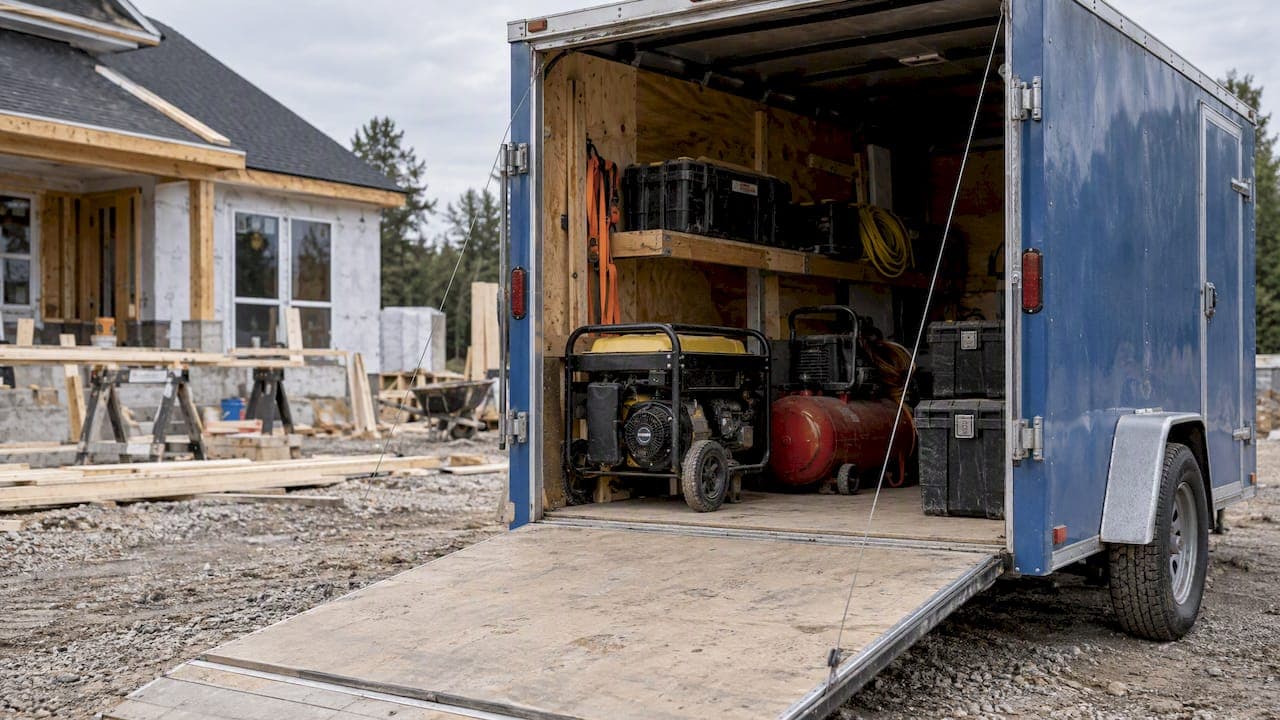
Inland marine insurance is property coverage for movable or specialized business assets: tools, equipment, cargo and similar items that travel over land or sit away from your main address. Despite the name, it has nothing to do with boats. If your property leaves your building, a standard commercial property policy or Business Owners Policy (BOP) often will not follow it, and inland marine is the coverage built to fill that gap.
Below, we explain what the term means, what is and is not covered, which businesses need it, how policies are written, and what to ask before you buy.
TL;DR
- Inland marine insurance protects movable business property, such as tools, equipment, cargo and fine art, while it is in transit, on a job site or stored off-site.
- "Inland marine" is a category, not one product. Your policy may be titled a contractor's equipment floater, a camera floater or a fine arts floater.
- Common exclusions include wear and tear, intentional damage and floods or earthquakes, which usually need separate coverage.
- Insurers may ask for proof of secure storage, transit tracking and an updated equipment list, so good records protect your claim.
- A free policy review can show whether your current BOP leaves your mobile equipment uncovered.
Table of Contents
- What inland marine insurance actually means
- Inland marine vs. ocean marine
- What inland marine insurance covers
- What it does not cover
- A worked example: a stolen trailer
- Who needs inland marine insurance
- How inland marine fits with your other coverage
- How policies are written and priced
- What to check before you buy
- Our perspective: what we see in policy reviews
- Get your coverage checked
- FAQ
- Sources
What inland marine insurance actually means
The word "marine" is historical. According to Wikipedia's overview, inland marine is an insurance category in the United States that covers loss to movable or specialized property, and it grew out of ocean marine insurance. The Insurance Information Institute (Triple-I) puts the contrast simply: marine insurance covers goods moving over water, while inland marine covers products, materials and equipment moving over land, for example by truck.
The category is wider than trucking, though. Investopedia notes that it covers movable or specialized assets that are transported over land or temporarily stored off-site, and that it can include tools, equipment, cargo, fine art and even infrastructure such as radio towers. The common thread is property that does not stay put, or property that is specialized enough that a general property form handles it poorly.
Why you will not see the words "inland marine" on your policy
Inland marine is defined as a broad class in the NAIC's nationwide inland marine definition, not as a single standard product. In practice, that means the document you receive is usually called a floater: a Contractor's Equipment Floater, a Camera Floater, a Fine Arts Floater. If you search your declarations page for "inland marine" and find nothing, look for the word "floater" or for scheduled property instead.
Inland marine vs. ocean marine
The difference is the route the property travels. Ocean marine insurance covers goods shipped by vessel or aircraft across international waters or by air. Inland marine is restricted to land transportation, such as truck or train, or to specialized land-based property. Triple-I describes the distinction and notes that some carriers offer worldwide cargo policies that combine both for seamless coverage.

If your business ships goods overseas or operates vessels, Triple-I's page on insuring marine businesses and cargo explains who is exposed to maritime risk. If your equipment rides in a pickup or trailer, inland marine is the relevant category.
What inland marine insurance covers
The most common uses fall into a few groups. The table maps typical property to the floater that usually covers it.
| Type of property | Typical floater or form | Who usually buys it |
|---|---|---|
| Hand tools, power tools, machinery, heavy equipment | Contractor's equipment floater | Contractors, landscapers, trades |
| Materials awaiting or undergoing installation | Installation floater | Electrical, HVAC, plumbing, solar trades |
| Cameras, lighting, audio-video gear | Camera or electronic equipment floater | Photographers, videographers, event companies |
| Fine art, instruments, collectibles | Fine arts or valuable articles floater | Galleries, musicians, collectors |
| Freight hauled for others | Motor truck cargo | For-hire carriers |
| Goods in transit or off-site storage | Transit or cargo coverage | Wholesalers, retailers, manufacturers |
The form names vary by carrier, so treat the table as a guide to what to ask for, not as exact policy wording.
Tools and equipment insurance
Many readers arrive looking for tools and equipment insurance or contractors equipment insurance. Those are the same idea. Insurance.com explains that tools and equipment insurance, also called an equipment floater or contractor's equipment insurance, covers business property while it is transported, used or stored somewhere other than your fixed company address.
That last phrase matters. A standard commercial property policy is built around a building and the contents inside it. Once a generator, laser level or pressure washer is on a client's property, a policy tied to your own address may offer little or nothing. NerdWallet gives similar examples: tools on a construction site, or inventory in a warehouse that is not yours.
What it does not cover
Exclusions vary by carrier and form, so read the wording. Triple-I's guidance lists these as common:
- Normal wear and tear.
- Intentional damage.
- Damage from natural disasters such as floods or earthquakes, which often require separate policies.
- Stationary property kept at the main business premises, which belongs under your commercial property coverage.
Two more points come up in claims. First, inland marine is property coverage. It does not pay for injuries or for damage your work causes to someone else's property, which falls under general liability. Second, vehicles are normally handled under commercial auto, not under a floater. Keeping those lines straight prevents the unpleasant surprise of finding out, after a loss, that the claim belonged on a different policy.
A worked example: a stolen trailer
Picture a two-person remodeling company in Illinois. Its owner keeps $40,000 of saws, compressors, nail guns and a laser level in a locked trailer. A BOP covers the office and its contents. One night the trailer is stolen from a job site.
With only the BOP, the owner may find that the equipment was away from the described premises and is not covered, depending on the policy's wording. With a contractor's equipment floater that lists the equipment and its values, the claim is about what the schedule says, the deductible and the policy's conditions on theft. The example is illustrative, not a promise of any particular outcome. It shows why the question to ask is not "do I have property insurance?" but "where does my property have to be for it to be covered?"
Who needs inland marine insurance
Ask yourself three questions:
- Does valuable business property leave your premises regularly?
- Do you keep equipment on client sites, in vehicles, or in storage you do not own?
- Would replacing it out of pocket hurt the business?
If you answered yes to any, inland marine deserves a look. Typical buyers include:
- Contractors and trades. Tools and machinery move between job sites daily. Our page on construction and contractor insurance covers how those exposures fit together.
- Trucking and logistics companies. Cargo in your custody is someone else's property and your responsibility. See our trucking and transportation insurance page.
- Auto dealers and exotic-car businesses. High-value inventory moves between lots, shows and customers. We cover that on our auto dealer and exotic car insurance page.
- Photographers, event and AV companies. Their gear is portable and expensive.
- Home-based businesses. Business equipment at home is often limited under a homeowners policy. Our guide to home-based business insurance limits shows how low those limits can be.
How inland marine fits with your other coverage
Think of inland marine as a complement, not a replacement. Your commercial property insurance covers the building and contents at your address. Inland marine follows the property that moves or that needs specialized valuation. General liability covers harm to others. Commercial auto covers the vehicle itself.
For individuals the same logic applies on a smaller scale. Personal property coverage under a homeowners policy has limits and conditions, which is why valuable items such as jewelry or art are often scheduled separately. Our High-Value & Specialty page covers that side.
If you are buying equipment with financing, look at the whole cost of ownership, including insurance. This comparison of owner financing versus bank loans is a useful read on how to fund equipment and property purchases.
How policies are written and priced
Inland marine can be written two main ways. A scheduled approach lists each item with its value, which suits a defined set of expensive equipment. A blanket approach covers a group of items up to a limit, which can be easier to manage for many smaller tools. Which one fits depends on how many items you have and how often they change.
Premiums depend on the underlying risk. We do not publish a price for inland marine because it is not a flat-rate product, and any figure quoted without your equipment list would be a guess. The factors that usually move the price are:
- The total value of what you insure.
- Your trade and how the equipment is used.
- Where it travels and how it is stored overnight.
- Theft and claims history.
- The deductible you choose.
Triple-I's guidance also points out that your risk management matters. Insurers may want proof of secure storage, transit tracking and an updated inventory schedule to keep coverage effective for high-value mobile equipment. Locked storage, serial numbers, photos and an up-to-date list all help you at renewal and, more importantly, at claim time.
What to check before you buy
- Valuation. Does the policy pay replacement cost or actual cash value? The difference can be large on older equipment.
- Where coverage applies. Job sites, vehicles, off-site storage, and whether unattended property is treated differently.
- Theft conditions. Some forms require locked, secured storage or visible signs of forced entry.
- Exclusions. Look for flood, earthquake, wear and tear, and anything specific to your trade.
- Rented or borrowed equipment. Ask whether equipment you do not own is covered, and whether you must cover it under a rental agreement.
- New purchases. How quickly is a newly acquired item covered, and how do you report it?
- Deductible. Pick one you could pay tomorrow without strain.
These questions are also the ones a good agent should be happy to answer in plain language.
Our perspective: what we see in policy reviews
The gap we run into most often is not a lack of insurance. It is an assumption. A business owner has a BOP, believes "property" is handled, and has never been told that the coverage is tied to an address. The first time anyone checks is after a loss.

Because we are an independent agency that compares options across more than 25 A-rated carriers, we can look at how different insurers write floaters rather than fit you into one company's form. We would rather you understand the difference between a scheduled and a blanket approach, and know exactly what your theft conditions are, than buy the lowest premium and learn the fine print at claim time. When a claim does happen, we advocate for you with the carrier.
If you are unsure whether your equipment is covered, do not guess and do not wait for a renewal notice. Pull out your declarations page, make a list of what leaves your premises, and compare the two. The mismatch, if there is one, is usually obvious in ten minutes.
— David
Get your coverage checked
We offer a fee-free policy review where we look at your existing coverage and point out gaps, with no obligation. If you already know you need protection for tools, equipment or cargo, start with our business insurance page or request insurance quotes and tell us what moves, where it goes and what it is worth. We are licensed in 17 states, including Illinois, Florida and Washington.
FAQ
What is inland marine insurance?
It is property insurance for movable or specialized assets, such as tools, equipment and cargo, while they are transported over land or kept away from your main address. It fills the gap left by BOPs and commercial property policies that typically cover only property at a fixed location. The name comes from ocean marine insurance, but it applies to land-based risks.
What is an example of an inland marine claim?
A contractor's trailer of tools is stolen from a job site, or a photographer's camera kit is damaged in transit to a shoot. In both cases the property was away from the business address, which is where a standard property policy often stops responding. Whether the claim is paid depends on the form, the schedule, the deductible and the policy conditions.
What is the difference between ocean and inland marine insurance?
Ocean marine covers goods carried by ship or aircraft over international waters or by air. Inland marine is limited to land transportation, such as truck or train, and to specialized land-based property. Some carriers combine both in worldwide cargo policies.
Is tools and equipment insurance the same as inland marine?
It is one type of inland marine. It is also called an equipment floater or contractor's equipment insurance, and it covers business property while it is transported, used or stored away from your fixed address. Other floaters cover cameras, fine art and similar property.
Sources
- Understanding inland marine insurance, Triple-I
- Insuring marine businesses and cargo, Triple-I
- Nationwide Inland Marine Definition (MDL-701), NAIC
- Inland Marine Insurance Explained, Investopedia
- Tools and equipment insurance: Do I need it?, Insurance.com
- Inland Marine Insurance: What It Covers, How to Get It, NerdWallet
- Inland marine insurance, Wikipedia