
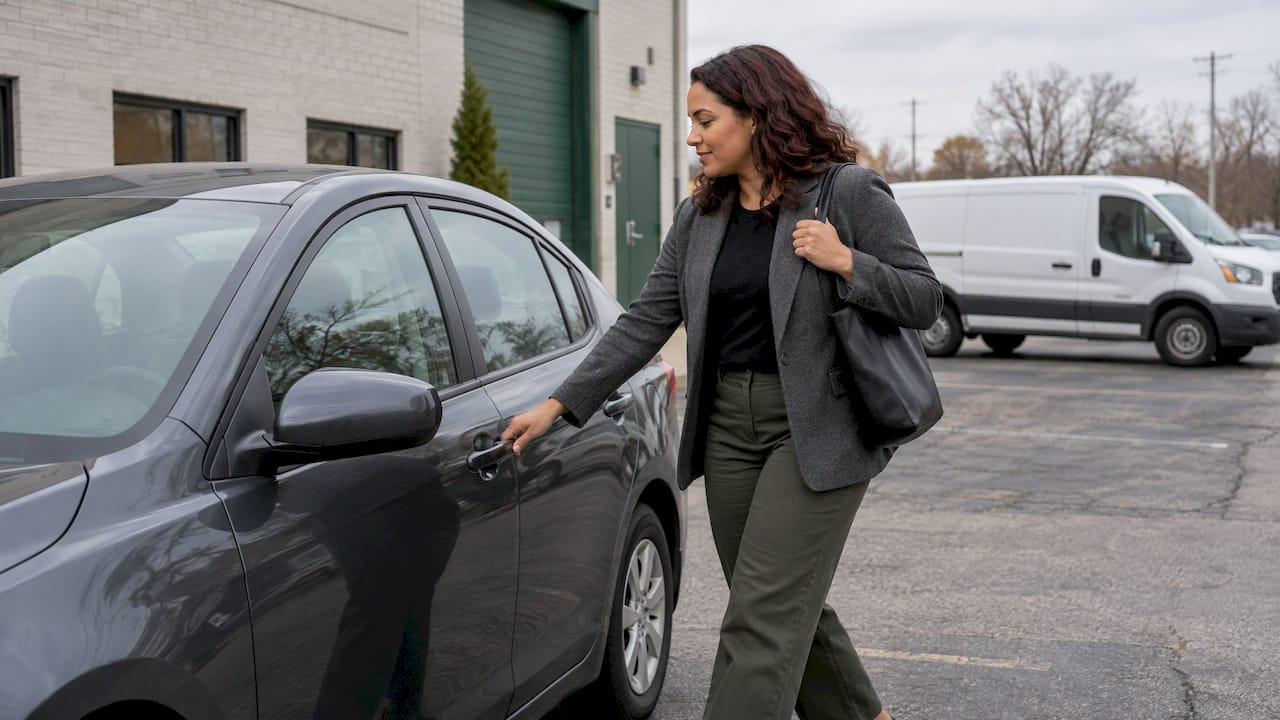
Hired and non-owned auto (HNOA) coverage is liability protection for your business when a vehicle you don't own is used for work. That means a van your company rents for a weekend job, or an employee's own car on a bank run, a client visit or a supply pickup. If that driver causes an accident, the claim can land on your business, and your personal auto policy and a standard general liability policy are not built to answer it. HNOA is the piece that closes that gap, and for a business with no company-owned vehicles it is often the only auto coverage needed. We place it as part of a business insurance review across more than 25 A-rated carriers, so you see how each one writes it before you choose.
TL;DR
- Hired auto means vehicles your business rents, leases or borrows. Non-owned auto means vehicles your business doesn't own or hire that are used for business, including employees' personal cars.
- HNOA is liability coverage. It pays for injury and property damage you are legally responsible for, plus legal defense. It does not repair the vehicle itself.
- Personal auto insurance usually doesn't cover vehicles used for work, so an employee's policy may not protect your business.
- Common exclusions include workers' compensation obligations, certain employee injuries, property in your care, custody or control, and racing.
- Cost depends on vehicle use, location, claims history and deductible. A free policy review shows whether you already have the coverage or have a gap.
Table of Contents
- What hired and non-owned auto means in plain terms
- What HNOA actually pays for
- Why your other policies may not respond
- HNOA vs commercial auto vs personal auto
- Who needs it
- What is typically excluded
- Limits: how much liability is enough
- What affects the cost
- How to put HNOA in place
- Perspective: what we see as the real HNOA risk
- Get your HNOA coverage reviewed
- FAQ
- Sources
What hired and non-owned auto means in plain terms
The two halves of the name describe two different situations, and they are written into the standard commercial auto form.
Hired auto. Under the standard Business Auto Coverage Form, hired autos are vehicles leased, hired, rented or borrowed by the business. The form carves out vehicles obtained from employees, partners, LLC members or their household members. So a rental van from a truck-rental counter is a hired auto. A car borrowed from the owner's own family member is not.
Non-owned auto. These are vehicles the business doesn't own, lease, hire, rent or borrow that are used in connection with the business. The same form includes employees' vehicles while they are used for business. An employee driving a personal sedan to meet a customer is the classic example.
The practical difference is simple. Hired is a vehicle your company arranged to use. Non-owned is a vehicle that belongs to someone else and ends up on a work errand. That is why people searching for hired auto vs non-owned auto often find the two bundled together: most policies sell them as a single endorsement or coverage line.

What HNOA actually pays for
HNOA is liability coverage. The NAIC, the national association of state insurance regulators, explains that liability coverage helps pay for damage or injuries you cause in an accident. The NAIC's 2022/2023 Auto Insurance Database Report adds that bodily-injury liability pays damages for injury to others for which the insured is legally liable, and that the insurer also defends the insured and pays legal defense costs.
In practice, that means HNOA responds when:
- An employee, running a work errand in their own car, hits another vehicle and the other driver's repair bill and medical costs are claimed against your business.
- A rented box truck damages a customer's property or injures a pedestrian.
- A lawsuit follows an accident, and defending it costs money before any judgment is decided.
What it generally doesn't do is pay to fix or replace the car being driven. Physical damage to the rental or the employee's car is a separate coverage question, and it is worth settling before the keys change hands.
Why your other policies may not respond
Many owners assume something else already covers this. Often it doesn't.
The NAIC notes that personal auto insurance usually doesn't cover vehicles used for work. Its small business guidance also advises businesses to check the provisions of personal auto and liability policies, because business-related liability may be excluded. Commercial auto policies, by contrast, may include coverage for rented and other non-owned vehicles, including employees' cars driven for company business.
That creates three common gaps:
- The employee's personal policy has an exclusion or low limits. The employee's own insurer may deny or limit a claim from a business trip. If the limits run out, a plaintiff can look to the business.
- General liability doesn't pick it up. Business liability policies commonly exclude auto accidents, since auto liability is meant to be insured separately.
- No commercial auto policy exists. A business with no owned vehicles often has no commercial auto policy at all, and so has no hired or non-owned protection either.
HNOA can be added to a commercial auto policy or, depending on the carrier, attached to another business policy. Where it sits matters less than confirming it exists and that the limits are adequate.
HNOA vs commercial auto vs personal auto
| Personal auto | Commercial auto (owned vehicles) | HNOA | |
|---|---|---|---|
| Who it protects | The vehicle owner and household | The business, for vehicles it owns | The business, for vehicles it doesn't own |
| Work use | Usually not covered | Covered | Covered for liability |
| Typical buyer | Individuals and families | Companies with vans, trucks or fleets | Companies whose people drive rentals or personal cars for work |
| Pays for damage to the vehicle | Yes, with physical damage coverage | Yes, with physical damage coverage | No, liability only |
The NAIC points out that business auto insurance often carries higher limits and extra protections, such as coverage for rented vehicles and vehicles driven or owned by employees. If your company owns even one vehicle, a commercial auto policy is the base layer, and non-owned exposure should be reviewed alongside it. If you own none, HNOA alone may be the right fit.
Who needs it
Ask one question: does anyone drive for the business in a vehicle the business doesn't own? If yes, you have the exposure. Typical examples:
- A contractor whose crew rents a trailer or truck for a large job.
- A real estate or sales office where staff drive personal cars to showings and meetings.
- A restaurant or retail shop where employees run deliveries or supply errands in their own cars.
- A home-based business owner who rents a van for trade shows. If that describes you, note that home-based business policies can carry low limits that don't extend to auto liability at all.
- A nonprofit or church where volunteers shuttle people in their own vehicles.
There is no general federal rule requiring HNOA. The NAIC says most states require drivers to carry at least a basic level of auto insurance, but that is a requirement on the vehicle's owner and driver, not a mandate to buy HNOA. Your obligation comes from contracts instead: clients, landlords and rental companies sometimes ask for proof of hired and non-owned coverage, and a lender or a larger customer may require it before you start work.
What is typically excluded
Read the exclusions before you rely on any policy. The standard business auto form excludes, among other things:
- Workers' compensation obligations, and certain injuries to employees. An employee hurt in the accident is generally a workers' compensation matter, not an auto liability one.
- Damage to property in the insured's care, custody or control.
- Racing and similar contests.
- Certain pollution-related losses.
The form also reminds readers that the symbols entered next to a coverage on the declarations page designate the only autos that are covered, and that the policy should be read carefully to determine what is and isn't covered. Hired autos and non-owned autos each have their own symbol. If the declarations page doesn't list them against liability, your business may not have the coverage you think it has.
Two more points are worth confirming on your own policy. First, whether employees who drive for work are required to have their own insurance, and at what limits. Second, how the carrier treats an employee who uses a personal car regularly as part of the job, such as a full-time delivery role, since that usage may be handled differently from an occasional errand.
Limits: how much liability is enough
State minimums are low, and they differ. California, for example, defines proof of financial responsibility under Vehicle Code section 16430 as at least $30,000 for injury or death to one person, $60,000 for two or more people in one accident, and $15,000 for property damage. The same section schedules an increase on January 1, 2035, to $50,000 per person, $100,000 per accident and $25,000 for property damage. That is the state where a minimum is written into code; the point is that minimums like these are a floor for a driver, not a sizing guide for a business that can be sued.
A serious injury claim can exceed those amounts quickly, and a business has assets to pursue. Two things to look at:
- Split limits or a combined single limit. Auto liability limits can be written as separate amounts per person, per accident and for property damage, or as one combined number. Our guide to how split limits and CSL differ explains how each one pays out.
- An umbrella on top. If the primary HNOA limit is not enough for your size or contracts, an umbrella policy can sit above it. We offer umbrella insurance for that layer.
What affects the cost
No honest article can quote one price for HNOA, because the premium depends on your business. The NAIC lists vehicle type, operating region, past claims and deductible choice as factors affecting commercial auto premiums, and says safety devices may help reduce them. It also notes that high-traffic, high-theft or severe-weather regions typically carry higher rates and that a high past-claims history can raise costs.
For HNOA specifically, the underwriting questions usually come down to:
- How many employees drive for work, and how often.
- Whether you rent vehicles occasionally or constantly, and for how long.
- What the drivers do: a courier is a different risk from an office manager visiting a bank.
- The liability limit you choose.
Keep a simple log for a month or two: who drove, what vehicle, how many miles, which days. It gives a carrier real numbers and gives you a realistic picture of your exposure.
How to put HNOA in place
- List every way a non-company vehicle is used for work. Include rentals, employee errands, volunteers and borrowed trucks.
- Pull your existing policies. Check the commercial auto, general liability and any umbrella for whether hired and non-owned autos are covered, and at what limit.
- Check the declarations page for the symbols. Confirm that hired and non-owned autos are designated for liability coverage.
- Choose a limit. Match it to your contracts and your assets rather than to the state minimum.
- Set a driver policy. Require valid licenses, personal auto insurance at a stated minimum for anyone using their own car for work, and a rule for rentals.
- Get comparable quotes. The same coverage can be priced and written differently by different carriers, which is where comparing across many of them pays off.
Steps 2 and 3 are where most owners get stuck, because they require reading policy language written in insurance jargon. Our free policy review does that reading for you. We go through the coverage you have, explain it in plain language and point out gaps, with no obligation. We can then run quotes across our carriers for whatever is missing.
Perspective: what we see as the real HNOA risk
We think HNOA is the most overlooked coverage on a small business policy. Owners know they need insurance for the trucks they own. Hardly anyone thinks about the employee who takes their own car to a client meeting, or the rental van picked up on a Friday.
Because we are an independent agency working with more than 25 A-rated carriers, we aren't tied to one company's version of the coverage. We can compare how different carriers handle hired and non-owned autos and explain the differences in plain English rather than policy jargon.
We also stay with you after the policy is bound. Our approach includes advocating for you during claims, which matters most when an accident involves a vehicle that isn't yours and several insurers are involved.
David
Get your HNOA coverage reviewed
If your business has people driving rentals or personal cars for work, start with a review of what you already carry. Our free policy review looks at your existing coverage and identifies gaps, at no cost and with no obligation. When you are ready to see options, request insurance quotes and we will compare carriers for you. You can also see everything we place on our business insurance page.
Business owners who also want to look at other lines can read our guides on cyber insurance for small business and small business health insurance.
FAQ
What is the difference between hired auto and non-owned auto?
Hired autos are vehicles your business rents, leases or borrows, such as a rental van. Non-owned autos are vehicles your business doesn't own or hire but that are used for business, such as an employee's personal car on a work errand. Policies usually combine both under one HNOA coverage.
Does HNOA cover damage to the rental or employee's car?
No. HNOA is liability coverage, so it pays for injury and property damage your business is legally responsible for, plus legal defense. Damage to the vehicle itself falls under physical damage coverage, which is a separate decision. Ask us to confirm how your rentals and employee vehicles are handled.
Does an employee's personal auto policy cover work driving?
Usually not fully. The NAIC says personal auto insurance usually doesn't cover vehicles used for work, and that business-related liability may be excluded from personal policies. Even when it responds, its limits may be low, which is why a business-level HNOA policy is the safer base.
Is HNOA required by law?
No general rule requires it. Most states require drivers to carry at least basic auto insurance, but that applies to the vehicle owner. HNOA is usually driven by contracts, lenders and your own exposure to lawsuits. Your state's insurance department can confirm any local requirements.
Sources
- NAIC: Auto insurance
- NAIC: Small business insurance
- NAIC: 2022/2023 Auto Insurance Database Report
- Business Auto Coverage Form
- California Vehicle Code section 16430