
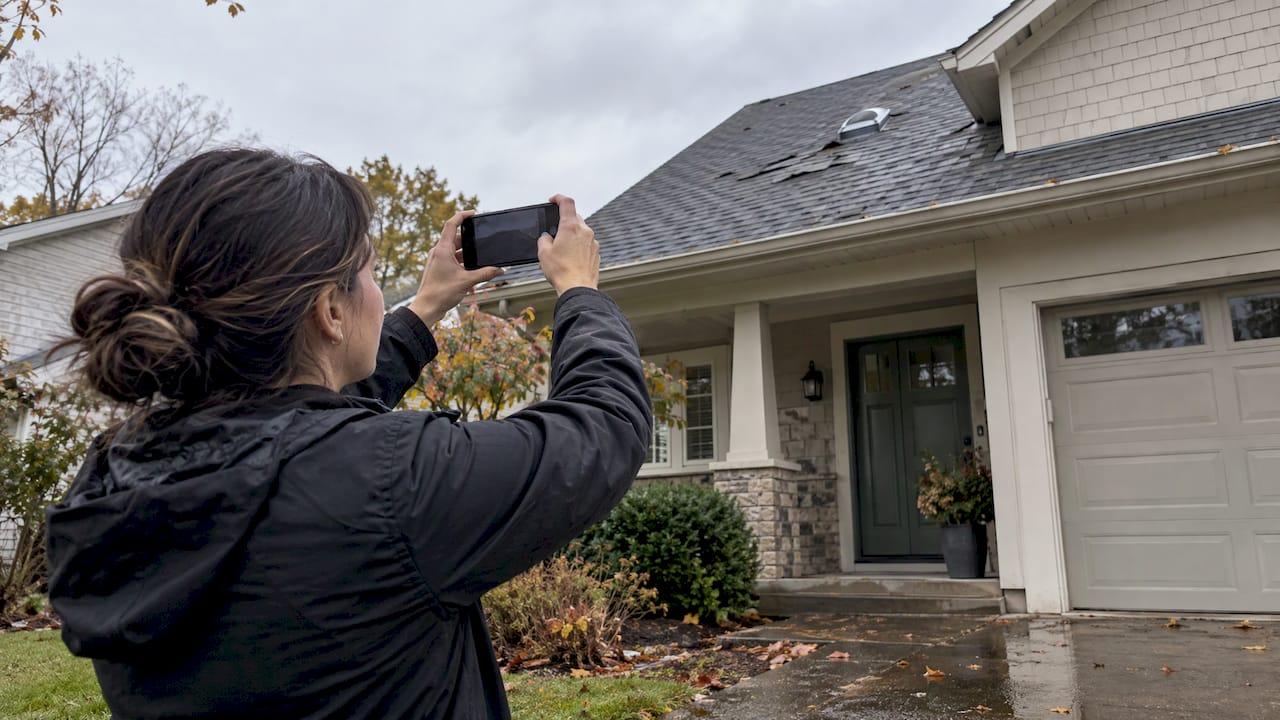
A roof claim runs in a fixed order: make things safe, document the damage, report it to your insurer, meet the adjuster, review the estimate, make repairs, and collect any held-back money. How well you handle the first three steps usually decides how smoothly the rest goes. Below is each step, what the paperwork means, and where homeowners most often lose money.
TL;DR
- Stay off the roof, photograph the damage from the ground, and stop further leaks with temporary measures. Save every receipt.
- Report the claim promptly. Some states set legal deadlines, and Florida's is one year from the date of loss for newer policies.
- Your payout depends on your deductible and on whether the roof is covered at actual cash value or replacement cost.
- Do not make permanent repairs until the insurer has had a chance to assess the damage.
- If part of the claim is denied, ask for the denial in writing and use your appeal options.
Table of Contents
- Step 1: Make everyone safe and look from the ground
- Step 2: Document everything before you touch anything
- Step 3: Stop further damage with temporary repairs
- Step 4: Decide whether the claim is worth filing
- Step 5: Report the claim and watch the deadline
- Step 6: Meet the adjuster
- Step 7: Review the estimate and understand your payout
- Step 8: Repair, supplement and close the claim
- If the insurer denies or underpays
- Perspective
- Check your roof coverage before the next storm
- FAQ
- Sources
Step 1: Make everyone safe and look from the ground
Before you think about paperwork, check that people and pets are safe and that no power lines, loose debris or ceiling water are putting anyone at risk. The BBB's storm guidance says to assess and document the damage before you contact your insurer, and to hold off on permanent repairs until the insurer approves them.
Stay off the roof. GAF, a shingle manufacturer, warns against climbing up, especially when the surface is wet or visibly damaged, and suggests recording what you can see from the ground with photos or video. Binoculars and a phone zoom do the job. Look for missing or lifted shingles, granules in the gutters, dented vents and flashing, and water stains on ceilings.
Step 2: Document everything before you touch anything
Good documentation is the single most useful thing you control. FEMA's guidance on what you need to file says to record the date, time, cause and damage, list damaged items, take photos or video inside and outside, and keep receipts for expenses, repairs and replacements.
A practical checklist:
- Wide and close photos. Take the whole elevation of the house, then each damaged area up close.
- Scale. Place a coin or ruler next to hail marks or lifted shingles so the size is clear. Roof Policy suggests this, along with checking the NOAA Storm Events Database for your county and date to tie the damage to a storm.
- Interior damage. Ceiling stains, wet insulation, damaged belongings. If you have a home inventory, pull it out now.
- Policy details. Your policy number and your insurer's claim phone number or app.
- A communication log. One law firm recommends recording dates, times and the names of every representative you speak with.
Contents damaged by a leak fall under personal property coverage, so it helps to know how Coverage C works.
Step 3: Stop further damage with temporary repairs
Most policies expect you to protect the home from more harm. Leaders Roof notes that most policies include a duty to mitigate and that rain after a storm often does more harm than the storm. A tarp over the opening, or a board-up, counts as temporary. A new set of shingles does not.

Keep the receipts for tarps, materials and any emergency crew. GAF's claim guide lists temporary repairs with saved receipts as a core step. Photograph the roof before and after the tarp goes on.
A roof's age also shapes how an insurer treats a loss. Regulators in Texas, for example, have addressed roof age and home insurance, and it is worth asking your own insurer how age affects your policy before a storm, not after.
Step 4: Decide whether the claim is worth filing
Not every dent justifies a claim. If the repair costs less than your deductible, you receive nothing, and the claim may still appear on your record. One law firm advises having a qualified roofer inspect first to see whether the damage exceeds the deductible and to avoid zero-payment claims.
Some rules of thumb:
- Get a written repair or replacement estimate.
- Find your deductible on the declarations page. Check for a separate wind or hail deductible.
- Compare. If the estimate is well above the deductible, file.
- If it is close, talk to your agent before you file. This is a conversation we have with clients regularly, and it costs nothing.
What's covered matters too. According to Liberty Mutual, a standard policy may cover roof damage from wind, hail, fire and certain water damage, while aging, poor maintenance, wear and tear, flooding and earthquakes usually are not covered.
Step 5: Report the claim and watch the deadline
Call your insurer or use its app, give your policy number, the date of loss and a short description, and ask for a claim number. Request the name and contact details of the adjuster. For a step-by-step view of this stage, see our guide on how to file an insurance claim.
Deadlines vary by state and policy. Many policies require prompt notice, and some homeowner guides cite windows of 30 to 60 days, but your policy wording governs. In Florida, Statute 627.70132, as described by a Florida roofer, requires that for policies issued or renewed on or after December 16, 2022, a new or reopened claim is reported within one year of the date of loss and a supplemental claim within 18 months. Read your policy or ask your agent to confirm the exact deadline for your state.
If your insurer sends a proof of loss form, return it on time. The Wisconsin Office of the Commissioner of Insurance explains that the process may begin with a proof of loss form or with an adjuster visit, and that permanent repairs must wait until the adjuster has assessed the damage.
Step 6: Meet the adjuster
An adjuster is a person trained to assess damage. Forbes Advisor describes the visit as a look for missing and damaged shingles, water damage beneath them and signs of wear and tear. LegalClarity adds that adjusters are trained to tell hail, wind and age damage apart: hail leaves scattered dents and granule loss, wind lifts shingles in a directional path, and age shows as uniform curling, cracking and moss across the whole surface. When a roof already had wear before the storm, the insurer may try to pay only for the storm's share.
How to prepare
- Have your photos, receipts and estimate ready.
- Consider having your roofer meet the adjuster. GAF's guide mentions possibly having a contractor present.
- Walk the adjuster through every area you documented, including interior damage.
What to say and what to avoid
Stick to facts: when the storm happened, what you saw, what you have done since. Avoid guessing about causes, avoid saying the roof was already in bad shape if you do not know, and avoid agreeing to a final number on the spot. Do not sign a release or accept a settlement until you have read the estimate. Keep notes after the visit and email a short summary of what was discussed, so there is a written record. Never make permanent repairs before the insurer has finished its assessment.
Step 7: Review the estimate and understand your payout
The estimate tells you what the insurer thinks the repair costs, minus what you pay. Three terms drive the result.
Deductible. You pay it first. The Maryland Insurance Administration explains that it may be a flat amount or a percentage, and some policies carry special wind, hail or hurricane deductibles. In its example, with $100,000 of coverage and $3,000 of damage, a 2% hurricane deductible is $2,000, while a 5% deductible is $5,000 and exceeds the loss. In Florida, our piece on the hurricane deductible shows how this plays out. For the basics, see our deductible glossary entry.
Actual cash value (ACV). This is replacement cost minus depreciation. The same Maryland advisory notes that under ACV a 20-year-old roof with a 25-year useful life may receive as little as 20% of replacement cost. Nebraska's insurance department gives a similar example: if the roof was worth 75% of a new one just before the hailstorm, you are entitled to 75% of the repair cost, minus the deductible.
Replacement cost value (RCV). Under RCV, depreciation is generally reimbursed after repairs are completed. Nebraska's advisory says the insurer may pay the difference once the repairs are made, usually within 180 days. Even with RCV, a policy may limit payment on roofs, paying ACV for the roof and RCV for the rest of the home. Check the declarations page and ask the adjuster which roof coverage applies.
A simple worked example
Suppose a roof costs $15,000 to replace and is half depreciated. ACV is $7,500. With a $2,000 deductible, an ACV payout is $5,500. With RCV coverage, you might first receive that $5,500, then the remaining depreciation after the work is finished, so the total reaches $13,000. The figures are illustrative, but the order of payments is how many claims unfold.

Partial damage
If only a portion of the roof is damaged, the Maryland advisory says the insurer may cover only the damaged portion. It also says that where a covered peril hits a roof already needing maintenance, the policy may not pay all or part of the claim. Some insurers also attach endorsements excluding cosmetic hail or wind damage. Know whether yours has one.
If you must leave the house, the Wisconsin guide notes that when a covered peril forces you out, the insurer pays reasonable and necessary additional living expenses.
Step 8: Repair, supplement and close the claim
Once the insurer approves the scope, choose your contractor and sign a contract that matches the approved scope and materials. Beware of anyone who knocks on your door after a storm promising to handle everything or to waive your deductible. Get written estimates, check licensing, and keep paying the deductible yourself.
If the roofer finds hidden damage after tear-off, ask for a supplement through your insurer, with photos. Keep the final invoice, because RCV holdback payments typically depend on proof of completed work. Our claims timeline guide explains how long each stage typically takes.
If the insurer denies or underpays
Ask for any denial in writing. The NAIC's post-disaster guide says that if the dispute is not resolved, you can sue or use arbitration, where a neutral third party hears both sides and the decision is usually binding. Forbes Advisor also notes you can negotiate, appeal, or consider hiring a public adjuster. We walk through the next moves in what to do when a claim is denied. Your state's department of insurance can also tell you what rights apply where you live.
Perspective
Most roof claim problems we see start long before the storm. The policy was bought on price alone, the deductible was a percentage nobody noticed, or the roof was covered at actual cash value without the owner knowing what that meant.
That is why we compare coverage across more than 25 A-rated carriers and explain the differences in plain language. Replacement cost versus actual cash value, a wind or hail deductible, a cosmetic damage exclusion: these are the lines that decide your payout, and they are easier to fix at renewal than after a loss.
When a claim does happen, we stay with you through it. Call your agent before you file, bring your photos, and ask what your roof coverage actually pays.
David
Check your roof coverage before the next storm
If you read your declarations page and still cannot say whether your roof is paid at replacement cost or depreciated value, we can tell you. Our free policy review looks at your current coverage, deductibles and gaps, with no fee and no obligation. If you want to compare options, homeowners insurance and insurance quotes are a click away. We are licensed in Illinois, Florida and Washington, among our 17 states.

Ask us to look at how your policy treats roof age, wind and hail deductibles and cosmetic damage, then see what other carriers offer for the same home.
FAQ
What should I do first after roof damage?
Make sure everyone is safe, then photograph the damage from the ground. Do not climb onto the roof. Cover openings with temporary measures to prevent leaks, save receipts, and avoid permanent repairs until your insurer has assessed the damage.
How long do I have to file a roof claim?
It depends on your policy and state. Many policies require prompt notice, and Florida sets a one-year limit from the date of loss for policies issued or renewed on or after December 16, 2022. Check your policy wording or ask your agent for the exact deadline.
Will insurance pay for a whole new roof?
Sometimes. It depends on the cause of damage, the roof's age, whether your policy pays actual cash value or replacement cost, and whether only part of the roof is damaged. Wear and tear is typically excluded, so older roofs often receive less.
Is it worth filing a hail damage claim?
It is when a roofer's estimate clearly exceeds your deductible. If the repair is near or under the deductible, you may receive nothing, so get an inspection and talk to your agent before filing.
Sources
- BBB: What to do after a damaging storm
- GAF: What to do if shingles blow off your roof
- FEMA: What information do I need to file a home insurance claim
- Roof Policy: Documenting roof damage
- Dick Law Firm: Steps after roof damage
- Leaders Roof: First 24 hours checklist
- GAF: Guide to roof damage insurance claims
- Texas roof age and home insurance
- United Law PA: Roof damage insurance claim
- Liberty Mutual: Roofs and home insurance
- TheHomeMag: Filing a roof damage claim
- Dalton Roofing: Florida roof insurance claims
- Wisconsin OCI: Settling property insurance claims
- Forbes Advisor: Roof damage claims
- LegalClarity: When insurance will replace an old roof
- Maryland Insurance Administration: Roof replacement advisory
- Nebraska Department of Insurance: Hail damage
- Maryland Insurance Administration: Post-disaster claims
- NAIC: Post-disaster claims guide