
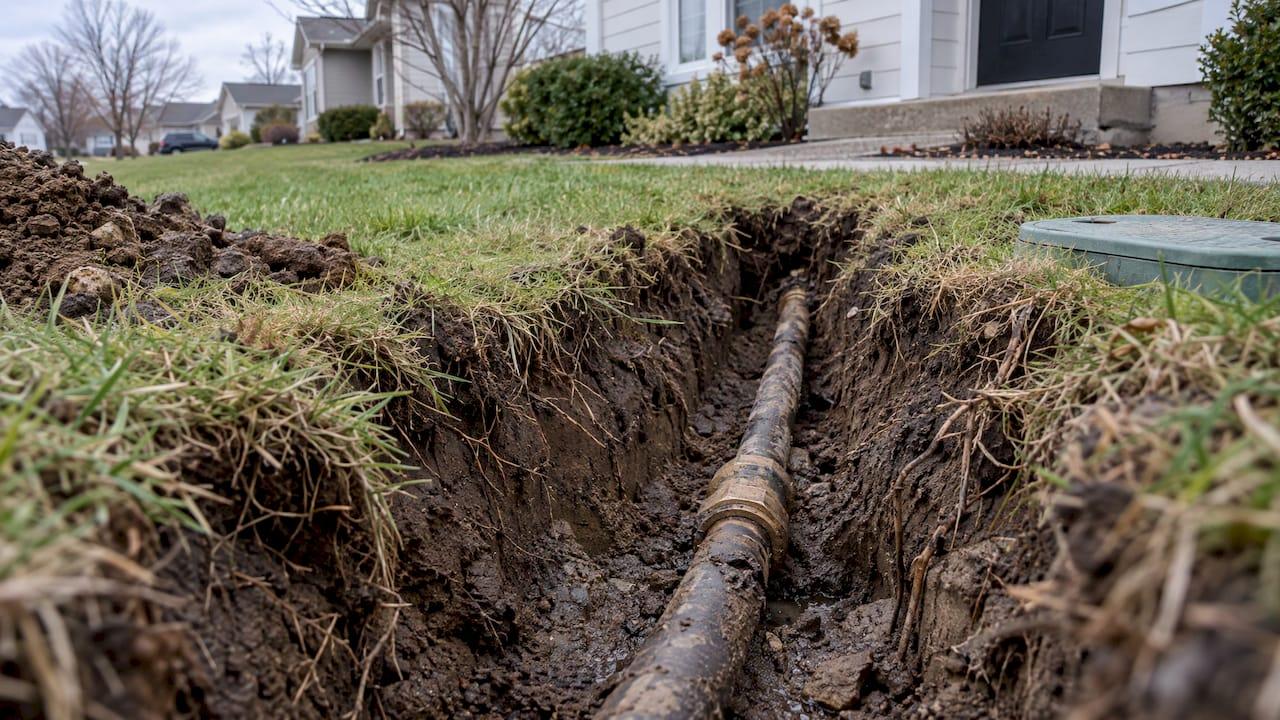
Service line coverage is an optional add-on to a homeowners policy. It pays to repair or replace the underground pipes and wires that carry water, sewage, gas, electricity and communications to your house, including the digging and the yard repair afterward. A standard policy usually leaves these lines out. The add-on typically costs a few dollars a month, which is small next to a dig-up repair bill. This guide explains what it covers, what it leaves out, what it costs and how to decide.
TL;DR
- Service line coverage (also called buried or underground utility line coverage) is an endorsement added to a homeowners policy. It is not built into most base policies.
- It can pay to repair or replace the line, excavation and some landscaping, and may help with living expenses if the home becomes unlivable.
- It generally excludes above-ground lines, wells, septic systems, fuel tanks and water damage inside the house from a sewer backup.
- NerdWallet reports a typical cost of $20 to $50 per year, a $500 deductible and a limit often around $10,000.
- You can ask us to check your current policy for this gap. The review is free and carries no obligation.
Table of Contents
- What a service line is and who owns the problem
- What service line coverage typically covers
- What service line coverage usually does not cover
- Service line coverage and sewer backup are different
- What service line coverage costs
- Homeowners endorsement or utility protection plan?
- Do you need it? A practical checklist
- Our perspective
- How to add service line coverage
- Check your own gap with a free review
- FAQ
- Sources
What a service line is and who owns the problem
A service line is the underground run of pipe or wire between the utility's main and your house. Think of the water line under your front lawn, the sewer lateral under the driveway, the gas line to the meter, or the buried electric and internet cable.
The dividing line is where the utility's responsibility ends and yours begins. The Office of the Ohio Consumers' Counsel explains that utilities are generally responsible for lines outside the home, while owners are typically responsible for lines from the meter leading inside. In practice the boundary differs by utility, city and sometimes by line, so a break in your yard can land on your bill even though you never saw the pipe.
That is the exposure this coverage addresses. When a buried line fails, you cannot see the damage, the repair needs an excavation, and the work is rarely cheap. The Hanover Insurance Group puts an average repair at roughly $3,000 to $4,000, with costs climbing well above that depending on the line and the extent of the repair. Those are the kinds of bills a modest endorsement is designed to absorb.
What service line coverage typically covers
Wording varies by carrier, so the policy form is what counts. The common pattern is consistent across regulators and consumer guides.
Which lines are included
The Maryland Insurance Administration describes underground pipes and wires, plus associated connections, valves or equipment, that provide water, sewage, drainage, electricity, gas, steam or communication services to or from the insured home. The Texas Office of Public Insurance Counsel lists water, steam, sewer, drain, power, fiber optic, cable, internet, natural gas and sprinkler lines as the underground lines typically covered.
If you searched for buried utility line coverage, this is the same product under a different name. Carriers use "service line," "buried utility line" and "underground utility" interchangeably.
What kinds of damage it pays for
Most forms respond to a physical failure of the line. Maryland's guidance says coverage generally applies to a leak, break, tear, rupture, collapse or electrical arcing. NerdWallet adds that it may pay for damage from wear and tear, root invasion, rust or corrosion, freezing, mechanical or electrical failure and animals. Wear and tear and tree roots matter most, because they are the usual reasons old lines fail, and a base policy typically excludes them.
What costs it pays
The same Maryland page says coverage may pay to repair or replace the line, including excavation. It may also pay additional living expenses if a covered loss makes the home uninhabitable, and for damage to outdoor property caused by the failure or the excavation. Texas OPIC describes excavation and landscape restoration as part of the benefit. That matters because a pipe fix is often the smaller part of the invoice. The trench, the broken driveway and the replanted lawn add up fast.
What service line coverage usually does not cover
Knowing the exclusions up front prevents a surprise at claim time. Across the sources, the same items keep appearing.
- Above-ground lines. NerdWallet notes the endorsement generally won't repair above-ground utility lines and may not cover water wells, septic systems or liquid fuel tanks.
- Lines inside or under the house. The Maryland Insurance Administration says coverage usually does not include pipes or wires within or under the insured house.
- Equipment and outdoor systems. Texas OPIC lists water wells, heating and cooling systems, sprinkler systems, fuel tanks, septic systems, lines under a swimming pool and lines that are not connected and ready for use as typical exclusions.
- Water damage in the home from a sewer backup. This one trips up many homeowners, so it gets its own section below.
One more point: your own policy, not a general guide, decides each of these. If you have a well, a septic tank, a pool or an irrigation system, tell your agent so you know exactly what the endorsement does and does not reach.
Service line coverage and sewer backup are different
A clogged sewer lateral is a common reason people look into this coverage, and it is where the two products get confused. NerdWallet explains that if a home fills with wastewater from a clogged sewer line, service line coverage could help pay to repair the piping, but won't pay for the water damage inside the home. That takes water backup coverage.
In short:
| Situation | Service line coverage | Water backup coverage |
|---|---|---|
| Cracked sewer pipe under the yard needs replacing | Designed for this | Not the right fit |
| Root-damaged water line under the lawn | Designed for this | Not the right fit |
| Sewage comes up through a basement drain and ruins flooring | Does not pay for the interior damage | Designed for this |
| Landscaping destroyed by the excavation | Often included | Not the right fit |
The two work as a pair. One protects the line outside, the other protects the house inside. Our page on water backup insurance coverage explains the second half in plain language, which is worth reading if your home has a basement or a finished lower level.
What service line coverage costs
The price is the main reason this add-on gets recommended so often. NerdWallet reports a typical cost of $20 to $50 per year, a typical $500 deductible and a limit often around $10,000. Texas OPIC notes companies often offer $10,000 or $25,000 of coverage with a $500 deductible.
Limits can also depend on the age of the line. Maryland's regulator notes insurers may cap payment at $10,000 for a covered line under 50 years old and $2,500 for a line 50 years or older, with the policy deductible applying on top. That is one state's description of how some insurers structure limits, not a universal rule, but it shows why asking about line age is worthwhile.
A quick worked example. Say a root-damaged water line needs a $9,000 repair, including digging and restoring the lawn. With a $10,000 limit and a $500 deductible, the policy would be designed to pay up to $8,500 of that. Without the endorsement, the whole $9,000 is yours. Your actual result depends on the policy wording and the cause of loss.

Homeowners endorsement or utility protection plan?
Many cities and utility partners sell their own line-protection plans, so you may have two options. They are not the same product.
The Maryland Insurance Administration states that service line coverage on a homeowners policy differs from warranty coverage offered by companies other than insurers and may provide different protections. Points worth comparing:
- Breadth. A utility plan generally covers the one line you pay that provider for. An endorsement can cover several buried lines in one place.
- Price. NerdWallet cites New York City's program at nearly $85 per year for water line coverage and $143 for sewer, or $228 for both, and notes a home insurer might cover other lines such as electric and cable at a lower price.
- Who controls the repair. Investopedia notes that with an insurer's rider you have the backing of your insurer and more control over the repair work and which contractors you use.
- Check first. The Ohio Consumers' Counsel advises checking with your homeowners insurer before buying a utility line warranty, because the coverage may be available as a rider for less than the warranty cost.
The same consumer-advocate coverage reports typical warranty-plan costs of $4 to $13 per month. That is why comparing before you sign a mailer offer makes sense.
Do you need it? A practical checklist
The Ohio Consumers' Counsel says homeowners in neighborhoods more than 40 years old, with older lines or trees near underground pipes and wires may want to consider protection. The same fact sheet gives typical lifespans: water lines 40 to 80 years, gas lines 30 to 75 years. Ask yourself:
- How old is the home, and have the lines ever been replaced? Original lines under a decades-old house are the likeliest to fail.
- Are there mature trees near the lines? Root invasion is a leading cause of sewer and water line failure.
- Do you know where your responsibility starts? Call your utility, or ask us to help read your policy.
- Could you pay a five-figure repair from savings tomorrow? If the answer is no, a small annual premium is one way to protect that budget.
- Do you rent the property out? Landlords face the same surprise-repair math, and so do planners comparing after-hours maintenance costs for small rental portfolios.
Pick limits with the same logic as the rest of your policy. Our guide on choosing coverage limits walks through that thinking.
Our perspective
Most people find out about service line coverage the day a line fails. By then it is too late to add it, and the bill is already in the thousands. That is the gap we look for first when we review a homeowners policy.
Because we are an independent agency comparing options across more than 25 A-rated carriers, we are not tied to one company's endorsement list. We look at your home's age, your lot, your trees and your existing limits, then explain in plain language what a service line endorsement would and would not do. No jargon, and no pressure to buy.
If you have an endorsement now, we check the limit, the deductible and whether sewer backup is covered alongside it. If you do not, we tell you what the gap looks like in dollars. And if you ever file a claim, we advocate for you through it.
David
How to add service line coverage
The steps are simple, and timing matters.
- Read your declarations page. Look for words like "service line," "underground utility" or "buried utility." If they are missing, you likely do not have it.
- Ask about timing. Nationwide's survey reported that many homeowners wrongly believe the endorsement can be added at any time, when it can only be added at renewal in its case. Ask your agent about your own carrier's rules.
- Compare limit and deductible. A $10,000 limit with a $500 deductible is common, as the figures above show. Higher limits may suit older homes with long lines.
- Pair it with water backup coverage. That protects the inside of the house from a sewer backup.
- Confirm what is excluded. Wells, septic systems, pools and fuel tanks are common exclusions.
If you own a condo, a renter's policy or a higher-value home, the right setup differs. Our homeowners insurance page covers homes and condos, and our high-value and specialty page covers homes with unusual or costly features.
Check your own gap with a free review
We are an independent agency licensed in 17 states, including Illinois, Florida and Washington. We compare coverage across more than 25 A-rated carriers and explain every option in plain language. Our policy review is free and carries no obligation: we read your current policy and point out gaps, including missing buried line protection and water backup.

If you want pricing for a new or updated homeowners policy, you can request insurance quotes in a few minutes. Or start with the free policy review and see where you stand first.
FAQ
What is included in service line coverage?
It typically covers underground water, sewer, drain, gas, electric, cable and internet lines serving your home. It may pay for the repair, the excavation and some landscape restoration. Some forms also pay living expenses if the home becomes unlivable. Your policy wording sets the details.
What is not covered by service line coverage?
Common exclusions are above-ground lines, wells, septic systems, fuel tanks, pool and sprinkler systems, and lines under or inside the house. It also does not pay for water damage inside the home from a sewer backup. That is a separate water backup coverage.
Is sewer backup insurance worth it?
It answers a different risk than service line coverage. Service line coverage can help with the pipe outside, while water backup coverage can help with the interior damage that backed-up wastewater causes. Homes with basements or finished lower levels are the ones that usually weigh it most carefully. We can price both together.
Can I buy it from my utility instead?
Yes, many utilities and cities offer plans, and Nationwide's survey found 36% of owners with coverage bought it from a utility provider. Those plans generally cover only the line you pay that provider for. Compare that with a homeowners endorsement before you buy.
Sources
- Buried Utility Lines Coverage, Maryland Insurance Administration
- Know Your Coverage: Service Line Coverage, Texas Office of Public Insurance Counsel
- What to Know About Utility Line Warranties, Office of the Ohio Consumers' Counsel
- What Is Service Line Coverage, and Do You Need It? NerdWallet
- Consumer Groups Criticize Water-Sewer Lines Plans, Investopedia
- A broken pipe can break the bank, Nationwide
- After Hours Maintenance With SLA Intake, RentrIQ Blog