
Telematics car insurance prices your policy partly on how you actually drive, measured by a phone app or a small plug-in device, instead of only on your age, ZIP code and vehicle. Safe drivers can earn a discount, and low-mileage drivers may find pay-per-mile pricing cheaper. The trade-off is data: you share your driving habits, and in some programs a poor score can cost you. Here is how to decide if it fits you.
TL;DR
- Telematics, also called usage-based insurance (UBI), uses an app or an OBD device to record mileage and driving behavior, then adjusts your rate or discount.
- In a 2024 Consumer Reports survey, the median annual saving was $120. Some programs advertise up to 25%, but typical discounts may be nearer 10%.
- Pay-per-mile is a variation: a base rate plus a charge for the miles you drive each month. It suits people who drive less than average.
- The main costs are privacy and uncertainty. Some programs can raise your premium, and others only shrink your discount.
- Before enrolling, get a quote with and without the program, read the data policy, and ask how you can leave.
Table of Contents
- What telematics car insurance is
- What the program actually tracks
- App or plug-in device
- How pay-per-mile insurance works
- How much you can really save
- Privacy and fairness questions to settle first
- Can you turn it off or leave?
- A checklist before you enroll
- Our perspective
- Get a telematics quote next to a standard one
- FAQ
- Sources
What telematics car insurance is
Telematics car insurance is a policy, or a discount attached to a policy, that uses technology such as mobile apps or on-board diagnostic (OBD) devices to monitor driving behavior and mileage. The National Association of Insurance Commissioners (NAIC) describes it as a way for insurers to move beyond traditional, grouped pricing and set premiums that reflect an individual driver's behavior and risk.
You will see several names for the same idea: telematics, usage-based insurance, pay-as-you-drive, pay-per-mile, and sometimes "black box" insurance. The differences matter less than the mechanics. Some product is watching how, when and how far you drive, and the insurer turns that into a price.
Washington's Office of the Insurance Commissioner explains the tradeoff plainly: your premium may go up or down depending on your driving, and not every driver will meet an insurer's standard for a discount.
Regulators have seen the logic for a long time. New York's Department of Financial Services wrote in 2014 that these programs align price with risk and encourage safer driving through timely feedback. That feedback loop is the best argument for telematics: you can see what you do and change it.
What the program actually tracks
The NAIC lists what telematics programs can collect: mileage, time of day, GPS location, rapid acceleration, hard braking, hard cornering and air-bag deployment. Not every program uses every item, and what is collected is not always what is scored.
Here is how the common signals tend to work:
| Signal | What it suggests to an insurer | What you can do |
|---|---|---|
| Hard braking | Consumer Reports notes many programs treat it as a primary indicator of crash risk, since it can reflect tailgating or inattention | Leave more following distance, look further ahead |
| Rapid acceleration and hard cornering | Aggressive driving | Ease into the throttle and slow before turns |
| Time of day | Late-night driving is often treated as riskier | Shift trips when you can |
| Mileage | Less time on the road means less exposure | Combine errands, work from home when possible |
| Speeding and phone use | Distraction and speed | Mount the phone, silence notifications |
One insurer's published program FAQ shows how this looks in practice. It collects data such as phone distraction, speeding and hard braking to set a discount, and says the driving data does not raise rates. Early enrollees there get a flat enrollment discount, and an overall 91-day score decides the discount adjusted at renewal. Other insurers do it differently, which is why the fine print matters.
If you want to see for yourself what this kind of data looks like, a standalone device shows similar trip and mileage detail. GPS trackers without a SIM card report trips and mileage to an app you control, which helps you understand how your own driving reads on a map before any insurer sees it. For families with a new driver at home, a teen driver tracker gives trip, arrival and speed information, which is the same set of behaviors a telematics score tends to reward.
App or plug-in device
There are two main ways data reaches the insurer.
Smartphone app. Easy to start, nothing to install. The catch, according to Consumer Reports, is that smartphone programs often need constant access to location data to capture movement and driving events. A phone can also confuse you being a passenger with you driving, which is worth asking about.
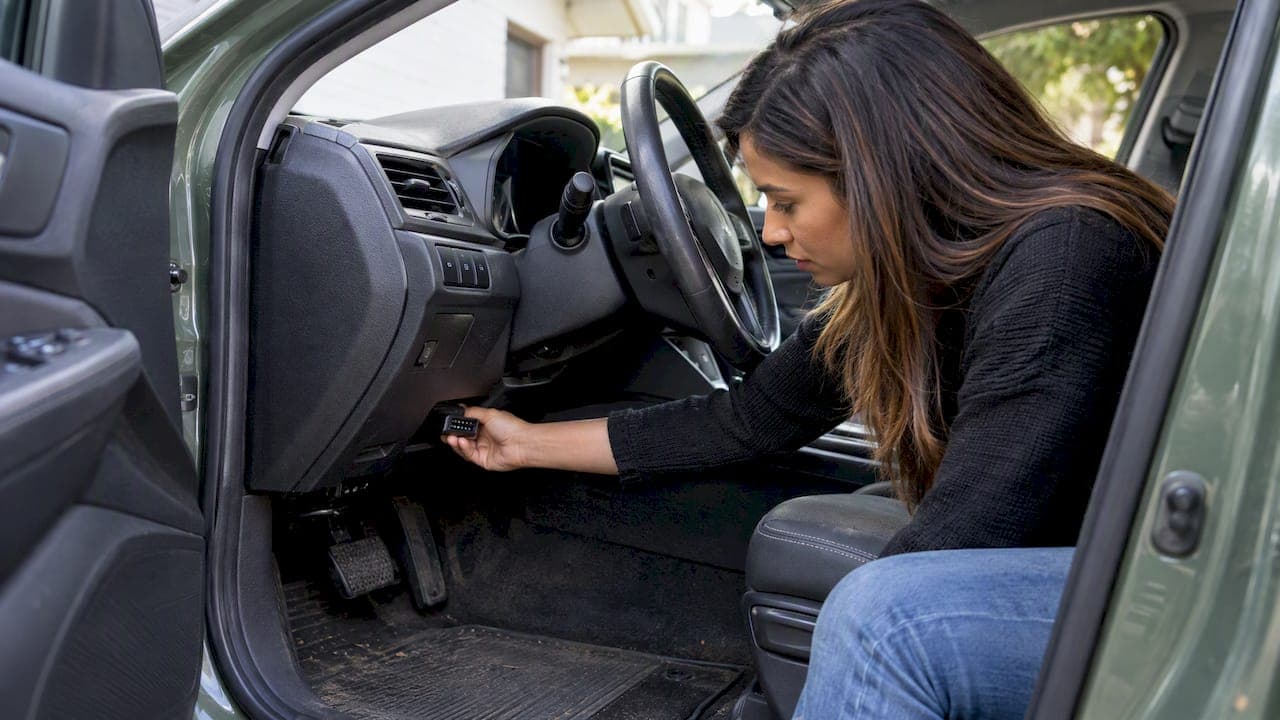
Plug-in OBD device. A small dongle goes into the diagnostic port under the dashboard. It tracks the vehicle rather than you, so it does not care which phone is in the car. It is also one more thing to plug in, and you need to know what the insurer does with it once your enrollment ends.
Neither is better in every case. If you share a car with a spouse or teen, the device follows the car and the app follows the person. Pick the one that matches who actually drives.

How pay-per-mile insurance works
Pay-per-mile is the version most people mean when they search for usage-based insurance with a lower-driving angle. The Texas Department of Insurance describes it as a base amount plus a fee for the miles you drive each month. Many such policies also use a device or app to track where and when you drive, along with speed, braking and acceleration.
The same page cites the Federal Highway Administration figure that the average car is driven 13,476 miles a year, about 1,123 a month, and says people who drive less may find pay-by-mile a good choice. That gives you a quick test: pull your last two oil-change or inspection records, work out your annual miles, and compare to that average.
Pay-per-mile tends to fit:
- Remote and hybrid workers
- Retirees who drive mainly for errands
- A second household car that mostly sits in the driveway
- City dwellers who take transit most days
It fits poorly if you commute long distances, because every mile adds to the bill. Run the numbers on your own annual mileage before you assume it is the cheaper route.
How much you can really save

Expect modest, not dramatic. In Consumer Reports' 2024 survey, median annual savings were $120. The same survey found higher medians for drivers under 45 ($145) and for Black ($186) and Latino ($174) policyholders. Some programs promise up to 25%, though typical discounts may be closer to 10%, and some insurers add a sign-up discount just for enrolling.
Here is a quick way to judge whether the effort is worth it:
- Get a quote for the same coverage with the program and without it.
- Subtract. If the guaranteed sign-up discount alone is meaningful, the program may be worth it even if you never improve your score.
- Check how long the monitoring lasts. A short trial period is a different commitment from tracking that continues for the life of the policy.
- Check what a bad score does. Consumer Reports noted that some insurers limit the penalty to a smaller or no discount, while others may raise premiums.
That last point is the one to settle before you start. A program that can only reward you is a very different bet from one that can also charge you.
Privacy and fairness questions to settle first
Tracking location and driving behavior can raise real privacy concerns, as Washington's insurance commissioner notes. The NAIC adds that those concerns have led some states to pass laws requiring disclosure and limiting what insurers can collect.
Three practical points:
- Collection can exceed scoring. Consumer Reports found insurers may collect more than they need for discounts, including phone type or fuel consumption, even when it does not feed into your price.
- De-identified is not always anonymous. The Electronic Privacy Information Center advised drivers to read insurer data policies, noting that de-identified data can be sold and later re-identified.
- Schedules can count against you. Consumer Reports raised the concern that night-shift workers with inflexible hours may be penalized by programs that treat time of day as a risk factor. If your job sets when you drive, ask whether time of day is scored.
The Texas Department of Insurance suggests asking what each device tracks, how much you could save, and whether the information could be used after an accident. Add the claims question to your list. It is the one most people forget until they need it.
Can you turn it off or leave?
It depends on the program, so ask before you sign, not after. New York regulators have said they approve usage-based filings only when the program is offered to consumers on a strictly voluntary basis. That principle, that you opt in, is a good standard to hold any insurer to wherever you live.
Questions to put in writing:
- Can I stop participating mid-term, and does my rate change if I do?
- Does the discount apply for the first term only or for every renewal?
- What happens to the data once I leave?
- Is there a trial period that does not affect my price?
Turning off location permission on your phone is not the same as leaving the program. It may simply produce an incomplete score. Get the exit terms first.
A checklist before you enroll
- Estimate your own mileage. Under the 13,476-mile national average, pay-per-mile deserves a quote.
- Audit your habits honestly. Frequent hard stops in stop-and-go traffic, late shifts or a long highway commute change the math.
- Compare identical coverage. A cheaper telematics price with weaker limits is not a saving. Our guide on how to normalize coverage first when comparing quotes walks through it.
- Read the data policy. Look for who gets the data and for how long.
- Check the downside. Does a bad score reduce a discount or raise the premium?
- Decide who drives. If a teen or a second driver shares the policy, one person's habits may set the score for the household.
If you are also weighing how much coverage to carry, our 10% rule for full coverage car insurance helps you decide what to keep on an older vehicle. And if you are financing or leasing a newer car, see how gap insurance fits alongside it.
Our perspective
Telematics is a good idea for a specific kind of driver: someone who already drives calmly, does not log many miles, and is comfortable sharing data. For that person, the savings can be real. For everyone else, the right first step is not enrolling anywhere. It is seeing what the whole market offers.
That is the part we care about. We are an independent agency, and we compare auto coverage across more than 25 A-rated carriers. We can show you a telematics price next to a standard price, in plain language, so you see the actual difference rather than a headline discount.
We also read the terms most people skip: how long the monitoring lasts, what a bad score does, and how you leave. And if you ever file a claim, we stay on your side of it.
If your current policy already has a program attached, our free policy review checks whether it is helping you or just collecting data.
David
Get a telematics quote next to a standard one
We will review your current auto policy at no cost, check whether a usage-based program makes sense for your mileage and habits, and point out coverage gaps along the way. Our service is fee-free for you, and there is no obligation.
Start with a free policy review, or go straight to insurance quotes. You can also see how we compare auto insurance options in Illinois, Florida and Washington, among the states where we operate.
FAQ
What is telematics for car insurance?
It is technology, usually a phone app or a plug-in OBD device, that records how you drive and how far. Insurers use the data to set a discount or a rate. Programs vary by insurer and state, so read the terms for yours.
What are the disadvantages of telematics?
The main ones are privacy and uncertainty. Your location and driving behavior are tracked, and depending on the insurer, a poor score can reduce your discount or raise your premium. Drivers with fixed night schedules may also score worse because of when they drive.
Can telematics be turned off?
Usually you can opt out of a program, but what happens to your rate afterward depends on the insurer. Simply disabling location sharing on your phone may not count as leaving and can produce an incomplete score. Ask for the exit terms in writing before enrolling.
Is usage-based insurance worth it?
It can be, if you drive carefully or do not drive much. Consumer Reports' 2024 survey found a median saving of $120 a year, so the gain is modest. Compare a quote with and without the program for identical coverage before deciding.
Sources
- NAIC: Telematics
- Washington Office of the Insurance Commissioner: Usage-based insurance
- New York DFS: Insurance Circular Letter No. 4 (2014)
- Consumer Reports: Car Insurance Telematics Discounts
- Consumer Reports: Car Insurance Telematics Pros and Cons
- Texas Department of Insurance: How you drive could save you money on car insurance
- Insurer program FAQ on driving data and discounts