
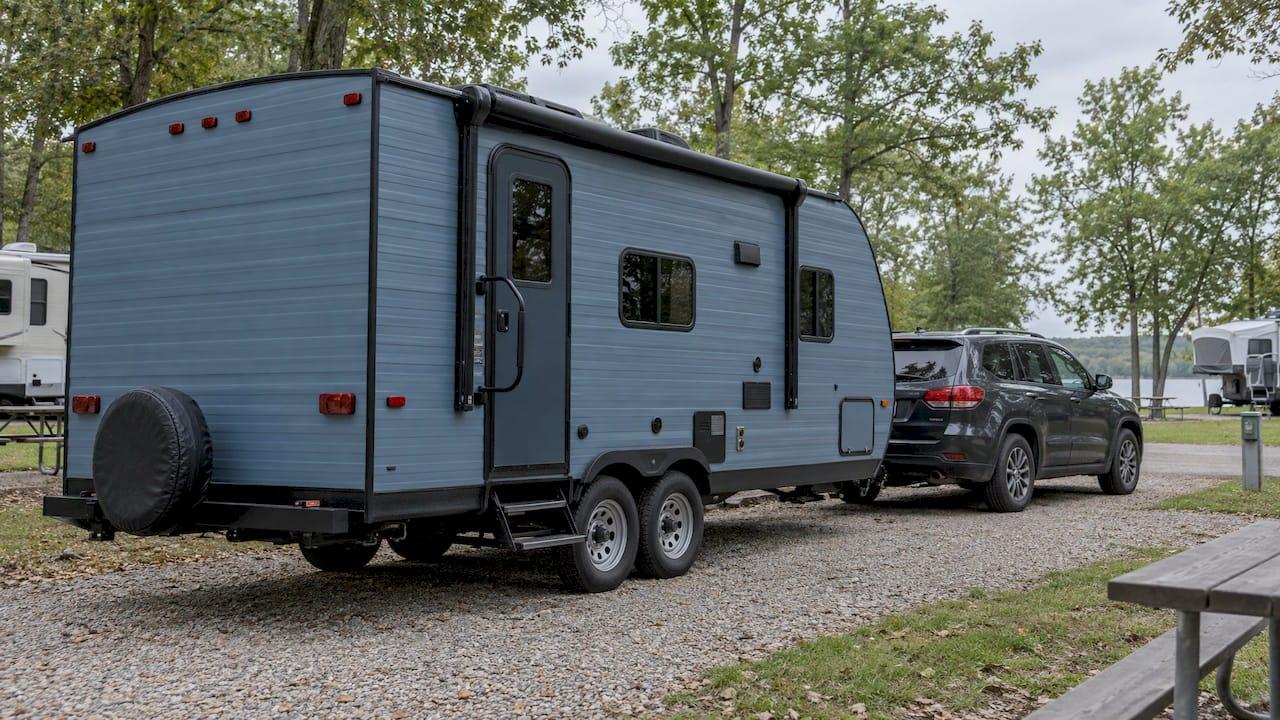
Your auto policy and an RV policy overlap on one thing: liability when you cause an accident. After that they split. A car policy is built for a vehicle you drive to work. An RV policy is built for a vehicle that is also a place where you sleep, cook and keep your belongings. Whether you need separate RV coverage depends on what you own (a motorhome or a towable trailer), how often you use it and whether you live in it. At Geneva Insurance Group we compare RV-related coverage across more than 25 A-rated carriers and explain every option in plain language, so you see where your current policies stop before a claim shows you.
TL;DR
- A motorhome needs its own auto-style policy with liability coverage. A towable trailer may get liability from your truck's auto policy, but damage to the trailer itself usually needs a separate RV policy or endorsement.
- Belongings inside the RV, attached accessories like awnings and satellite dishes, and living in the RV for stretches of time are the most common gaps in an auto policy.
- State law sets minimum liability limits for motorized RVs. Lenders can require more, even where the state does not.
- Full-timers can add coverage that works like a homeowners policy, including personal liability and loss assessment.
- A free policy review lays your auto, home and RV coverage side by side so you can see the gaps.
Table of Contents
- The short answer: where auto insurance ends and RV insurance begins
- What an RV policy adds that a car policy doesn't
- Do you need RV insurance? It depends on three things
- What states require for liability
- Living in your RV full time
- The gap people miss: what's inside
- What drives the price
- Step by step: how to check whether you're covered
- Perspective
- Get your RV and auto coverage compared
- FAQ
- Sources
The short answer: where auto insurance ends and RV insurance begins
The cleanest way to think about it is by vehicle type.
Motorhomes (Class A, B and C: drivable, with the engine and living space in one unit) are treated like vehicles on the road. The Texas Department of Insurance says Texas law requires an auto policy with liability coverage for a motorhome, and that collision and comprehensive coverage pay for damage to the motorhome itself, including fire, flood and theft. Maryland takes the same approach: its Insurance Administration says a self-propelled RV must be insured, while the state does not require insurance for non-self-propelled RVs such as some trailers.
Towables (travel trailers and fifth wheels, pulled by a truck or SUV) are different. The same Texas guidance says your auto insurance might pay for accidents you cause while towing, but you probably need a separate RV policy or endorsement to cover damage to the trailer itself. Your auto policy was priced for your truck, not for a 30-foot living space behind it.
Contents are the third piece. Texas regulators note that a separate RV policy is needed to cover personal property inside a trailer or motorhome. Your car policy is not designed to cover the grill, the bedding, the electronics or the kitchen gear you carry.

What an RV policy adds that a car policy doesn't
According to the Maryland Insurance Administration, RV policies often offer broader protection than a typical auto or homeowners policy, because auto policies generally don't account for living in the RV for a period of time, and homeowners policies don't cover loss to the RV, collision or travel-related incidents. An RV policy can include:
- Liability, comprehensive and collision
- Uninsured and underinsured motorist coverage
- Contents and personal effects
- Towing and roadside assistance
- Emergency expenses
- Campsite liability
The Virginia State Corporation Commission puts the idea in one line: RV risks mirror auto risks, plus the belongings and accessories on board. In a 2024 release, it notes that personal belongings, equipment and attached accessories such as awnings and satellite dishes may require additional coverage.
Side-by-side comparison
| What you're protecting | Standard auto policy | Homeowners policy | RV policy |
|---|---|---|---|
| Liability when you cause a crash | Yes, for your car; may extend to a trailer you tow | No | Yes |
| Damage to a motorhome | Generally not designed for it | No | Yes (collision, comprehensive) |
| Damage to a towable trailer | Probably not | No | Yes, or by endorsement |
| Belongings inside the RV | No | Not for loss tied to the RV | Yes, contents and personal effects |
| Living in the RV for a period | Generally not accounted for | No | Available |
| Campsite liability, roadside, emergency expenses | No | No | Can be included |
Treat the table as the general pattern drawn from the state guidance above. Your own policy wording decides, and that is exactly what a policy review checks.
Do you need RV insurance? It depends on three things
1. Is it a motorhome or a trailer?
If it has its own engine, assume the law requires insurance. If you tow it, the law may not require anything for the trailer itself, but the money at risk is the same. Maryland's insurance regulator points out that even where insurance isn't required for a trailer, it is advisable to protect against loss of or damage to the RV or its contents.
2. Is there a lender?
The Virginia SCC states that Virginia does not require individuals to buy RV insurance, but lenders may require it. If you financed the RV, your loan agreement is probably the real requirement, regardless of what your state says. Lenders typically want collision and comprehensive on the vehicle, so confirm the exact terms in your loan documents.
3. What would a total loss cost you?
A motorhome or a well-equipped trailer is often one of the larger assets a family owns outside the house. If a fire, flood or theft would hurt your finances, the question stops being whether the law requires coverage and becomes whether your current policy pays for the loss. Our guide to choosing coverage limits walks through how to decide how much protection you need.
What states require for liability
Liability minimums are set state by state, and they apply to motorized RVs the way they apply to cars. J.D. Power's March 2026 summary of state rules reports that the most common bodily injury requirement is $25,000 per person and $50,000 per accident, enforced by more than 30 states, including Illinois and Washington.
Property damage minimums vary more. The same J.D. Power page lists:
- $5,000 per accident in Massachusetts and Pennsylvania
- $10,000 in states including California, Florida and Washington
- $15,000 in states including Arizona, Colorado and Maryland
- $20,000 in Illinois, Missouri and Montana
Two cautions on reading those numbers. First, they are minimums, the floor that keeps you legal, not the amount that protects your savings. A serious crash with a 30-foot, multi-ton vehicle can exceed a $10,000 or $20,000 property damage limit quickly. Second, state rules change, so confirm your state's current minimums with your state's department of insurance before you buy.
If you want liability above those floors without raising every limit on every policy, an umbrella policy can sit on top. Ask in your review how it would apply to your RV.

Living in your RV full time
Full-timers sit in a different category. Your RV is your home, and neither a standard auto policy nor a homeowners policy fits it. J.D. Power explains that although it isn't required by law, a full-time RV plan offers optional coverages, including loss assessment and personal liability. Loss assessment covers shared repair costs billed by an RV association, much like a condo association assessment. Personal liability works like the liability in a homeowners policy: it covers expenses if a visitor is injured in your RV and you are held responsible.
If you are the person who keeps a house and an RV, the interplay matters too. Homeowners policies generally exclude the RV itself, as the Maryland guidance notes, so the home policy won't pick up the slack. If you own a home or condo as well, see how HO-3 and HO-5 homeowners policies differ so you know what each part of your coverage is meant to do.
The gap people miss: what's inside
Most RV owners think about the vehicle. The bigger surprise at claim time is often the contents. Bikes, kayaks, generators, outdoor furniture, camera gear and electronics add up. Because a separate RV policy is what covers personal property in the RV, per Texas regulators, an owner relying on an auto policy has nothing for those items.
Two practical steps help:
- Walk through the RV with your phone and film every cabinet, compartment and storage bay. Add serial numbers for the expensive items.
- Separate what is built in (awnings, satellite dishes, solar panels, upgraded appliances) from what you carry in. They can be treated differently on a policy.
For high-value items that you want named individually, our overview of scheduled personal property explains how scheduling works. Gear that moves between locations is also the subject of our guide to inland marine insurance.
What drives the price
Premiums differ widely, and no single number fits every RV. The factors that typically carry weight are the type and value of the RV (a Class A costs more to insure than a pop-up), how often you use it, whether it is a full-time home, where it is stored and where you drive, your driving record, the deductibles you pick and the coverage limits you choose. Because each carrier weighs these differently, the same RV can be priced very differently by two carriers. That is the case for comparing instead of taking the first quote.
Step by step: how to check whether you're covered
- Write down what you own. Motorhome or towable, year, value, how it is financed and how much of the year you use it.
- Pull your current auto declarations page. It lists liability limits, collision and comprehensive, and any endorsements. Look for any mention of a trailer.
- Check your lender's requirements. Loan paperwork often spells out the coverage and deductible limits.
- List your contents. Estimate their total replacement cost.
- Decide how you use it. Weekend trips, long seasonal stays and full-time living call for different coverage.
- Compare the same limits across carriers. Price is only comparable when coverage is identical, which is the hard part to do alone.
The Virginia SCC also advises reviewing liability limits before summer trips and carrying a copy of your insurance card. Both are simple habits that pay off at a roadside stop or a campground check-in.
Perspective
Most RV owners we talk to arrive with the same assumption: the truck is insured, so the trailer must be too. Sometimes the liability does carry over. The trailer itself, the contents and the weeks you spend living in it often don't.
That's why we start with your existing policies rather than a quote. Our free policy review lines up your auto, home and any RV coverage in plain language and points out where one ends and the next begins. Because we are an independent agency working with more than 25 A-rated carriers, the comparison isn't tied to one company's product.
And when a claim happens, we advocate for you. A policy is only as good as the day you need it.
David
Get your RV and auto coverage compared
If you want to see where your current policies fall short, start with our free policy review. We analyze your existing coverage, identify gaps and explain the findings without insurance jargon, with no fee and no obligation. If you then choose to move forward, we compare options across our carriers and stay with you through claims. We are licensed in 17 states, including Illinois, Florida and Washington.
Ready to compare? Request a free policy review or quote from Geneva Insurance Group. You can also see where we're licensed.
FAQ
Is RV insurance the same as car insurance?
No. They share liability, collision and comprehensive, but an RV policy can add contents, emergency expenses, campsite liability and roadside assistance, according to the Maryland Insurance Administration. It is built for a vehicle that doubles as living space.
Does my auto policy cover a travel trailer I tow?
Possibly for accidents you cause while towing, but not for damage to the trailer. Texas regulators say a separate RV policy or endorsement is probably needed for trailer damage and for anything inside it. Check your declarations page and ask your agent how towables are handled.
Is RV insurance more expensive if you live in it full time?
Full-time coverage adds protections such as personal liability and loss assessment, so the policy is built differently from a weekend-use policy. Price depends on the RV, your limits and the carrier, so the way to learn the real number is to compare quotes for your situation.
Is RV insurance required by law?
For motorized RVs, yes: states set minimum liability limits, and J.D. Power reports that more than 30 states use the $25,000 per person and $50,000 per accident bodily injury minimum. For trailers, some states, such as Virginia, don't require individuals to carry RV insurance, but lenders may.
Sources
- Insuring your Recreational Vehicle, Maryland Insurance Administration
- Insurance for RVs: Know your coverages, Texas Department of Insurance
- SCC Encourages Insurance Review Before Summer Excursions, Virginia State Corporation Commission
- How Do States Vary in Coverage Requirements for RV Insurance, J.D. Power